
What is the Simplify Radical Expressions Calculator?
This tool rewrites a square root \(\sqrt{n}\) in its simplest radical form \(a\sqrt{b}\). A radical is in simplest form when the number left under the root sign has no perfect-square factors other than 1. For example, \(\sqrt{72}\) simplifies to \(6\sqrt{2}\) because \(72 = 36 \times 2\) and \(36 = 6^2\). The calculator does the factoring for you and also returns the decimal approximation.
How to use it
Enter a positive whole number under the radical and press calculate. The result shows the coefficient (the number that comes out of the root), the radicand (the number that stays inside), and the decimal value. If the number is already a perfect square, the radicand will be 1 and you get a whole number.
The formula explained
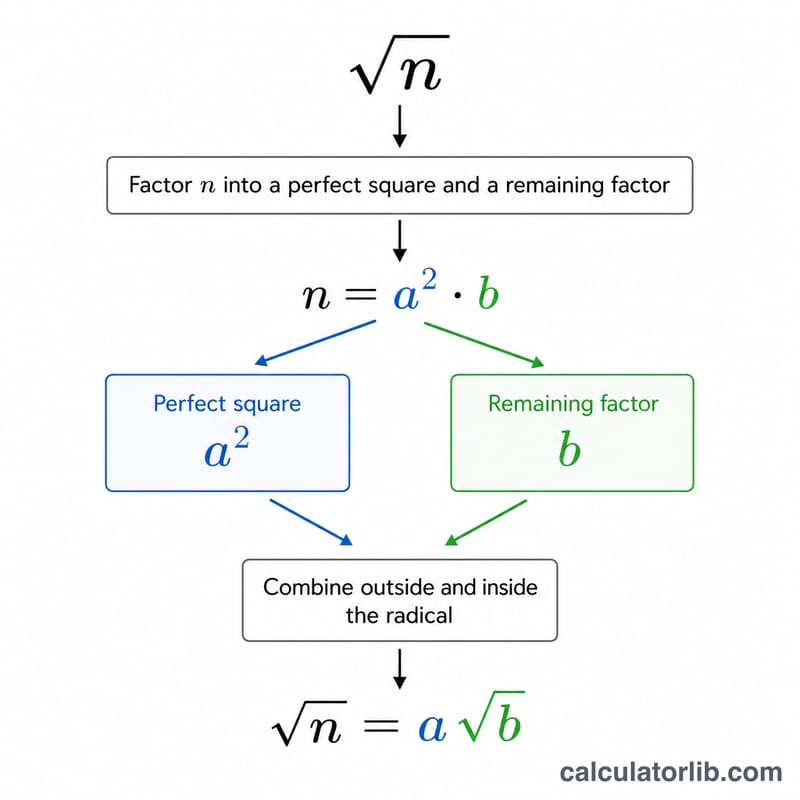
To simplify \(\sqrt{n}\), find the largest perfect square \(a^2\) that divides \(n\) evenly. Then \(n = a^2 \times b\), and since \(\sqrt{a^2} = a\), we can pull \(a\) outside:
$$\sqrt{n} = a\sqrt{b}\quad\text{where } a^2 \text{ is the largest perfect-square factor of } n$$The remaining radicand \(b\) contains no further perfect-square factors, so the expression is fully simplified.
Worked example
Simplify \(\sqrt{200}\). The perfect-square factors of 200 are 4, 25, and 100. The largest is \(100 = 10^2\). So \(200 = 100 \times 2\), giving
$$\sqrt{200} = 10\sqrt{2} \approx 14.142136$$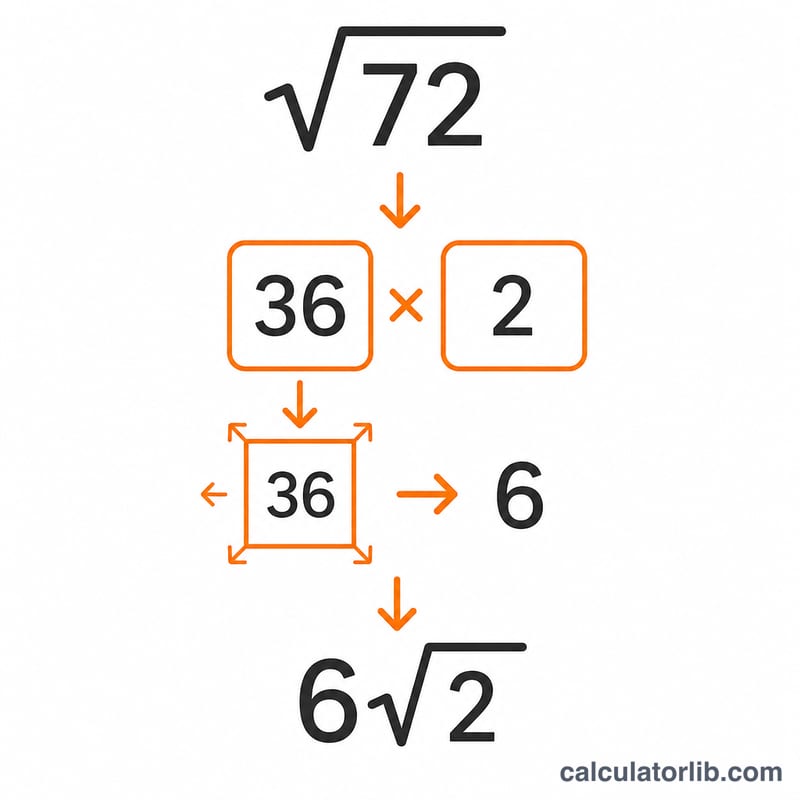
FAQ
What if my number is a perfect square? Then \(b = 1\) and the answer is just the whole number \(a\), e.g. \(\sqrt{144} = 12\).
Can it handle prime numbers? Yes — primes like \(\sqrt{7}\) are already simplified, so the coefficient stays 1.
Does it work with non-integers? This calculator is designed for positive whole numbers under a square root.