
What this calculator does
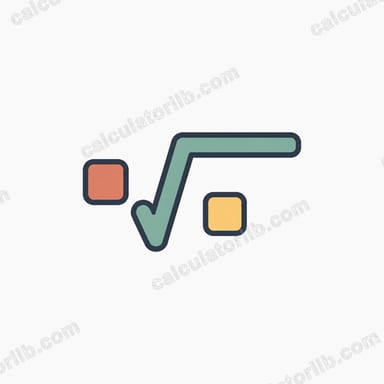
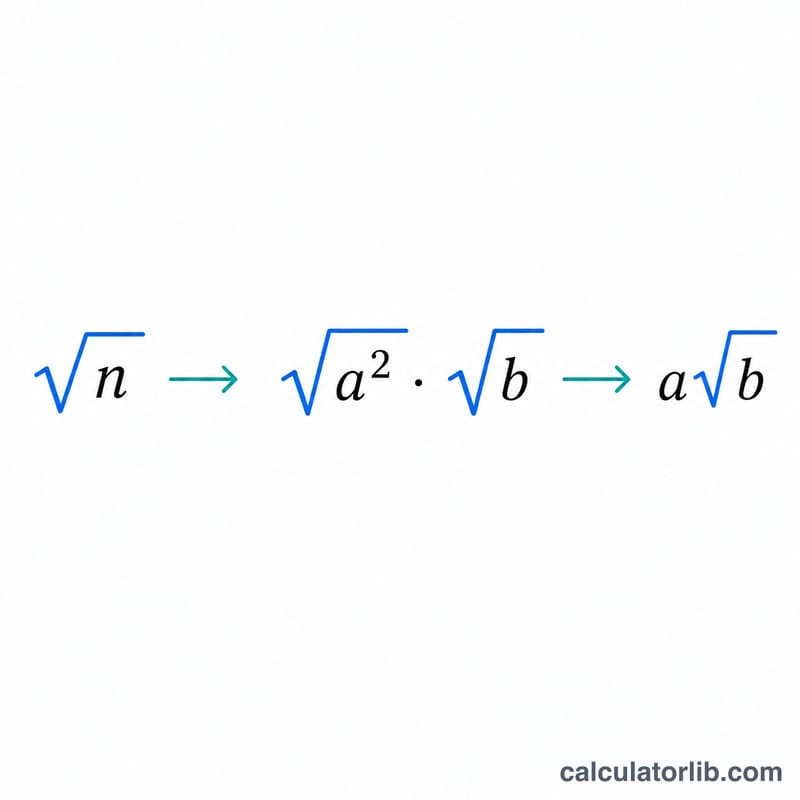
The Simplifying Radicals Calculator rewrites a square root \(\sqrt{n}\) into its simplest radical form \(a\sqrt{b}\). It extracts the largest perfect-square factor of n so the number left under the radical is as small as possible. This is a core skill in algebra, geometry, and trigonometry where exact answers are preferred over decimal approximations.
How to use it
Type any positive whole number into the field and submit. The calculator finds the largest integer a whose square divides n, then reports the coefficient a, the remaining radicand b, the full simplified form \(a\sqrt{b}\), and the decimal approximation. If n is already a perfect square, the result is just an integer; if n has no square factors greater than 1, the radical is already in simplest form.
The formula explained
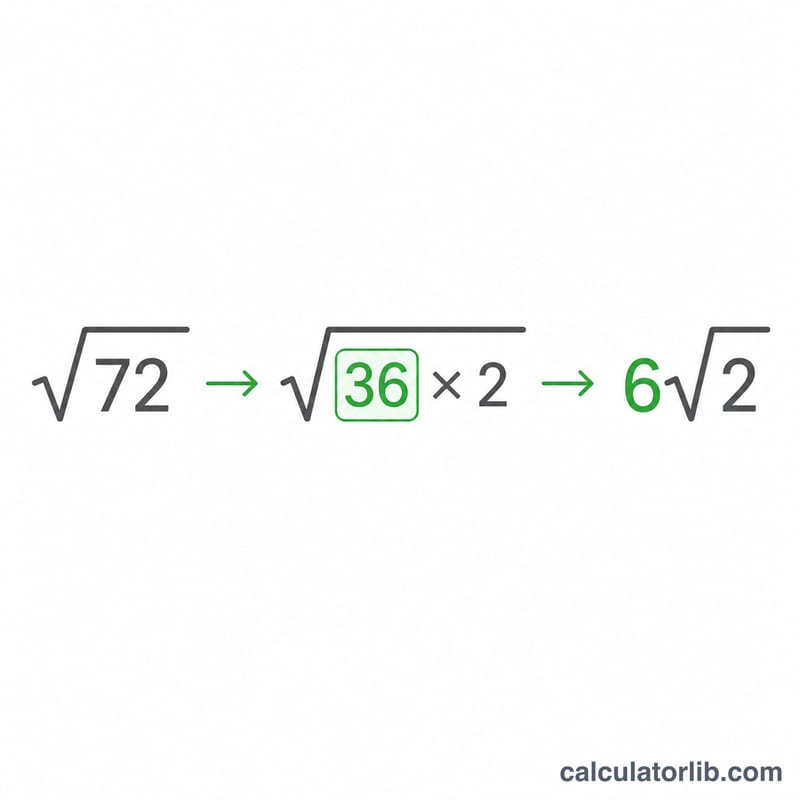
We write $$\sqrt{n} = a\sqrt{b} \qquad a^2 \cdot b = n$$ where \(a^2\) is the largest perfect square that divides n and \(b = n / a^2\). For example, \(72 = 36 \times 2\), and \(36 = 6^2\) is the largest perfect square factor, so \(\sqrt{72} = 6\sqrt{2}\). The factor 6 comes out of the radical and 2 stays inside because 2 has no perfect-square factors.
Worked example
Simplify \(\sqrt{72}\). List perfect-square divisors of 72: 1, 4, 9, 36. The largest is \(36 = 6^2\). So \(a = 6\) and \(b = 72 / 36 = 2\). Therefore $$\sqrt{72} = 6\sqrt{2} \approx 8.485281$$
FAQ
What if my number is a perfect square? Then \(b = 1\) and the answer is the whole number a — for example \(\sqrt{49} = 7\).
Can it handle numbers that are already simplest? Yes. \(\sqrt{15}\) has no square factor besides 1, so it returns \(1\sqrt{15}\), displayed as \(\sqrt{15}\).
Does it work with non-square-free results like \(\sqrt{48}\)? Yes: \(48 = 16 \times 3\), so \(\sqrt{48} = 4\sqrt{3} \approx 6.928203\).