
What this calculator does
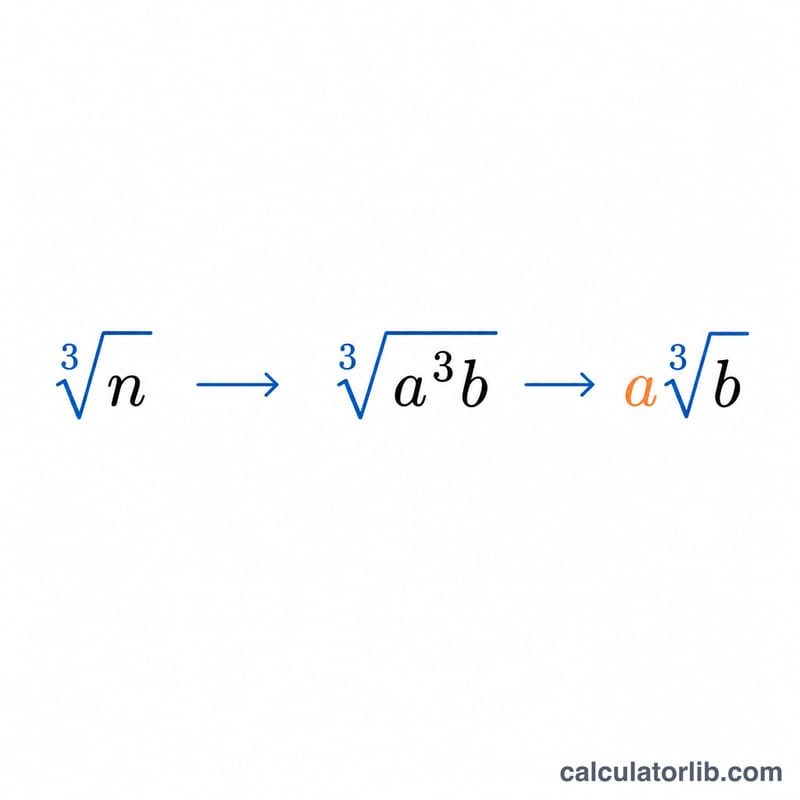
This tool simplifies a cube root \(\sqrt[3]{n}\) into the cleanest possible exact form, \(a\cdot\sqrt[3]{b}\). It does this by finding the largest perfect cube that divides \(n\), pulling its cube root out front as the coefficient \(a\), and leaving the remaining cube-free factor \(b\) inside the radical. You also get the decimal approximation of the cube root.
How to use it
Enter any positive whole number under the cube root and submit. The calculator returns the simplified radical (for example \(\sqrt[3]{54} = 3\sqrt[3]{2}\)), the coefficient, the radicand, and the decimal value. If the number is a perfect cube, the radicand becomes 1 and the answer is a whole number.
The formula explained
We write \(n = a^{3} \times b\) where \(a^{3}\) is the largest perfect-cube factor of \(n\). Because the cube root distributes over multiplication, $$\sqrt[3]{n} = \sqrt[3]{a^{3} \times b} = \sqrt[3]{a^{3}} \times \sqrt[3]{b} = a\cdot\sqrt[3]{b}.$$ The calculator factors \(n\) by trial division, removing each prime cube \(k^{3}\) as many times as possible and multiplying it into \(a\), then keeps whatever is left as \(b\).
Worked example
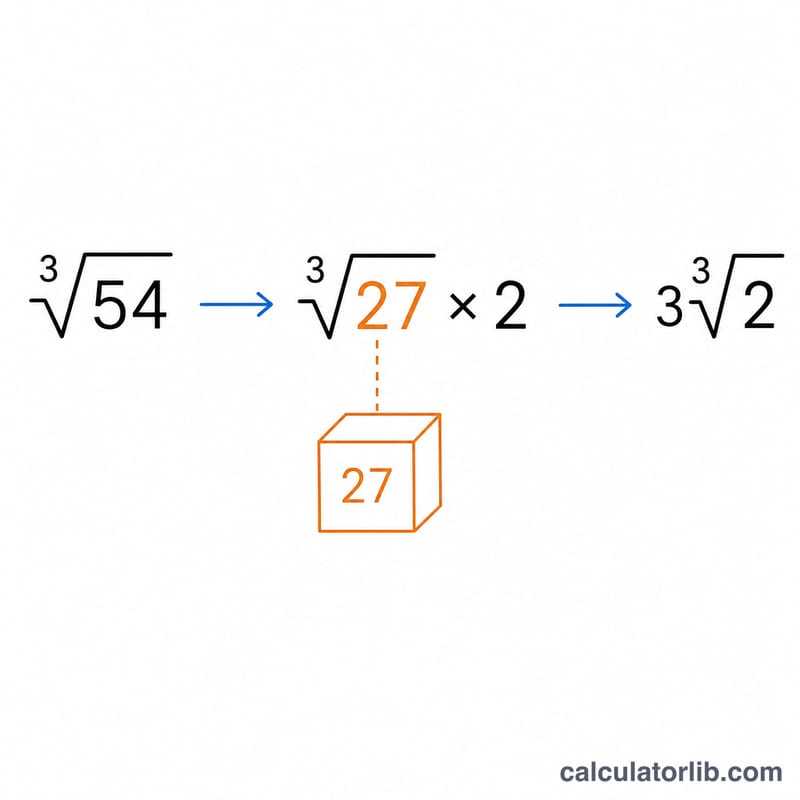
For \(n = 54\): $$54 = 27 \times 2 = 3^{3} \times 2.$$ The largest perfect cube factor is 27, so \(a = \sqrt[3]{27} = 3\) and \(b = 2\). Therefore \(\sqrt[3]{54} = 3\sqrt[3]{2}\), and the decimal value is about \(3.779763\).
FAQ
What if \(n\) is a perfect cube? Then \(b = 1\) and the result is simply the whole number \(a\) — for example \(\sqrt[3]{64} = 4\).
What if \(n\) has no cube factor? Then \(a = 1\) and the cube root cannot be simplified; \(\sqrt[3]{2}\) stays as \(\sqrt[3]{2}\).
Does it handle large numbers? Yes, within standard integer limits, using efficient trial division up to the cube root of \(n\).