
What this calculator does
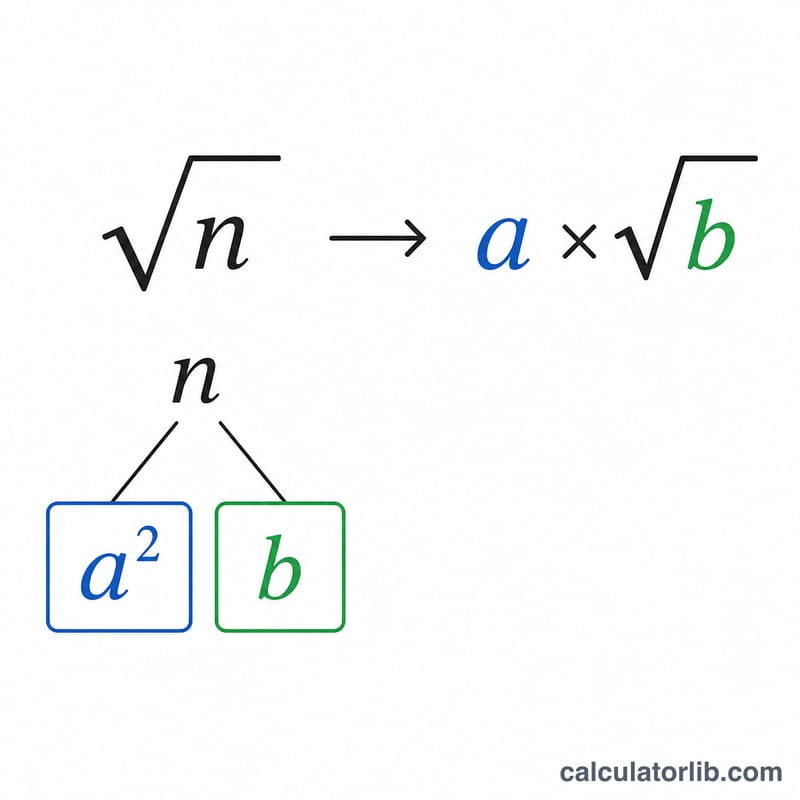
This tool rewrites the square root of any non-negative whole number into its simplest radical form. A square root is in simplest form when no perfect-square factor (other than 1) remains under the radical sign. The result is expressed as a coefficient multiplied by a smaller square root, written as \(a\sqrt{b}\).
How to use it
Type any whole number into the input box and submit. The calculator returns three things: the coefficient \(a\) (the number pulled outside the radical), the radicand \(b\) (the number left inside the radical), and the decimal approximation of the root. If the number is a perfect square, the radicand becomes 1 and you simply get a whole number.
The formula explained
For an integer \(n\), we find the largest integer \(a\) such that \(a^2\) divides \(n\) evenly. We then set \(b = n / a^2\). Because we removed the biggest possible square factor, \(b\) is square-free, so \(a\sqrt{b}\) is the simplest radical form.
$$\sqrt{n} = a\sqrt{b}\qquad \text{where }a^{2}\text{ is the largest perfect-square factor of }n,\ b=\dfrac{n}{a^{2}}$$This satisfies \(a^2 \cdot b = n\), which guarantees that \((a\sqrt{b})^2 = a^2 \cdot b = n\).
Worked example
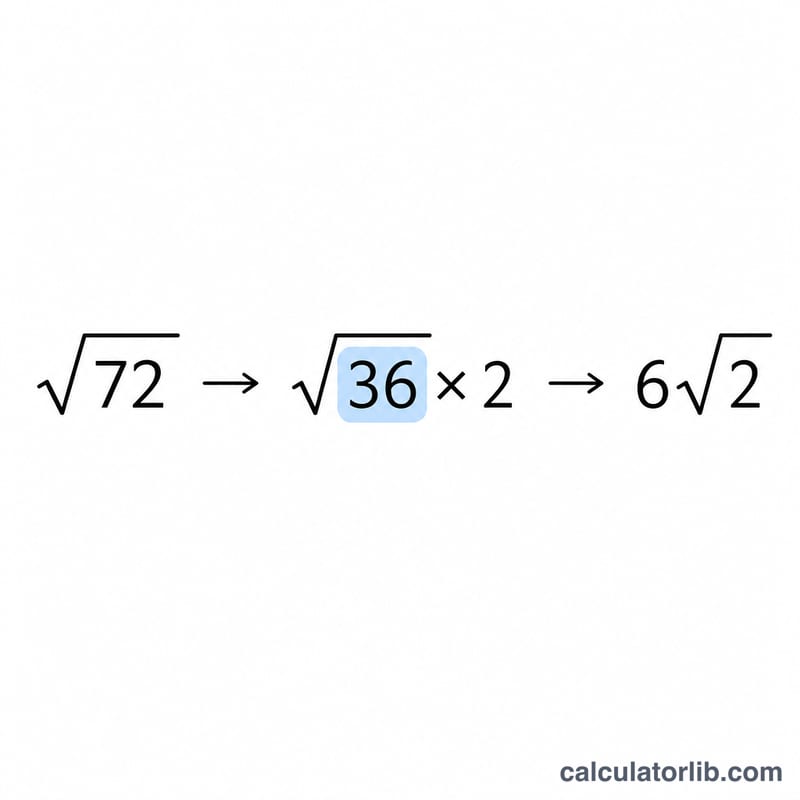
Simplify \(\sqrt{72}\). The largest square dividing 72 is 36 (since \(36 \times 2 = 72\)), so \(a = 6\) and \(b = 2\). Therefore
$$\sqrt{72} = 6\sqrt{2} \approx 8.485281$$Check: \(6^2 \times 2 = 36 \times 2 = 72\). ✓
FAQ
What if the number is a perfect square? Then \(b = 1\) and the result is just the whole number \(a\). For example \(\sqrt{49} = 7\).
What if it cannot be simplified? If the number is already square-free (like 15), the coefficient stays 1 and the form remains \(\sqrt{15}\).
Does it work for 0? Yes — \(\sqrt{0} = 0\), with coefficient 0 and radicand 0.