
What this calculator does
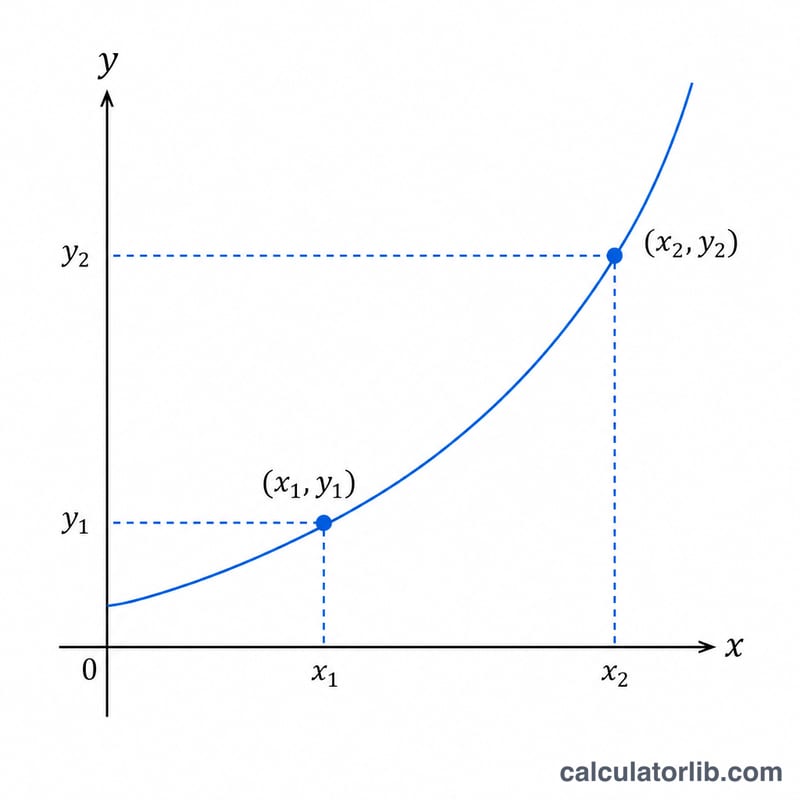
An exponential function has the form \(y = a\cdot b^{x}\), where a is the value when x = 0 and b is the constant multiplier (growth or decay factor). Given any two points (x₁, y₁) and (x₂, y₂) that lie on the curve, there is exactly one exponential function through them. This tool computes the base b and coefficient a for you.
How to use it
Enter the coordinates of your two points. Both y-values must be the same sign and non-zero (an exponential of this form never crosses zero), and the two x-values must differ. The calculator returns the full equation \(y = a\cdot b^{x}\) plus the per-step percentage growth rate, \((b - 1) \times 100\%\).
The formula explained
Dividing the two point equations eliminates a: \(y_2/y_1 = b^{(x_2 - x_1)}\). Solving for the base gives $$b = \left(\frac{y_2}{y_1}\right)^{\frac{1}{x_2 - x_1}}$$ Substituting back into \(y_1 = a\cdot b^{x_1}\) gives $$a = \frac{y_1}{b^{x_1}}$$
Worked example
Suppose the curve passes through (0, 3) and (2, 27). Then $$b = \left(\frac{27}{3}\right)^{\frac{1}{2-0}} = 9^{0.5} = 3,$$ and $$a = \frac{3}{3^{0}} = 3.$$ The function is \(y = 3\cdot 3^{x}\), with a 200% increase each step.
FAQ
Why must the y-values share a sign? Because \(b^{x}\) is always positive, \(a\cdot b^{x}\) keeps the sign of a for every x, so two points with opposite signs cannot lie on one curve.
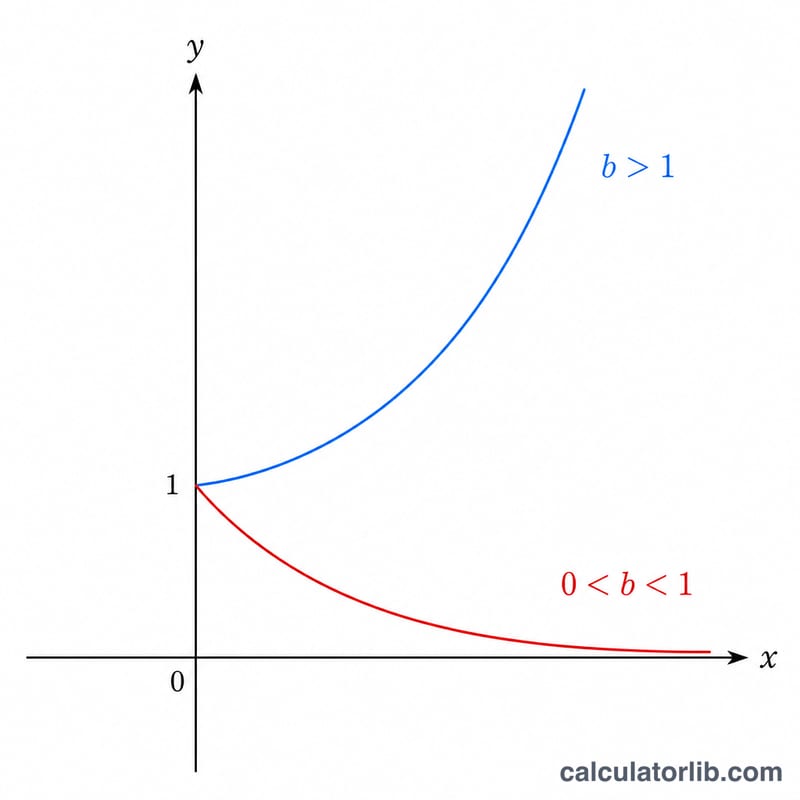
What if b is less than 1? Then the function is exponential decay — values shrink as x increases, and the growth rate is negative.
Can x-values be negative or non-integer? Yes. Any real x-values work as long as \(x_1 \neq x_2\).