
What is the Nth Root Calculator?
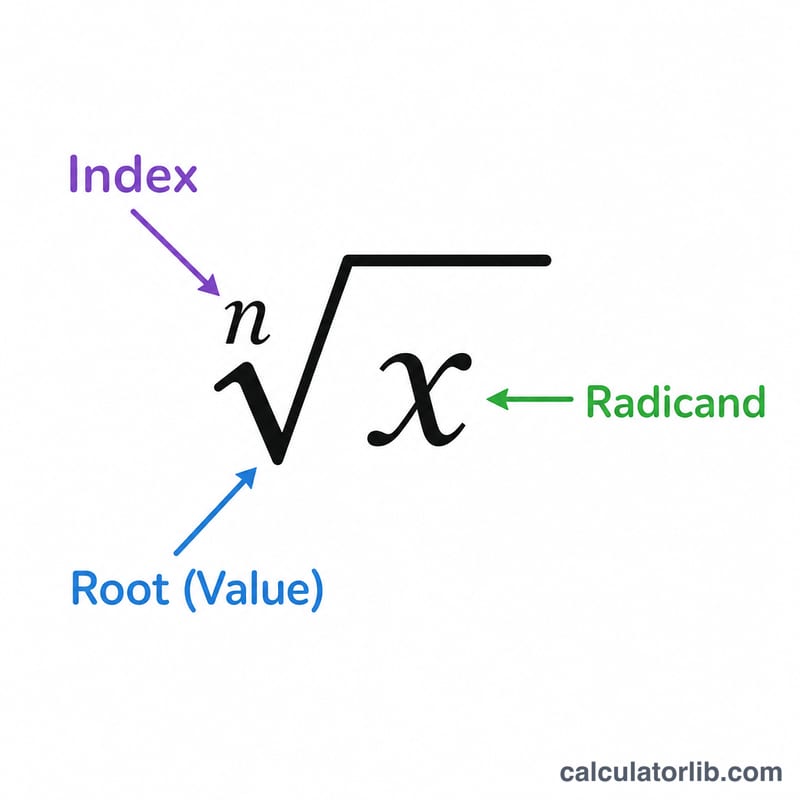
This tool evaluates the nth root (also called a radical) of a real number. Mathematically, the nth root of x is written as the radical of degree n over x and equals x raised to the power 1/n. $$\sqrt[n]{x} = x^{\frac{1}{n}}$$ Enter the root index n and the radicand x, and the calculator returns the real-valued root. Use it for square roots (\(n = 2\)), cube roots (\(n = 3\)), fourth roots, fifth roots, and any other degree, including negative or fractional indices.
How to use it
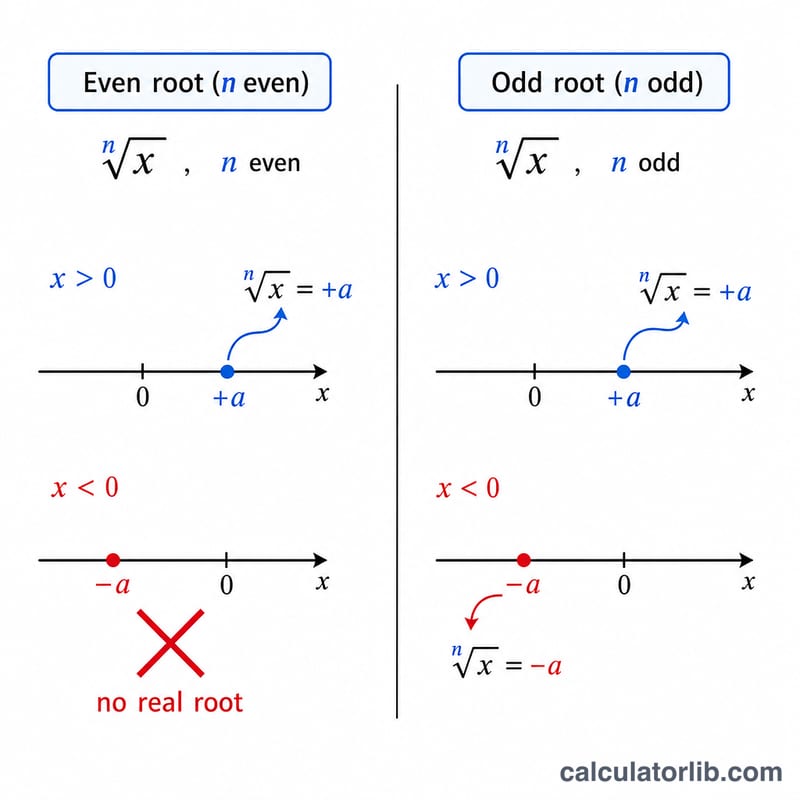
Type the index in the "n =" box and the value under the radical in the "x =" box. Both fields accept positive or negative numbers. Press calculate to see the answer. When the index is an even integer and the radicand is positive, the result is shown with a plus-or-minus sign because both signs raised to an even power return the same number. For an odd index, a single signed value is returned.
The formula explained
The core relation is \(x^{\frac{1}{n}}\). Because raising a negative base to a fractional power returns NaN in most software, this calculator always computes the magnitude as \(|x|^{\frac{1}{n}}\) and then re-applies the correct sign. If \(x\) is negative and \(n\) is an odd integer, a real negative root exists and we negate the magnitude. If \(x\) is negative and \(n\) is even (or non-integer), no real root exists, the answer would be imaginary or complex.
Worked example
To find the 4th root of 81: compute $$81^{\frac{1}{4}} = 3$$ Since 4 is an even integer and 81 is positive, both \(+3\) and \(-3\) work, so the answer is \(\pm 3\). To find the cube root of -27: the magnitude is $$27^{\frac{1}{3}} = 3$$ and because 3 is odd and the radicand is negative, the result is \(-3\).
FAQ
Why does an even root of a negative number have no answer here? Because no real number raised to an even power yields a negative result. The solution is imaginary, so it falls outside a real-number calculator.
Can the index be negative? Yes. A negative index gives a reciprocal-style root; for example \(x^{\frac{1}{-2}} = \frac{1}{\sqrt{x}}\). Just avoid \(x = 0\) with a negative index.
What if the index is zero? It is undefined, since \(\frac{1}{n}\) divides by zero.