
What Is a Root Calculator?
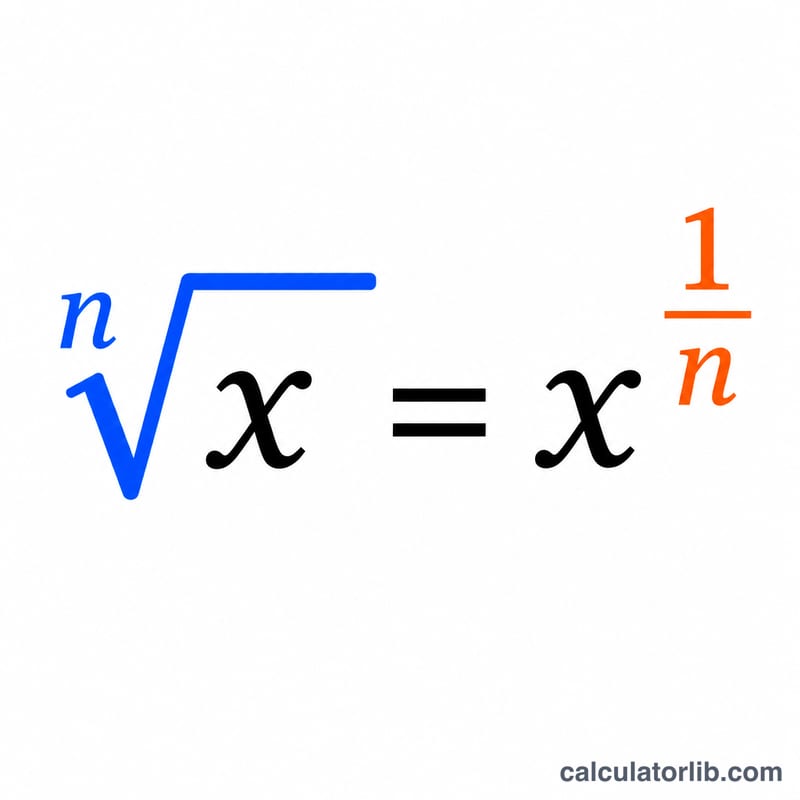
A root calculator finds the nth root of any number — the value that, when raised to the power of n, gives back your original number. The most familiar roots are the square root (n = 2) and the cube root (n = 3), but this tool handles any degree, including fractional ones. It applies the universal formula \(\sqrt[n]{x} = x^{1/n}\), making it useful in mathematics, engineering, finance (e.g. compound growth rates) and science.
How to Use It
Enter the number (\(x\)) you want the root of, then enter the root degree (\(n\)). For a square root, set \(n = 2\); for a cube root, set \(n = 3\). Press calculate and the result appears instantly. Negative numbers return a real result only when paired with an odd degree (since even roots of negatives are not real numbers); in those odd cases the calculator returns the negative real root.
The Formula Explained
Taking a root is the inverse of raising to a power. The nth root of \(x\) is written as \(\sqrt[n]{x}\) and is mathematically identical to \(x\) raised to the exponent \(1/n\).
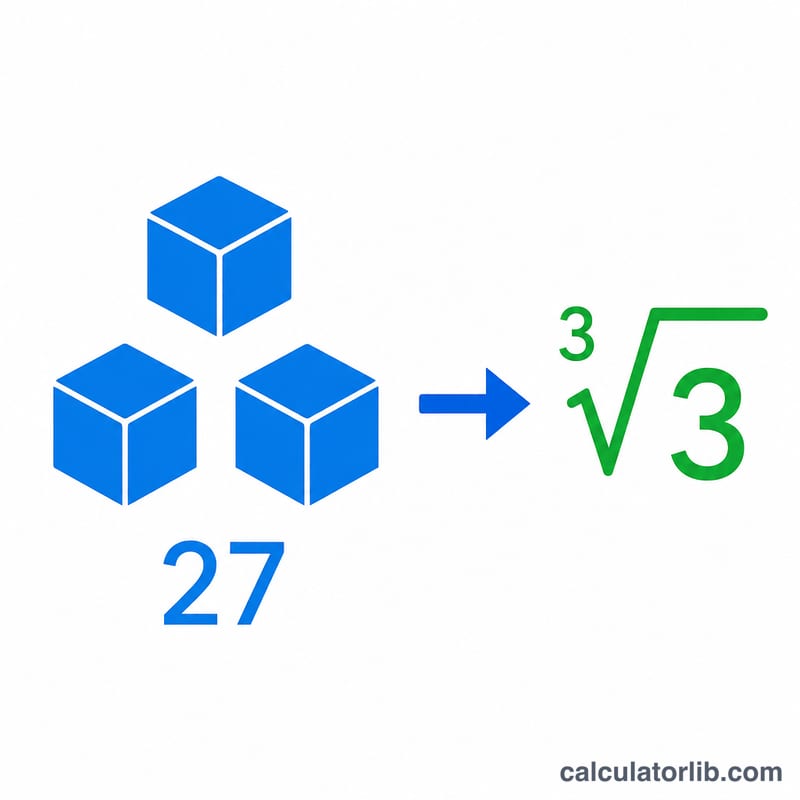
$$\sqrt[n]{x} = x^{\frac{1}{n}}$$For example, the cube root of 27 is \(27^{1/3} = 3\), because \(3 \times 3 \times 3 = 27\). This exponent form lets a single power operation compute any root.
Worked Example
Suppose you want the 4th root of 81. Compute
$$81^{\frac{1}{4}} = 81^{0.25} = 3$$because \(3^4 = 3 \times 3 \times 3 \times 3 = 81\). So the 4th root of 81 is 3.
FAQ
What is the difference between a root and a power? A power multiplies a number by itself \(n\) times; a root reverses that operation, asking which base produces the number.
Can I take the root of a negative number? Only odd-degree roots of negatives are real (e.g. the cube root of \(-8\) is \(-2\)). Even roots of negatives are complex and are not returned here.
Can the degree be a decimal? Yes. Fractional degrees are supported via the \(x^{1/n}\) formula, so you can compute, for instance, the 2.5th root of a number.