
What Is the Radicals and Roots Calculator?
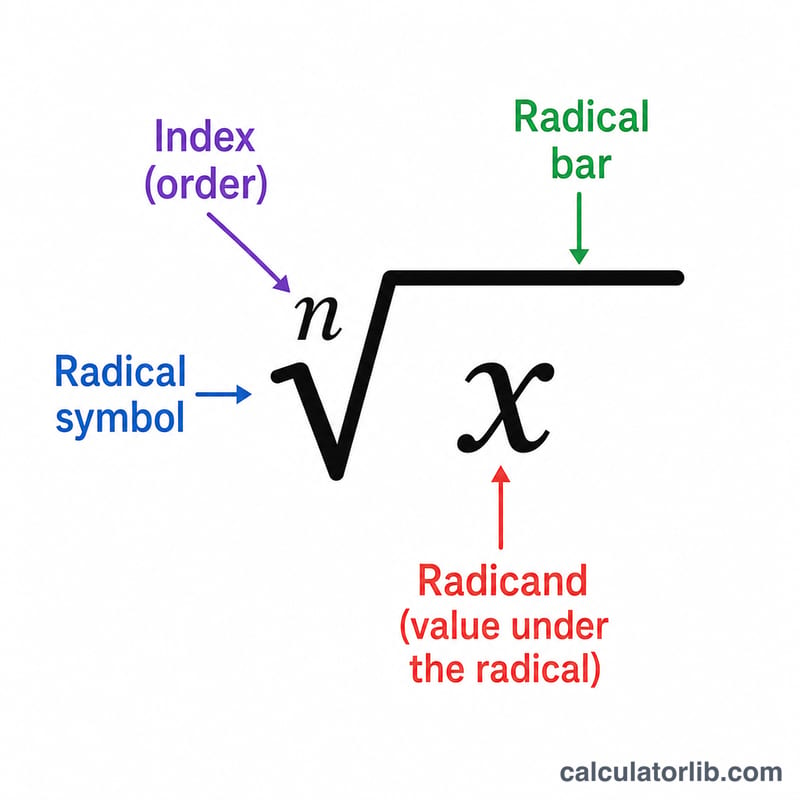
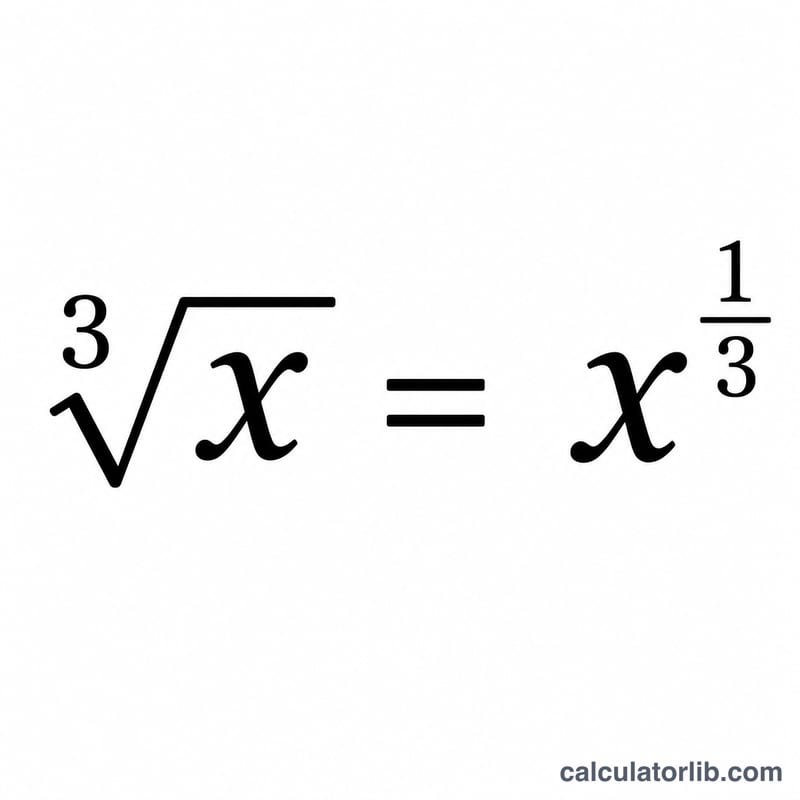
This calculator finds the nth root (also called a radical) of any number. The square root is the 2nd root, the cube root is the 3rd root, and so on. Mathematically, the nth root of x is the value that, when multiplied by itself n times, equals x. It is computed as x raised to the power 1/n.
How to Use It
Enter two values: the radicand (the number under the root sign, x) and the index (the degree of the root, n). For a square root use index 2, for a cube root use index 3. The calculator returns the principal real root instantly. Indexes do not have to be whole numbers — a fractional index works too.
The Formula Explained
The core identity is:
$$\sqrt[n]{x} = x^{1/n}$$
This works because raising a power to another power multiplies the exponents: \((x^{1/n})^{n} = x^{n/n} = x\). For negative radicands, a real result only exists when n is an odd integer (for example the cube root of −8 is −2), because no real number raised to an even power gives a negative result.
Worked Example
Find the cube root of 27. Here x = 27 and n = 3. So the result is $$27^{1/3} = 3,$$ since \(3 \times 3 \times 3 = 27\). Likewise, the 4th root of 16 is $$16^{1/4} = 2,$$ because \(2^{4} = 16\).
FAQ
What is the difference between a radical and a root? They describe the same operation — "radical" refers to the √ symbol and expression, while "root" refers to the resulting value.
Can I take the root of a negative number? Only for odd integer indexes (cube root, 5th root, etc.). Even roots of negatives are not real numbers.
What does an index of 1 do? The 1st root of any number is the number itself, since \(x^{1/1} = x\).