
What this calculator does
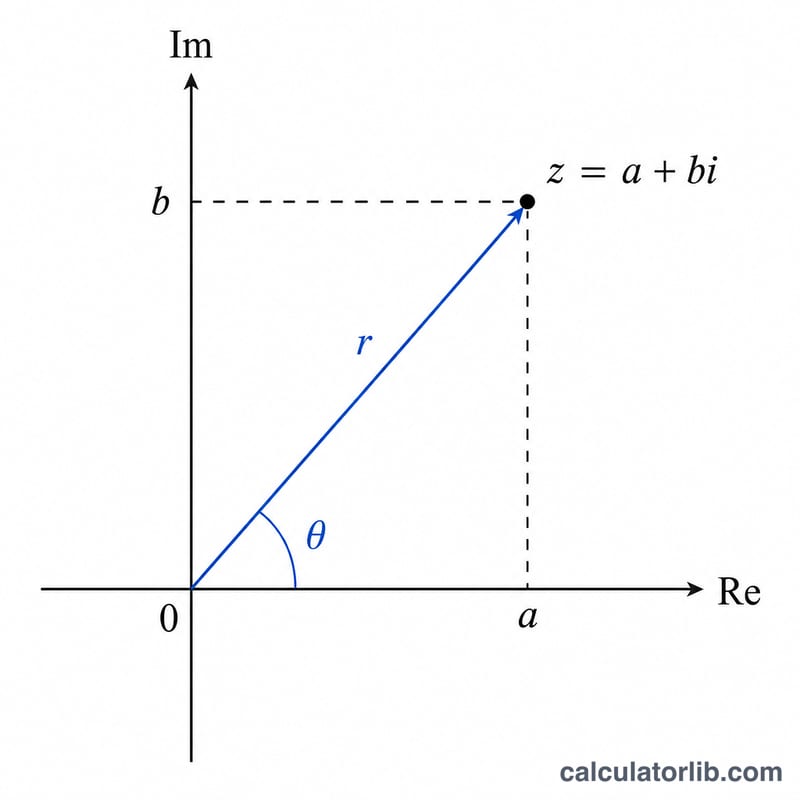
This tool computes the square root, cube root, or general nth root of any real number x. You can ask for only the real-valued root (the familiar answer) or for all n complex roots, and you can display each result in rectangular form \(a + b\cdot i\) or in polar form \(r \angle \theta\). It is a pure mathematics tool that works the same everywhere — no country, currency or unit assumptions apply.
How to use it
Pick the root type. Choose "Square root" for degree \(n = 2\), "Cube root" for \(n = 3\), or "Nth root" and type your own positive integer \(n\). Enter the radicand \(x\). Select whether you want real roots only or all complex roots, choose rectangular or polar display, and pick how many significant digits to show. The number of digits is purely cosmetic; the underlying arithmetic uses standard double precision.
The formula explained
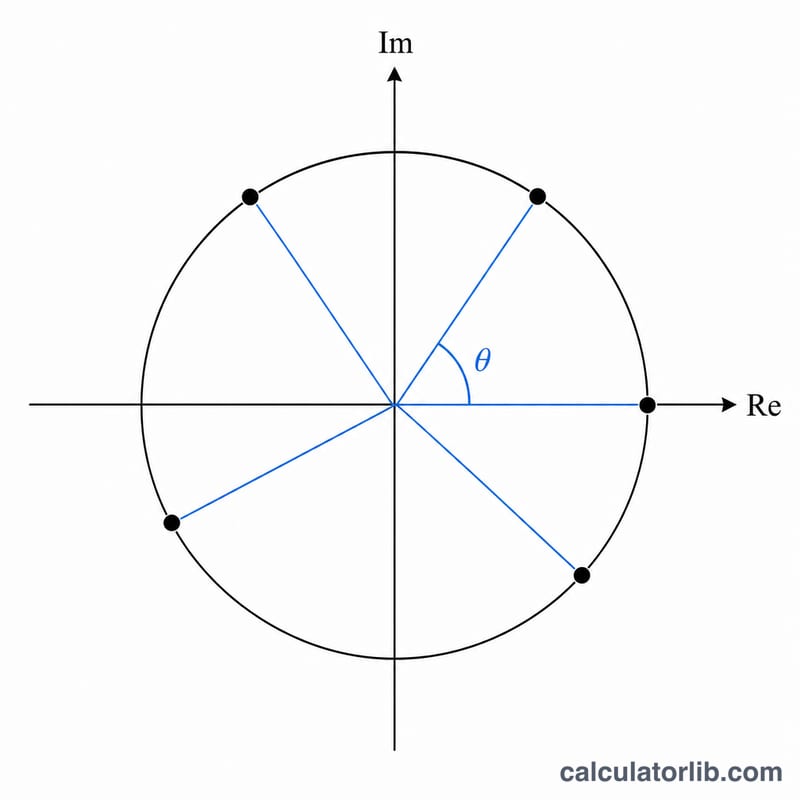
Write x in polar form as \(\rho\cdot e^{i\varphi}\), where \(\rho = |x|\) and \(\varphi = 0\) when x is non-negative or \(\varphi = \pi\) when x is negative. Every nth root has the same magnitude $$r = \rho^{1/n}.$$ The n distinct roots are evenly spaced by an angle of \(2\pi/n\): $$w_k = r\left[\cos\frac{\varphi+2\pi k}{n} + i\cdot\sin\frac{\varphi+2\pi k}{n}\right]$$ for \(k = 0,1,\ldots,n-1\). A root is real only when its imaginary part is zero.
Worked example
Take the cube root of \(x = -8\) with complex roots in rectangular form. Here \(\rho = 8\), \(\varphi = \pi\), so $$r = 8^{1/3} = 2.$$ The three roots are: \(1 + 1.7320508\cdot i\) (k=0, angle 60°), \(-2\) (k=1, angle 180° — the real cube root), and \(1 - 1.7320508\cdot i\) (k=2, angle 300°). In real-only mode the single answer is \(-2\).
FAQ
Why does a positive number have two square roots? For even \(n\) a positive radicand has both a positive and a negative real root, e.g. the square roots of 2 are \(+1.41421356\) and \(-1.41421356\).
Why is there no real root for the square root of a negative number? When n is even and x is negative, none of the roots land on the real axis, so real-only mode returns "no real root" while complex mode still returns all n roots.
Does negative x always give a real cube root? Yes — whenever n is odd there is exactly one real root, equal to \(-|x|^{1/n}\).