
What is the Complex Number Square Root Calculator?
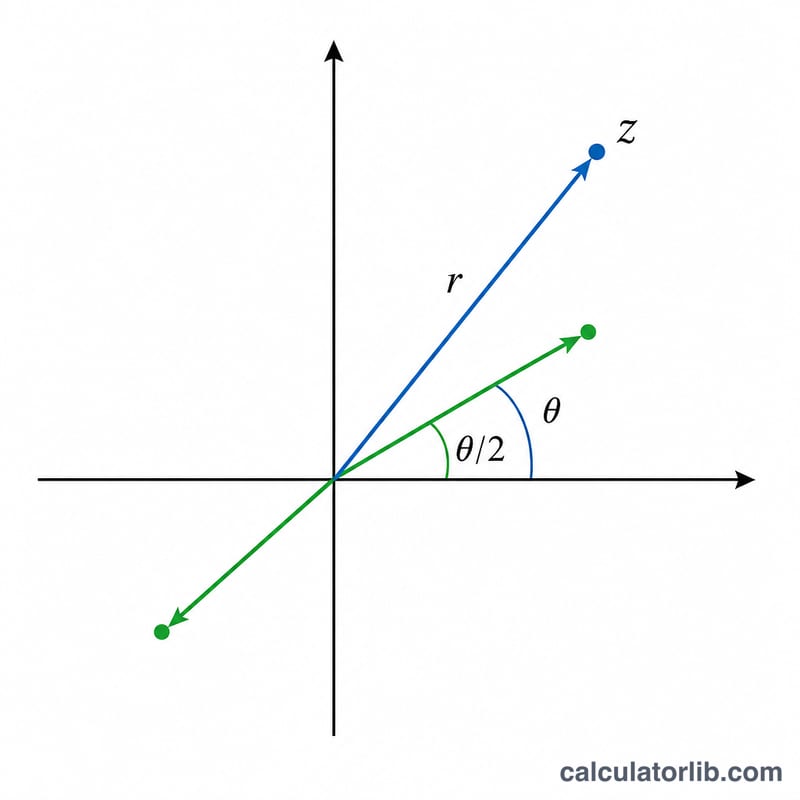
This tool finds the square root of any complex number written as a + bi, where a is the real part and b is the imaginary part. Every nonzero complex number has exactly two square roots that are negatives of each other; this calculator returns the principal root and notes that the other root is simply its negative.
How to use it
Enter the real part (a) and the imaginary part (b) of your complex number, then read off the result. For a purely real negative number such as -4, just set a = -4 and b = 0. The calculator also reports the modulus of the input and the modulus of the resulting root.
The formula explained
If z = a + bi with modulus \(|z| = \sqrt{a^2 + b^2}\), the principal square root is:
$$\sqrt{z} = \sqrt{\frac{|z| + a}{2}} + i\cdot\operatorname{sgn}(b)\cdot\sqrt{\frac{|z| - a}{2}}$$
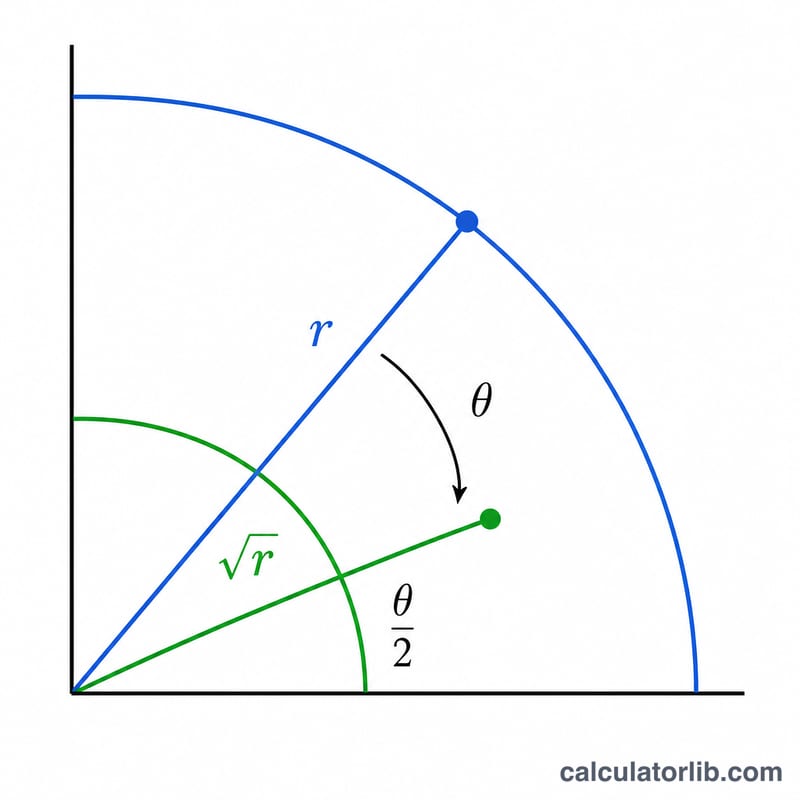
The sign of b determines the sign of the imaginary part. When b = 0 and a ≥ 0 the root is purely real; when b = 0 and a < 0 the root is purely imaginary. The modulus of the root equals \(\sqrt{|z|}\).
Worked example
Take z = 3 + 4i. Then \(|z| = \sqrt{9 + 16} = 5\). The real part of the root is \(\sqrt{\frac{5 + 3}{2}} = \sqrt{4} = 2\). Since b > 0, the imaginary part is \(+\sqrt{\frac{5 - 3}{2}} = \sqrt{1} = 1\). So $$\sqrt{3 + 4i} = 2 + i$$ (and the other root is −2 − i).
FAQ
Why are there two square roots? Squaring negates a sign, so if \(w^2 = z\) then \((-w)^2 = z\) too. The two roots always differ only by sign.
What is the principal root? By convention it is the root with non-negative real part (and, when the real part is zero, non-negative imaginary part).
Can I take the root of a negative real number? Yes. Set b = 0 and a negative; for example \(\sqrt{-4} = 2i\).