

What is the Quadratic Sequence nth Term Calculator?
A quadratic sequence is a list of numbers whose second differences are constant. Its general term follows the rule \(T_n = an^2 + bn + c\). This calculator takes the first three terms of such a sequence and works out the coefficients a, b and c, giving you the full nth-term formula. It can also evaluate any specific term you choose.
How to use it
Enter the first three terms (T₁, T₂ and T₃) in order. Optionally enter a term number n to instantly read off that term. The calculator shows the rule plus the value of a, b, c and the constant second difference.
The formula explained
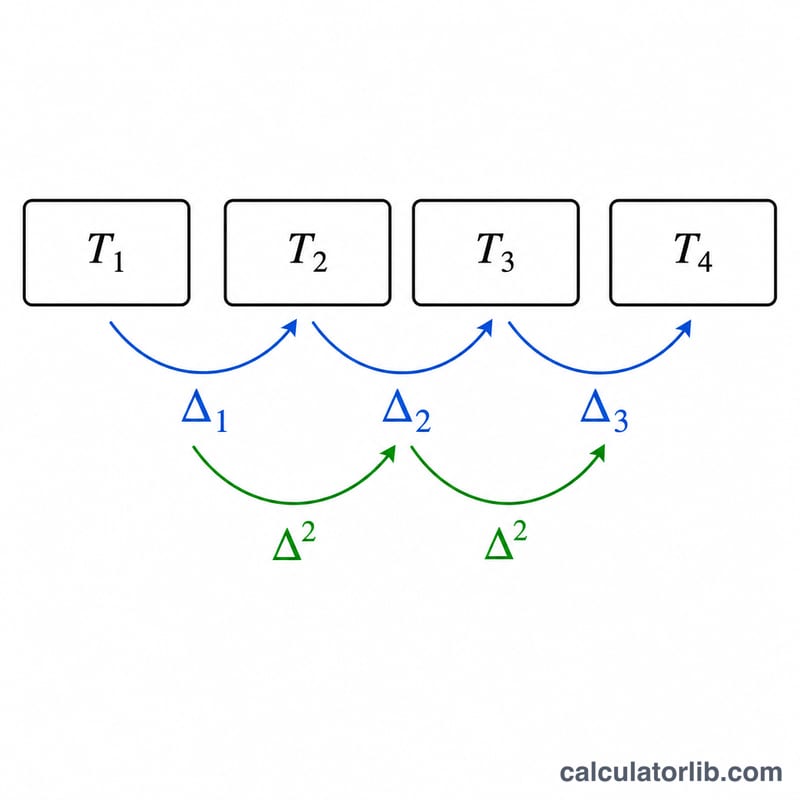
Take the differences between consecutive terms: \(d_1 = T_2 - T_1\) and \(d_2 = T_3 - T_2\). The second difference is \(\Delta^2 = d_2 - d_1\), and for a quadratic this equals \(2a\), so \(a = \Delta^2/2\). Because \(T_2 - T_1 = 3a + b\), we get \(b = (T_2 - T_1) - 3a\). Finally, since \(T_1 = a + b + c\), we have \(c = T_1 - a - b\).
$$T_n = a\,n^{2} + b\,n + c$$ $$\text{where}\quad \left\{ \begin{aligned} a &= \frac{(\text{T}_3 - \text{T}_2) - (\text{T}_2 - \text{T}_1)}{2} \\ b &= (\text{T}_2 - \text{T}_1) - 3a \\ c &= \text{T}_1 - a - b \\ n &= \text{Term number} \end{aligned} \right.$$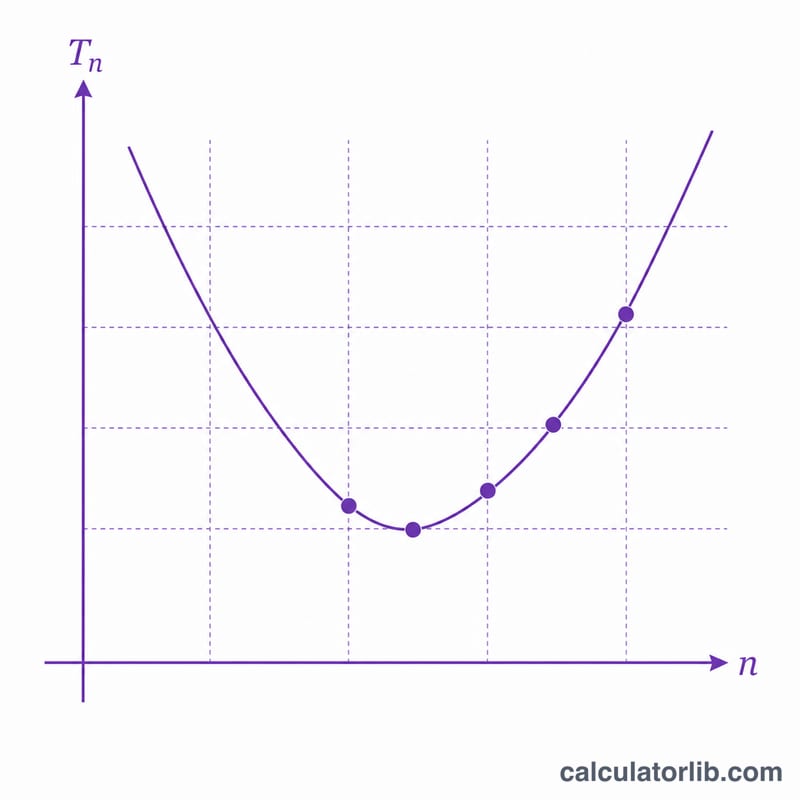
Worked example
For the sequence 3, 8, 15: first differences are 5 and 7, so the second difference is 2, giving \(a = 1\). Then \(b = 5 - 3(1) = 2\), and \(c = 3 - 1 - 2 = 0\). The rule is $$T_n = n^2 + 2n.$$ Checking $$T_5 = 25 + 10 = 35.$$
FAQ
Why do I only need three terms? A quadratic has three unknowns (a, b, c), so three equations — one per term — are enough to solve them.
What if the second difference is zero? Then \(a = 0\) and the sequence is actually linear (arithmetic), so the rule reduces to \(T_n = bn + c\).
Can it handle decimals or negatives? Yes — any real numbers work for the terms, and coefficients may come out as fractions or negatives.