
What this calculator does
This tool multiplies or divides two fractions and returns the answer as a fully simplified (reduced) fraction together with its decimal equivalent. Enter the numerator and denominator of each fraction, choose multiply or divide, and the calculator handles the arithmetic and the simplification for you.
How to use it
Type the top number (numerator) and bottom number (denominator) of your first fraction, pick the operation, then enter the second fraction. The result box shows the reduced fraction, while the table below shows the unreduced product and the decimal value so you can follow exactly what happened.
The formula explained
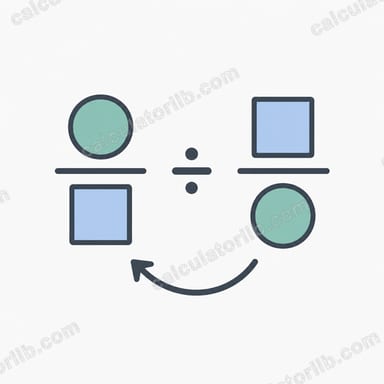
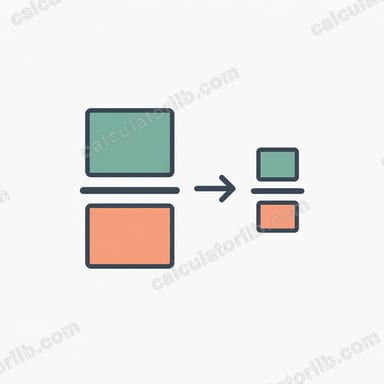
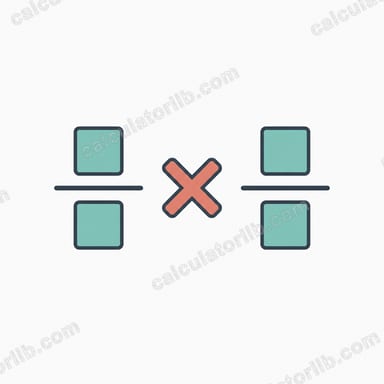
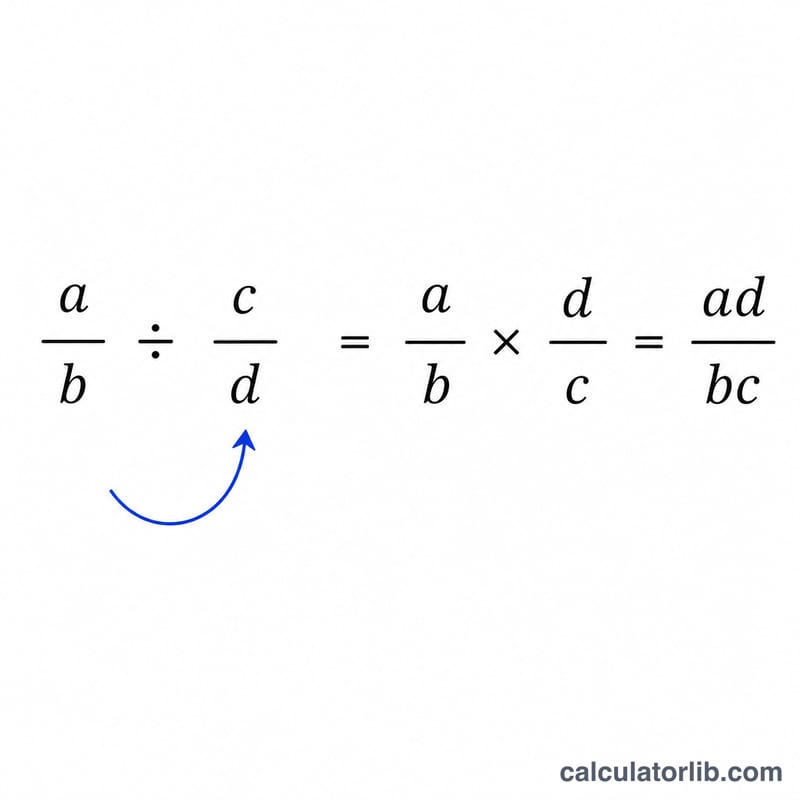
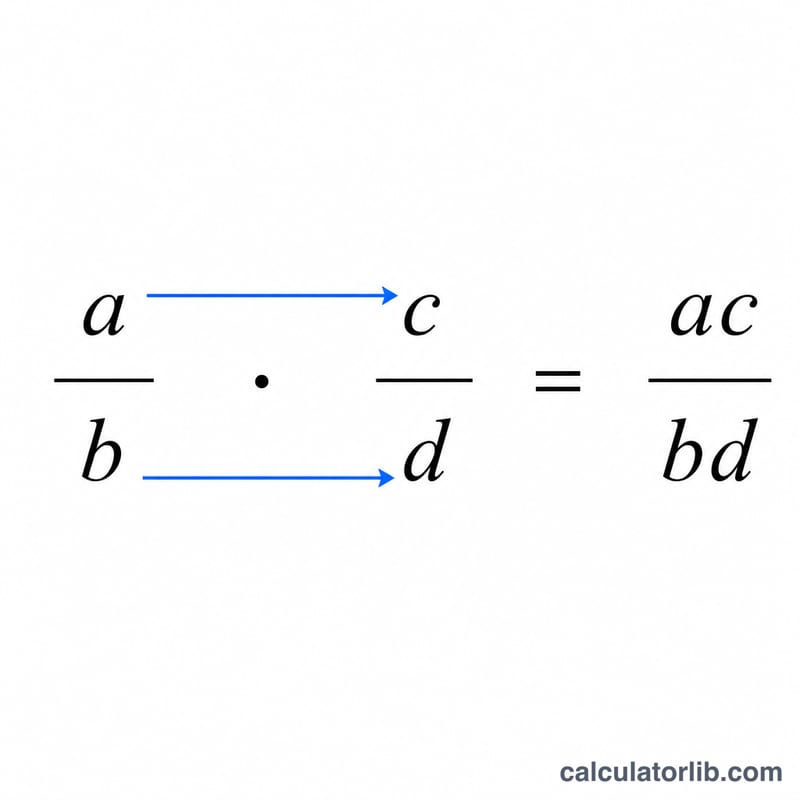
To multiply fractions, multiply straight across: \(\frac{a}{b} \times \frac{c}{d} = \frac{ac}{bd}\). To divide, flip the second fraction and multiply: \(\frac{a}{b} \div \frac{c}{d} = \frac{a}{b} \times \frac{d}{c} = \frac{ad}{bc}\). After computing, the calculator divides both numbers by their greatest common divisor (GCD) to reduce the fraction to lowest terms, and keeps the denominator positive.
Worked example
Suppose you divide 1/2 by 3/4. Using the rule, multiply 1/2 by the reciprocal of 3/4, which is 4/3:
$$\frac{1 \times 4}{2 \times 3} = \frac{4}{6}$$The GCD of 4 and 6 is 2, so the reduced answer is \(\frac{2}{3} \approx 0.6667\).
FAQ
Do I need to find a common denominator? No — common denominators are only needed for adding and subtracting. For multiplying and dividing you work straight across.
Can I use negative numbers? Yes. Enter a minus sign on the numerator or denominator; the result sign is computed automatically and the denominator is normalized to be positive.
What if the answer is a whole number? It is shown as a fraction over 1 (for example \(\frac{6}{1}\)), and the decimal value confirms the whole-number result.