
What Is Serum Osmolality?
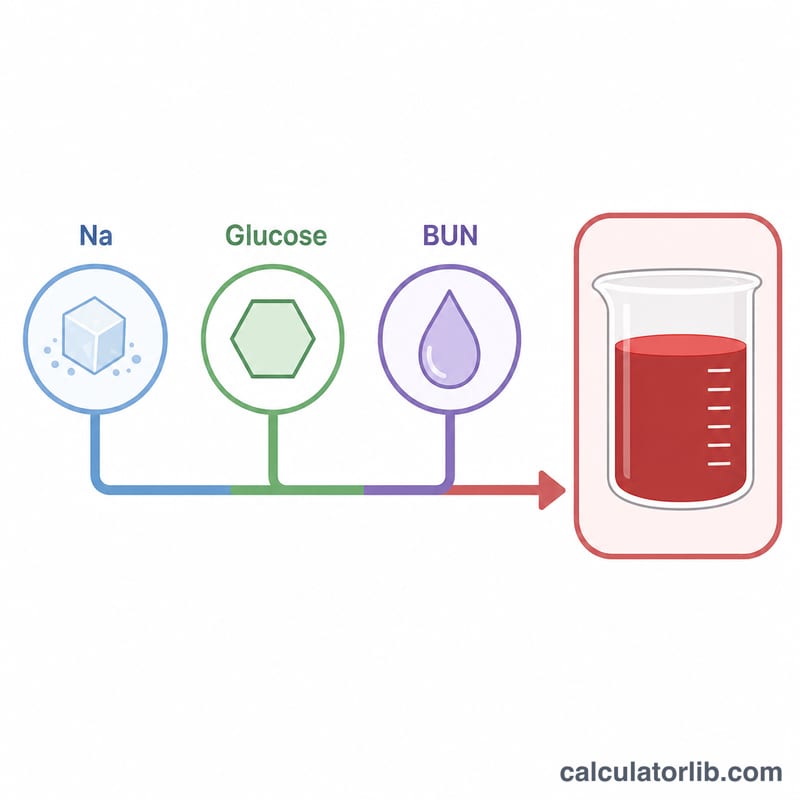
Serum osmolality measures the concentration of dissolved particles (solutes) in the blood, expressed in milliosmoles per kilogram of water (mOsm/kg). It is a key indicator of the body fluid balance and hydration status. The calculated (estimated) osmolality uses the three solutes that contribute most to plasma tonicity: sodium, glucose, and urea (reported as blood urea nitrogen, BUN). Note: this formula assumes US conventional lab units — sodium in mEq/L and glucose and BUN in mg/dL.
How to Use the Calculator
Enter the patient sodium value in mEq/L, glucose in mg/dL, and BUN in mg/dL. The calculator returns the estimated osmolality and breaks down how much each solute contributes. A normal calculated osmolality is roughly 275–295 mOsm/kg.
The Formula Explained
The standard equation is $$\text{Osmolality} = 2 \times \text{Na} + \frac{\text{Glucose}}{18} + \frac{\text{BUN}}{2.8}$$ Sodium is multiplied by 2 to account for its accompanying anions (mostly chloride and bicarbonate). Glucose is divided by 18 and BUN by 2.8 to convert from mg/dL into mmol/L (their respective molecular weight conversions). The osmolal gap — the difference between a measured osmolality and this calculated value — can flag the presence of unmeasured osmoles such as ethanol, methanol, or ethylene glycol.
Worked Example
For Na = 140 mEq/L, glucose = 90 mg/dL, and BUN = 14 mg/dL:
$$2 \times 140 = 280, \quad \frac{90}{18} = 5, \quad \frac{14}{2.8} = 5$$Total = 290 mOsm/kg, which falls within the normal range.
FAQ
What is a normal serum osmolality? Approximately 275–295 mOsm/kg for the calculated value.
What is the osmolal gap? Measured osmolality minus calculated osmolality; a gap above ~10 mOsm/kg suggests unmeasured solutes.
Is this a substitute for lab testing? No. This is an estimate to support clinical interpretation and should not replace direct measurement or professional judgment.