
What Is the Plasma Osmolality Calculator?
This tool estimates calculated plasma (serum) osmolality, a measure of the concentration of dissolved particles in blood plasma. It uses the widely taught formula based on the three major osmotically active solutes: sodium, glucose, and urea (reported as blood urea nitrogen, BUN). The inputs here use US conventional units (glucose and BUN in mg/dL), which is why the conversion factors 18 and 2.8 appear. A normal calculated osmolality is roughly 275–295 mOsm/kg.
How to Use It
Enter the patient's serum sodium in mEq/L, glucose in mg/dL, and BUN in mg/dL, then submit. The calculator returns the total osmolality plus a breakdown showing how much each solute contributes. Comparing this calculated value with a laboratory-measured osmolality gives the osmolal gap, which can suggest unmeasured osmoles such as alcohols.
The Formula Explained
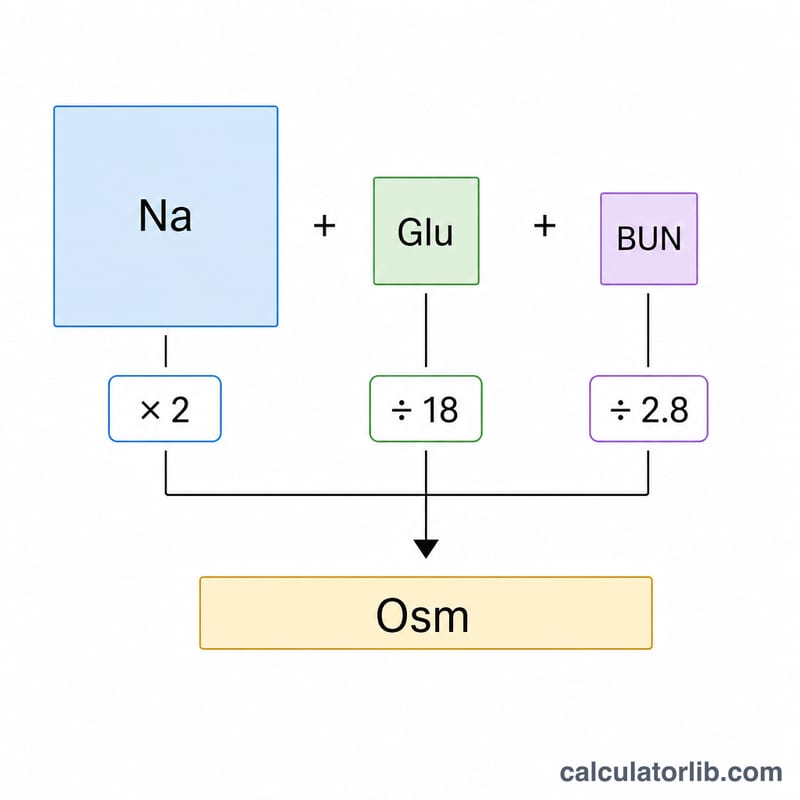
$$\text{Osmolality} = 2 \times \text{Na} + \frac{\text{Glucose}}{18} + \frac{\text{BUN}}{2.8}$$ Sodium is multiplied by 2 to account for its accompanying anions (mainly chloride and bicarbonate). Glucose is divided by 18 and BUN by 2.8 to convert mg/dL into mmol/L, since the molecular weight of glucose is ~180 and urea nitrogen has an effective factor of 2.8.
Worked Example
For Na = 140 mEq/L, glucose = 90 mg/dL, and BUN = 14 mg/dL: $$2 \times 140 = 280; \quad 90 \div 18 = 5; \quad 14 \div 2.8 = 5$$ Total = \(280 + 5 + 5 = 290\) 290 mOsm/kg, a normal value.
FAQ
What is the osmolal gap? It is the measured osmolality minus this calculated value. A gap above ~10 mOsm/kg may indicate toxic alcohols (methanol, ethylene glycol) or other unmeasured osmoles.
Why divide BUN by 2.8? Urea nitrogen mg/dL divided by 2.8 converts to mmol/L because nitrogen has an atomic weight of 14 and urea contains two nitrogen atoms (\(28/10 = 2.8\)).
Is this a substitute for lab testing? No. This is an educational estimate. Clinical decisions should rely on measured laboratory values and professional judgment.