Sodium Deficit Calculator

Sodium Deficit Calculator

Emerging AI Skill PRO

Enter Calculation

Formula

Na Deficit=TBW Factor×Weight (kg)×(Target Na−Actual Na)\text{Na Deficit} = \text{TBW Factor} \times \text{Weight (kg)} \times \left( \text{Target Na} - \text{Actual Na} \right)

Example

Na Deficit=0.6×70×(140−120)=840\text{Na Deficit} = 0.6 \times 70 \times \left( 140 - 120 \right) = 840
Usage stats

Advertisement

Results

Sodium Deficit
840
mEq of sodium
Total Body Water 42 L
Sodium Gap (target − actual) 20 mEq/L
Maximum sodium rise in 24 h 10 mEq/L per 24 h; 8 mEq/L per 24 h if at high risk of osmotic demyelination
Deficit for the first 24 h at an 8 mEq/L rise 336 mEq
Deficit for the first 24 h at a 10 mEq/L rise 420 mEq
Minimum days to reach the target at 8 mEq/L per 24 h 3

Correction limits: Spasovski G et al., Eur J Endocrinol 2014 (doi:10.1530/EJE-13-1020); Verbalis JG et al., Am J Med 2013 (doi:10.1016/j.amjmed.2013.07.006).

For reference only — the actual dose must follow the instructions of a doctor or pharmacist.

Report an error on this page

What Is the Sodium Deficit Calculator?

This tool estimates the total sodium deficit (in milliequivalents, mEq) in a patient with hyponatremia. It multiplies an estimate of total body water (TBW) by the difference between the desired (target) and measured (actual) serum sodium concentration. It is intended as an educational and clinical estimation aid only and does not replace bedside judgement, repeat lab measurements, or correction-rate safety limits.

How to Use It

Select the total body water factor that matches your patient: roughly 0.6 for adult males and children, 0.5 for adult females and elderly males, and 0.45 for elderly females. Enter the patient's body weight in kilograms, the actual (measured) serum sodium, and the target serum sodium you wish to reach. The calculator returns the sodium deficit in mEq plus the intermediate total body water and sodium gap.

The Formula Explained

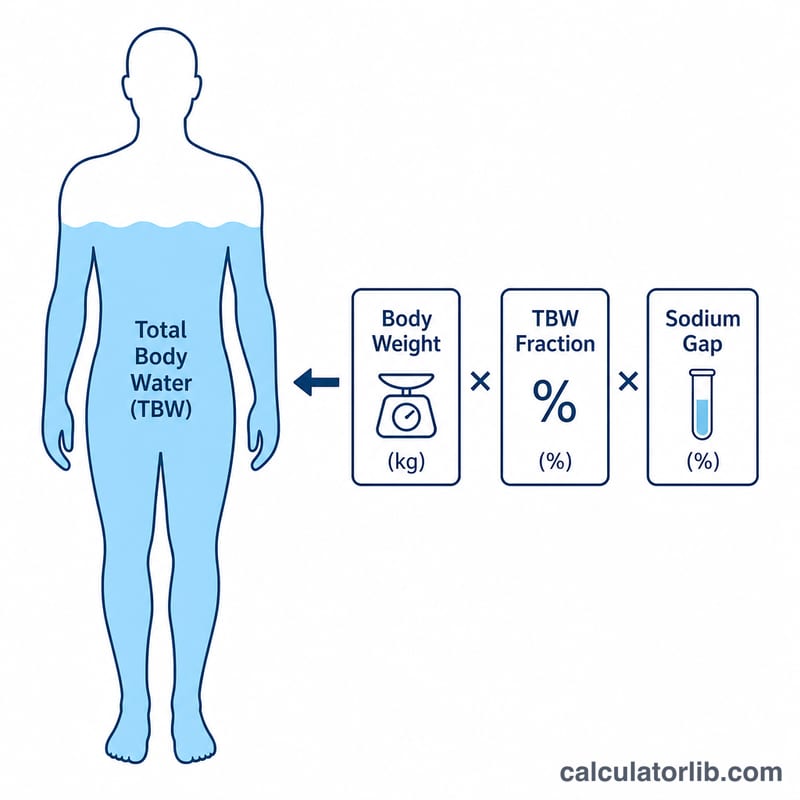
The relationship used is $$\text{Na deficit} = (\text{TBW factor} \times \text{weight}) \times (\text{target Na} - \text{actual Na})$$. The first part, \(\text{TBW factor} \times \text{weight}\), estimates total body water in litres. Multiplying litres by a concentration difference in mEq/L gives the total milliequivalents of sodium required to shift the serum concentration to the target.
Advertisement
Diagram showing total body water and the three multiplied factors of the sodium deficit formula
The sodium deficit combines total body water with the gap between target and actual serum sodium.

Worked Example

A 70 kg adult male (TBW factor 0.6) has an actual serum sodium of 120 mEq/L and a target of 140 mEq/L. Total body water = \(0.6 \times 70 = 42\) L. Sodium gap = \(140 - 120 = 20\) mEq/L. Deficit = \(42 \times 20 =\) 840 mEq of sodium.
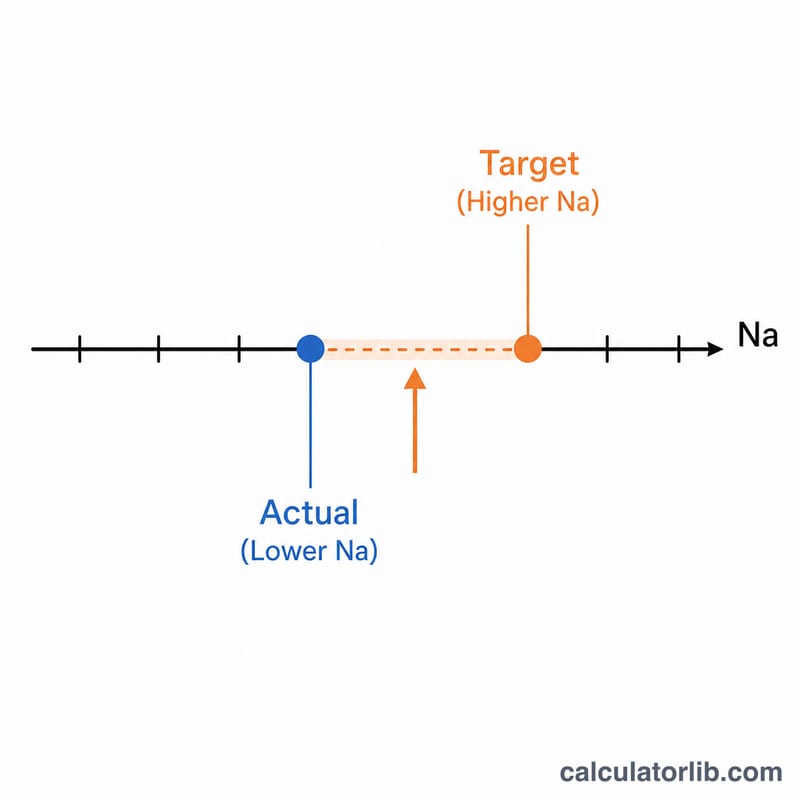
Number line comparing actual and target serum sodium with the gap between them highlighted
The deficit depends on the difference between target and actual serum sodium.

FAQ

Does this tell me the infusion rate? No. It estimates total deficit only. Correction must respect safe rates (commonly \(\leq\) 8–10 mEq/L in 24 hours) to avoid osmotic demyelination.

Which TBW factor should I choose? Use 0.6 for most males/children, 0.5 for females and elderly males, and 0.45 for elderly females, reflecting lower body-water fraction with age and sex.

Can the result be negative? Yes — if the target is below the actual sodium, the deficit becomes negative, indicating a surplus relative to your target.


Sources & References

  • Hyponatremia - MSD Manual Professional Edition — MSD Manual Professional Edition (Merck & Co.), Endocrine and Metabolic Disorders. Na deficit = TBW x (desired - measured Na); TBW 0.6 x kg adult males, 0.5 x kg adult females; example 70 kg male 106 to 112 mEq/L. · Verified 2026-11-07
  • Hyponatremia - MSD Manual Professional Edition — MSD Manual Professional Edition (Merck & Co.), Endocrine and Metabolic Disorders. Serum Na should not be raised by more than 8 mEq/L over the first 24 hours (osmotic demyelination risk). · Verified 2026-11-07
  • The diagnosis and management of inpatient hyponatraemia and SIADH — Grant P et al., Eur J Clin Invest 2015, doi:10.1111/eci.12465, PMID 25995119. Consensus: safe limit is a rise of no more than 10 mmol/L in the first 24 h and 8 mmol/L in the next 24 h. · Verified 2026-11-07

Checked against these sources on . Not reviewed by a clinician. For general information only, not medical advice or a diagnosis. Talk to a doctor about any health concern.

Last updated:

Most popular in Health and Fitness

View all Health and Fitness calculators