

What Is Winters' Formula?
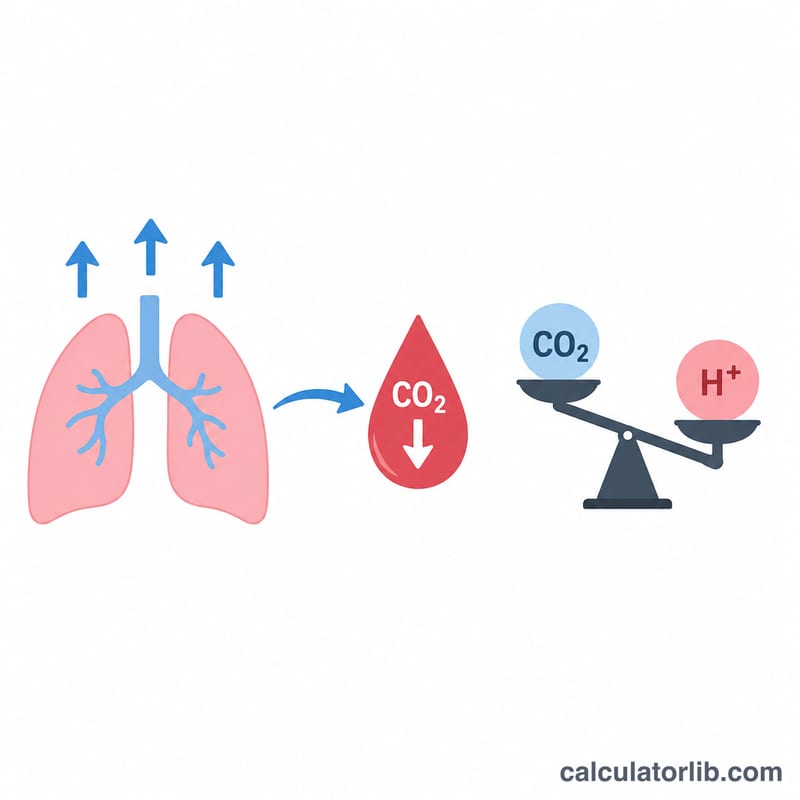
Winters' formula estimates the expected partial pressure of carbon dioxide (PaCO₂) in a patient with metabolic acidosis. The respiratory system compensates for a falling bicarbonate by hyperventilating and blowing off CO₂. This calculator predicts what the PaCO₂ should be if that compensation is appropriate, helping clinicians decide whether a mixed acid–base disorder is also present.
How to Use It
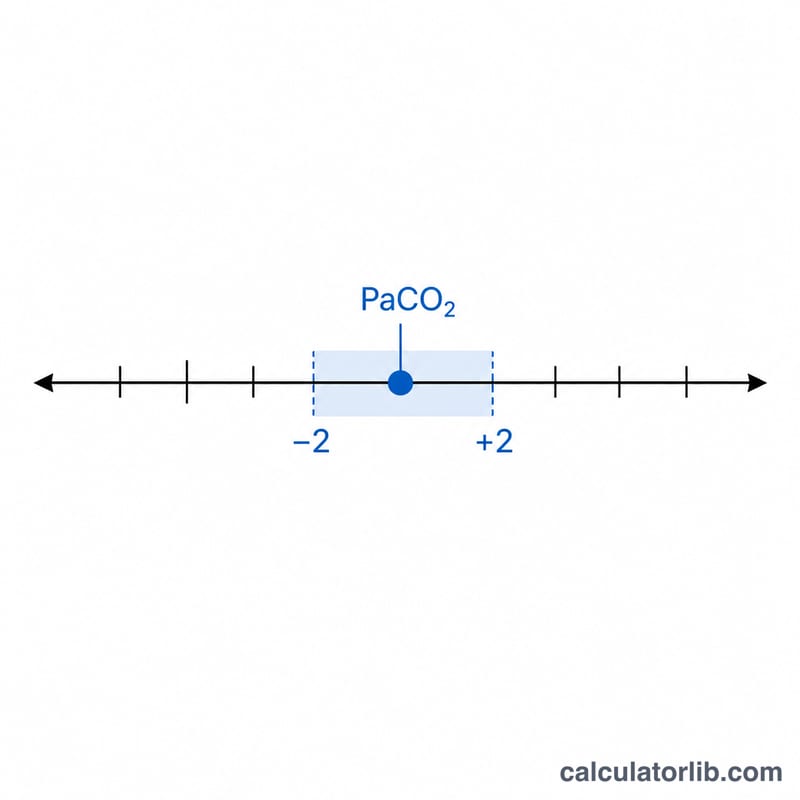
Enter the patient's measured serum bicarbonate (HCO₃⁻) in mEq/L, typically taken from a basic metabolic panel or arterial blood gas. The calculator returns the expected PaCO₂ along with an acceptable range of ±2 mmHg. Compare this predicted value to the patient's actual measured PaCO₂.
The Formula Explained
The equation is: $$\text{Expected PaCO}_2 = (1.5 \times \text{HCO}_3^-) + 8 \pm 2$$. If the measured PaCO₂ falls within the calculated range, respiratory compensation is appropriate (a simple metabolic acidosis). A measured PaCO₂ higher than expected suggests a concurrent respiratory acidosis; a value lower than expected suggests a concurrent respiratory alkalosis.
Worked Example
For a patient with HCO₃⁻ of 12 mEq/L: $$\text{Expected PaCO}_2 = (1.5 \times 12) + 8 = 18 + 8 = 26 \text{ mmHg}$$ with an acceptable range of 24–28 mmHg. If the measured PaCO₂ were 40 mmHg, that would indicate an inadequate respiratory response and a coexisting respiratory acidosis.
FAQ
When is Winters' formula used? Only in metabolic acidosis to verify the adequacy of respiratory compensation.
What units should I use? HCO₃⁻ in mEq/L (equivalent to mmol/L) and PaCO₂ in mmHg.
Is this a substitute for clinical judgment? No. It is a screening aid and should be interpreted alongside the full clinical picture and other lab values.