
What is the Baby Formula Calculator?
This calculator gives a quick estimate of how much infant formula a healthy, full-term baby may need each day and at each feed. It uses a widely cited rule of thumb of roughly 150 mL of formula per kilogram of body weight per day, then splits that total across the number of feeds you give. It is a starting point for planning, not medical advice — always follow guidance from your pediatrician and the instructions on your formula tin.
How to use it
Enter your baby's current weight in kilograms and the number of feeds you offer in a 24-hour period (newborns often feed 8–12 times, older babies fewer). The calculator shows the total daily volume and the suggested amount per feed. Round to convenient measuring increments and let your baby's appetite be the final guide — feed on demand and never force the full amount.
The formula explained
The total daily requirement is weight (kg) × 150 mL. The per-feed amount is simply that total divided by the number of feeds per day. For example, a baby that needs 600 mL across 8 feeds gets about 75 mL each time.
$$\text{Per Feed (mL)} = \frac{150 \times \text{Weight (kg)}}{\text{Feeds per Day}}$$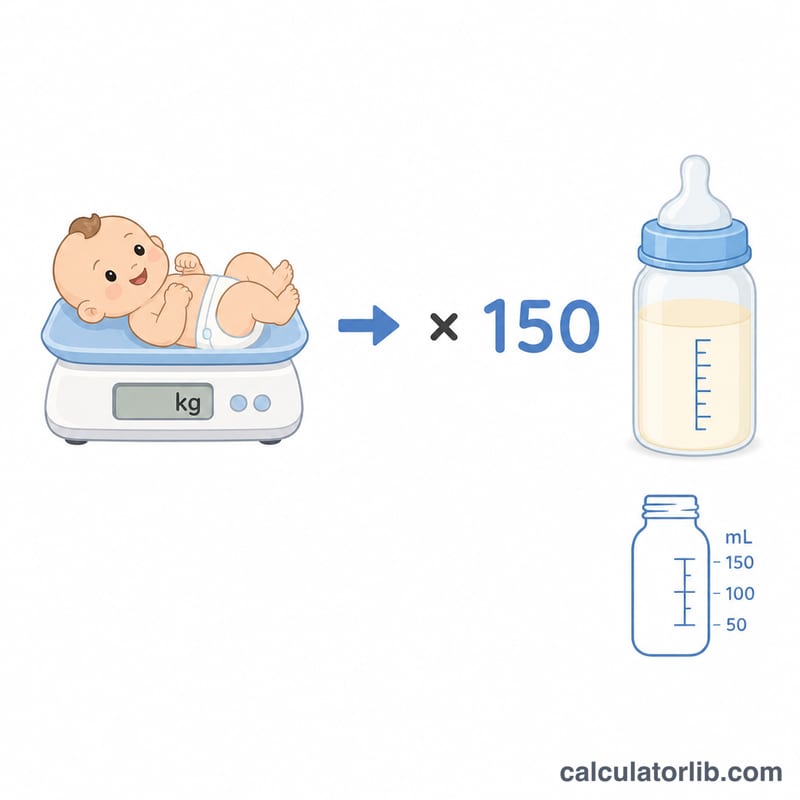
Worked example
A 4 kg baby fed 8 times a day: daily volume = 600 mL. Per feed = 75 mL per feed.
$$\text{Daily} = 4 \times 150 = 600 \text{ mL}$$$$\text{Per Feed} = \frac{600}{8} = 75 \text{ mL}$$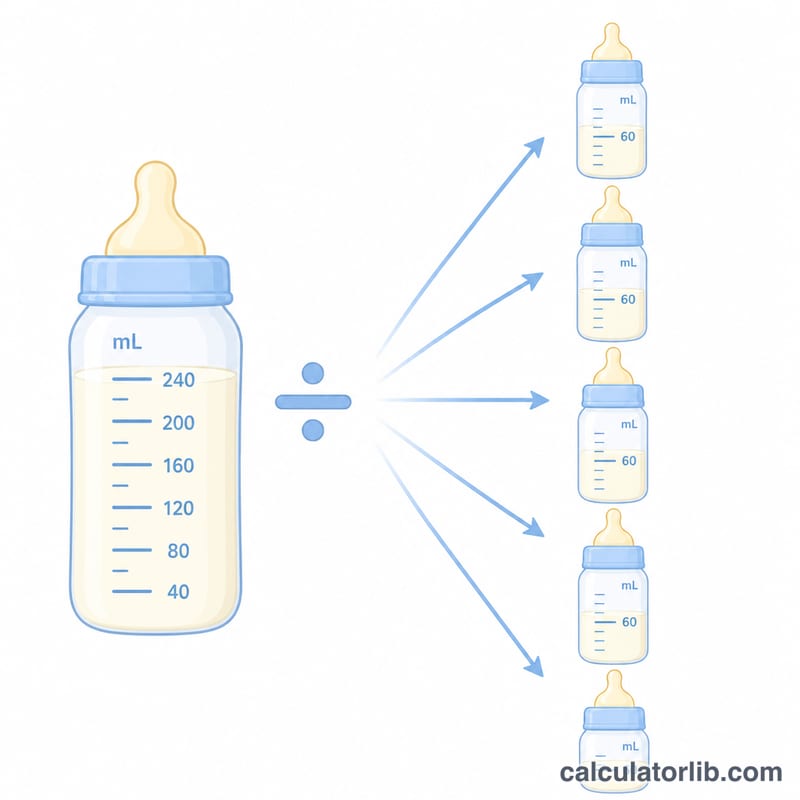
Interpreting Your Result
The 150 mL/kg/day figure is a starting guideline, not a strict target. Many healthy infants take anywhere from roughly 120 to 200 mL/kg/day, and the right amount for any given baby shifts with age, growth phase, and appetite. Younger newborns and babies in a growth spurt may want more frequent or larger feeds, while older babies who are sleeping longer stretches may take fewer, bigger bottles.
There is also a practical ceiling: for most babies under about 6 months, total formula intake is commonly capped around 960 mL (about 32 fl oz) per day, because beyond that point babies generally need additional calories and nutrients from other sources rather than ever-larger formula volumes.
Most importantly, your baby's hunger and fullness cues override the calculated number. Signs of hunger (rooting, hand-to-mouth, fussing) and fullness (turning away, slowing down, releasing the bottle) are more reliable than any formula. A baby who is steadily gaining weight, producing regular wet and dirty diapers, and is content between feeds is almost always getting enough.
This is general information for planning and education only, not medical advice. For questions about your baby's intake, growth, or any feeding concerns, consult your pediatrician or a qualified health professional.
Typical Feeding Ranges by Age
The amount per feed and the number of feeds per day change quickly during the first months. The ranges below reflect common pediatric guidance for formula-fed, full-term infants; individual babies vary widely.
| Age | Feeds per 24 hours | Typical per-feed volume |
|---|---|---|
| Newborn (0–4 weeks) | 8–12 | 30–90 mL (1–3 oz) |
| 1–2 months | 7–9 | 90–120 mL (3–4 oz) |
| 2–4 months | 5–7 | 120–180 mL (4–6 oz) |
| 4–6 months | 4–6 | 180–240 mL (6–8 oz) |
In the first days of life, volumes start very small (often just 15–30 mL per feed) and increase rapidly as the baby's stomach grows. As babies get older they typically take larger amounts at each feed but feed less often. Around 6 months, when solid foods are introduced, total formula intake usually begins to level off or decline. Use these bands together with your baby's weight-based estimate and their feeding cues, and discuss any concerns with your pediatrician.
FAQ
Is 150 mL/kg always right? No — it is a general guideline. Premature babies, those with reflux, or rapidly growing infants may need different amounts. Ask your healthcare provider.
What if my baby doesn't finish a bottle? That's normal. Babies self-regulate; offer more if still hungry, and don't push leftovers.
Does this replace breastfeeding advice? No. This tool is for formula feeding estimates only. For combination or breastfeeding, talk to a lactation consultant or doctor.