
What is the Baby's Milk Intake Calculator?
This calculator estimates how much milk or formula a baby needs each day based on body weight. The widely used guideline is roughly 150 mL of milk per kilogram of body weight per day, with a healthy range of about 100–200 mL/kg/day. It also splits the total across the number of feeds so you can see a rough amount per bottle.
This tool is a general guide for full-term, healthy infants. Always follow the advice of your pediatrician or health visitor, as needs vary with age, growth, and individual circumstances.
How to use it
Enter your baby's weight in kilograms, the mL-per-kg figure you want to use (150 is the standard average), and how many feeds you give per day. The calculator returns the estimated total daily intake, the amount per feed, and the typical low–high range.
The formula explained
The core formula is
$$\text{Daily Milk (mL)} = \text{weight (kg)} \times 150$$The low end of the typical range uses \(\times 100\) and the high end uses \(\times 200\). Per feed is simply the daily total divided by the number of feeds.
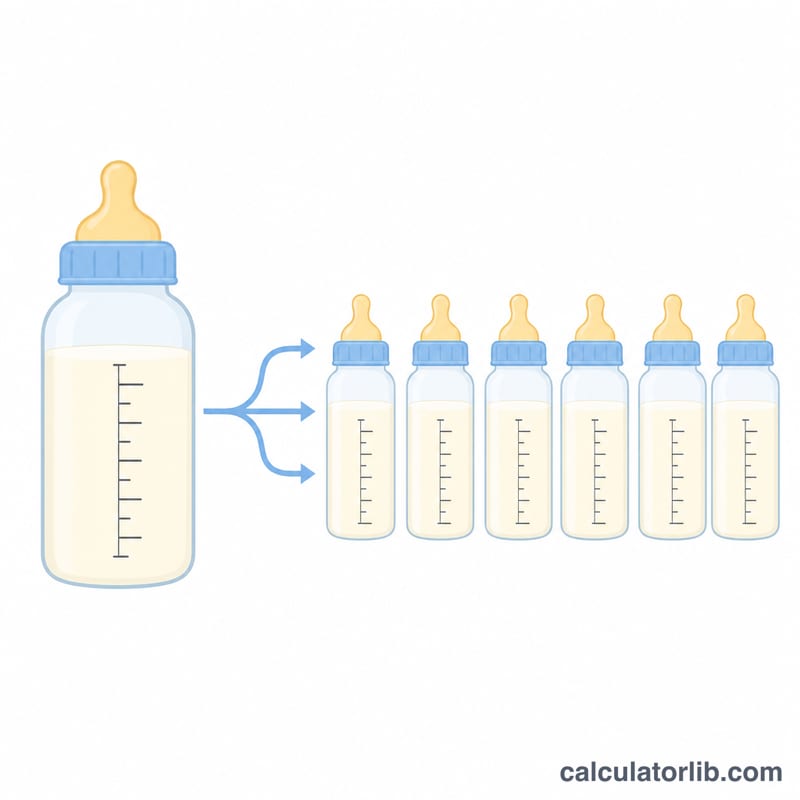
$$\text{Per Feed} = \frac{\text{Weight (kg)} \times \text{mL per kg}}{\text{Feeds per day}}$$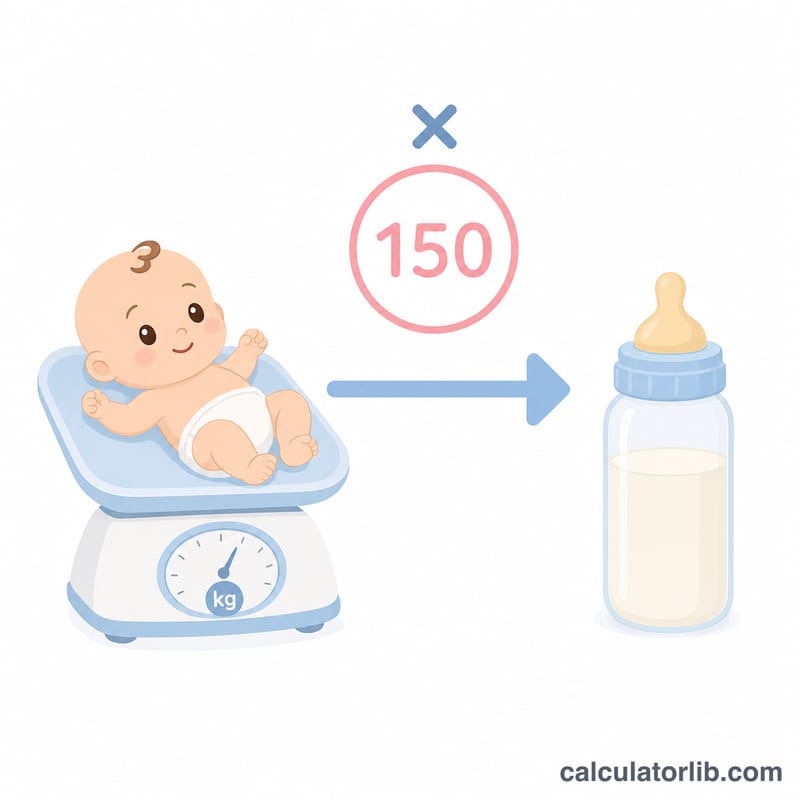
Worked example
For a baby weighing 4 kg fed 8 times a day at 150 mL/kg: daily milk =
$$4 \times 150 = 600 \text{ mL/day}$$Per feed =
$$600 \div 8 = 75 \text{ mL}$$The typical range is \(4 \times 100 = 400\) mL to \(4 \times 200 = 800\) mL per day.
Interpreting Your Result
The number this calculator returns is an estimate of average daily intake for a full-term, healthy infant, based on the standard pediatric guideline of about 100–200 mL of milk per kilogram of body weight per day (roughly 150 mL/kg/day on average, often quoted as around 2.5 oz per pound). It is a planning reference, not a precise prescription.
The wide 100–200 mL/kg range exists because normal, healthy babies vary considerably in how much they need. A baby near the lower end of the range and a baby near the upper end can both be growing perfectly well. Day-to-day and feed-to-feed variation is also normal — appetite changes with growth spurts, illness, and sleep.
Needs shift with age and growth. In the first weeks intake per kilogram is often higher and feeds are smaller and more frequent; as a baby grows the volume per feed rises while the milliliters per kilogram gradually decline. From around 6 months, as complementary solid foods are introduced, milk continues to be important but covers a smaller share of total energy needs.
Breastfed babies self-regulate their intake at the breast and cannot be measured by these volume formulas in the same way. For exclusively breastfed infants, the best guides are wet and dirty diaper counts, contentment after feeds, and steady weight gain plotted on a growth chart rather than a target number of milliliters.
The most reliable sign that intake is adequate is healthy growth tracked over time. If you want to check how your baby's weight compares for their age, a weight-for-age percentile tool can put the figure in context, and a weight converter helps if your records are in pounds and ounces while this calculator uses kilograms.
This is general information, not professional medical advice. Always follow the feeding guidance of your pediatrician or health visitor, and seek medical advice promptly if your baby is feeding poorly, not producing enough wet diapers, unusually sleepy, or not gaining weight as expected.
FAQ
Is this accurate for newborns? Newborns in the first days drink much less as the stomach is tiny; intake ramps up over the first week. Use this as a guide after the early days and check with your provider.
Does breastfeeding follow the same numbers? Breastfed babies self-regulate, so these figures mainly apply to bottle/formula feeding for planning purposes.
What if my baby drinks less or more? Some variation is normal. Persistent very low intake, poor weight gain, or other concerns should be discussed with a healthcare professional.