
What this calculator does
The Riemann zeta function graph calculator evaluates the real-argument Riemann zeta function, \(\zeta(x)\), over a range of x values. For each point it reports both \(\zeta(x)\) and the shifted value \(\zeta(x) - 1\), which is handy because \(\zeta(x)\) approaches 1 for large positive x, so \(\zeta(x) - 1\) shows the decaying tail more clearly. The output is a table that doubles as the data for a graph.
How to use it
Enter three numbers: the initial value of x, the increment (step) added at each iteration, and the number of iterations (points). The calculator generates $$x_k = \text{startX} + k \cdot \text{stepX}, \quad k = 0, 1, \dots, \text{iterations} - 1$$ and computes zeta at each. For example, startX = -14, step = 0.1, and 131 iterations sweep x from -14 up to -1.
The formula explained
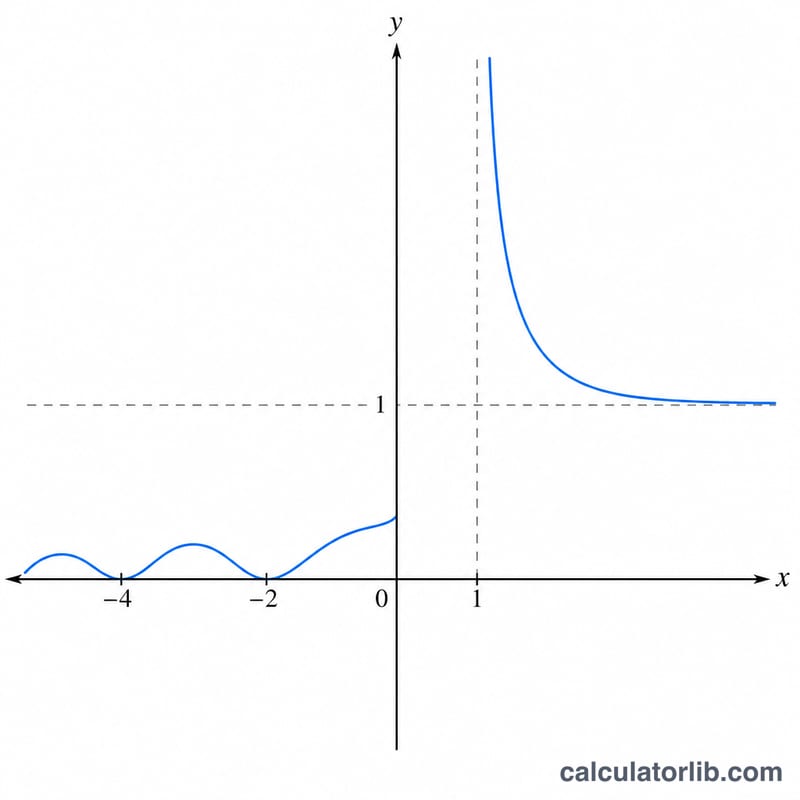
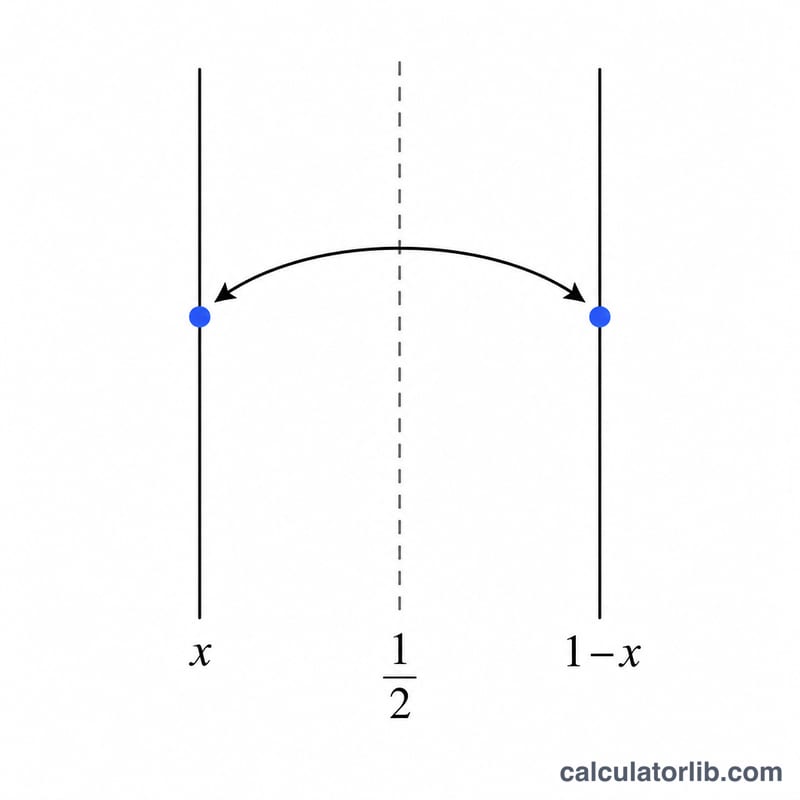
For x > 1 the function is the convergent Dirichlet series $$\zeta(x) = \sum_{n=1}^{\infty} \frac{1}{n^{x}};$$ this calculator accelerates it with an Euler-Maclaurin tail correction so only about 20 terms are needed. For x at or below 1 it uses the functional equation $$\zeta(x) = 2^{x}\,\pi^{x-1}\,\sin\!\left(\frac{\pi x}{2}\right)\Gamma(1-x)\,\zeta(1-x),$$ where the gamma function is evaluated with the Lanczos approximation. Special cases: x = 1 is a simple pole (infinity), and negative even integers (-2, -4, -6, ...) are trivial zeros.
Worked example
With startX = 2, step = 1, iterations = 4 the points are x = 2, 3, 4, 5. The results are $$\zeta(2) = \frac{\pi^2}{6} = 1.6449340668,$$ $$\zeta(3) = 1.2020569032,$$ $$\zeta(4) = \frac{\pi^4}{90} = 1.0823232337,$$ and $$\zeta(5) = 1.0369277551.$$ The matching \(\zeta(x) - 1\) column starts at 0.6449340668 and shrinks toward 0.
FAQ
What is zeta(0)? The analytic continuation gives \(\zeta(0) = -\frac{1}{2}\), so \(\zeta(0) - 1 = -\frac{3}{2}\).
What is zeta(-1)? \(\zeta(-1) = -\frac{1}{12}\), the famous regularized value linked to 1 + 2 + 3 + ...
Why does the graph dip to exactly zero at -2, -4, -6? These are the trivial zeros of the zeta function, where \(\sin(\pi x/2)\) vanishes in the functional equation.