
What is the Gamma Function Calculator?
The Gamma function, written as \(\Gamma(a)\), is one of the most important special functions in mathematics. It is the analytic continuation of the factorial: for any non-negative integer \(n\), \(\Gamma(n+1) = n!\). Unlike the factorial, Gamma is defined for almost every real (and complex) number, including fractions and negatives. This calculator builds a table of \(\Gamma(a)\) over a sequence of equally spaced arguments and plots the resulting curve. It is universal mathematics, applicable everywhere with no country-specific rules.
How to Use It
Enter three values: the initial value of a (the first argument), the step (the constant increment added each row), and the number of rows. Row \(k\) uses argument $$a_k = \text{initialA} + k \cdot \text{step}.$$ The tool evaluates Gamma at each argument, lists the pairs in a table, and shows the minimum and maximum finite values. Poles at \(a = 0, -1, -2, \dots\) are reported as undefined.
The Formula Explained
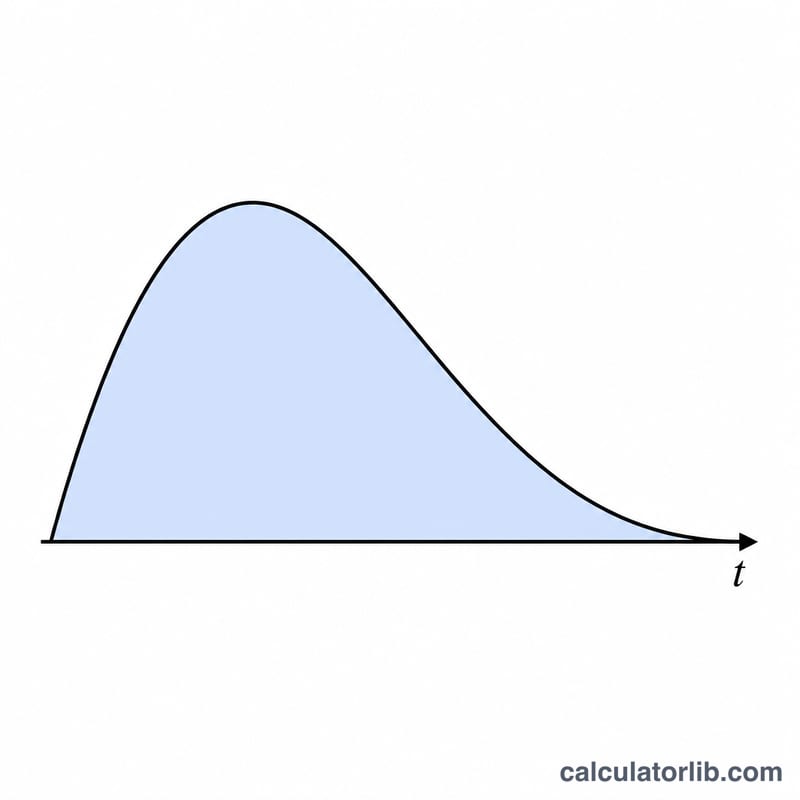
The defining integral is $$\Gamma(a) = \int_{0}^{\infty} t^{\,a-1}\, e^{-t}\, dt$$ for \(\operatorname{Re}(a) > 0\). Numerically we use the Lanczos approximation, which gives roughly 15-digit accuracy. For \(a \le 0.5\) the reflection formula $$\Gamma(a) = \frac{\pi}{\sin(\pi a) \cdot \Gamma(1-a)}$$ handles negatives and small arguments and avoids divergence. Key special values: \(\Gamma(1/2) = \sqrt{\pi} = 1.77245\), \(\Gamma(1) = 1\), \(\Gamma(n+1) = n!\).
Worked Example
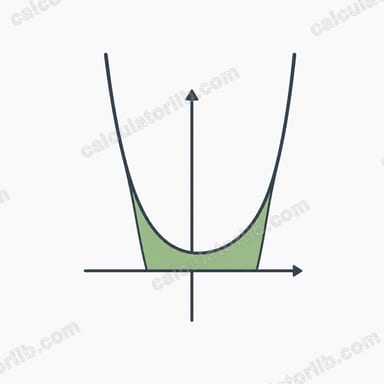
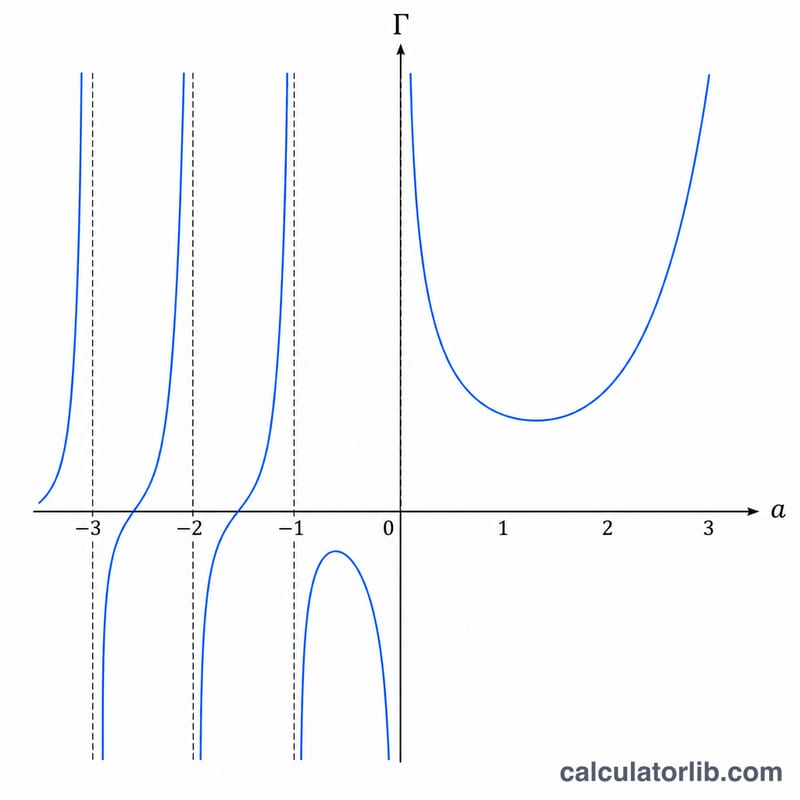
With initialA = 0.5, step = 0.5, count = 5 the arguments are 0.5, 1.0, 1.5, 2.0, 2.5. The results are \(\Gamma(0.5) = 1.77245\) (\(= \sqrt{\pi}\)), \(\Gamma(1.0) = 1.0\), \(\Gamma(1.5) = 0.88623\), \(\Gamma(2.0) = 1.0\), and \(\Gamma(2.5) = 1.32934\). The curve dips to its minimum (about 0.8856 near \(a = 1.4616\)) for positive \(a\), then rises again.
FAQ
Why is Gamma(0) undefined? The non-positive integers \((0, -1, -2, \dots)\) are simple poles where Gamma diverges to plus or minus infinity, so no finite value exists there.
Can a be negative? Yes. Negative non-integers are valid; values alternate sign and grow large in magnitude between consecutive negative integers, e.g. \(\Gamma(-0.5) = -3.5449\).
How accurate is the result? The Lanczos approximation yields about 15 significant digits, sufficient for virtually all practical and educational use.