
What this calculator does
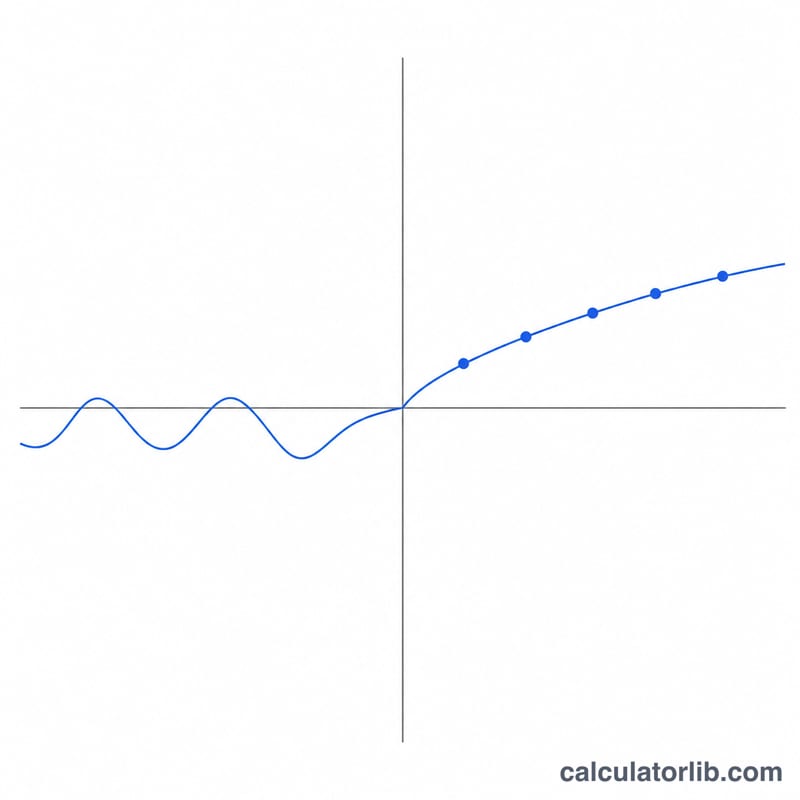
This tool computes the Fibonacci function \(F(\nu)\): the extension of the familiar Fibonacci numbers from integer indices to any real number \(\nu\). It uses the closed-form (Binet-style) real extension and builds a table of (index \(\nu\), value \(F(\nu)\)) pairs over a range you choose. This is pure mathematics, so it applies identically everywhere.
The formula
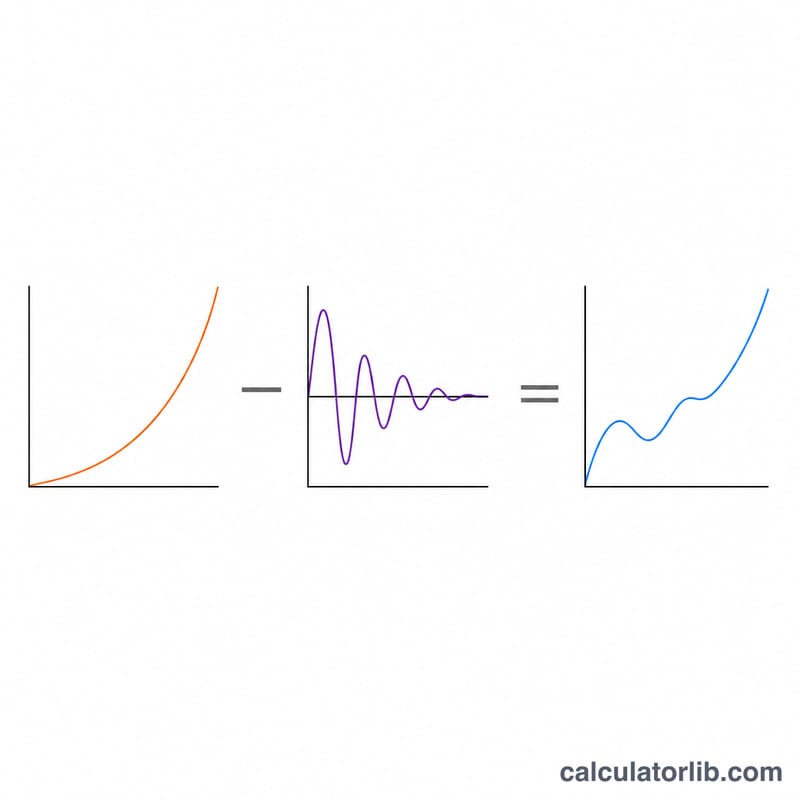
Let \(\varphi = \frac{1+\sqrt5}{2}\) be the golden ratio (about 1.6180339887) and note \(\frac{1}{\varphi} = \frac{\sqrt5 - 1}{2}\). The real Fibonacci function is:
$$F(\nu) = \frac{1}{\sqrt5}\left[\varphi^{\nu} - \left(\frac{1}{\varphi}\right)^{\nu}\cos(\nu\pi)\right]$$
For the discrete Binet formula \(F(n) = \frac{\varphi^n - \psi^n}{\sqrt5}\) with \(\psi = \frac{1-\sqrt5}{2} = -\frac{1}{\varphi}\), the term \(\psi^{\nu}\) is multi-valued for real \(\nu\). Taking the real branch gives \(\psi^{\nu} = \left(\frac{1}{\varphi}\right)^{\nu}\cos(\nu\pi)\), which reproduces the integer Binet formula exactly because \(\cos(n\pi) = (-1)^n\).
How to use it
Enter the Initial value of index \(\nu\) (the first row's \(\nu\)), the Increment (how much \(\nu\) changes per row, which may be negative), and the Number of repetitions (how many rows). The calculator lists \(F(\nu)\) for each \(\nu_k = \text{startIndex} + k\cdot\text{stepSize}\) and highlights the first and last values.
Worked example
At \(\nu = 10\): \(\varphi^{10} \approx 122.9919\) and \(\left(\frac{1}{\varphi}\right)^{10} \approx 0.00813\), with \(\cos(10\pi) = 1\). So $$F(10) = \frac{122.9919 - 0.00813}{\sqrt5} = 55,$$ matching the tenth Fibonacci number. At \(\nu = 0.5\), \(\cos(0.5\pi) = 0\), so $$F(0.5) = \frac{\varphi^{0.5}}{\sqrt5} \approx 0.568864.$$
FAQ
Does it return the usual Fibonacci numbers? Yes — at every integer index it reduces to the standard Binet formula, including negative-index "negafibonacci" values.
Why use \(\cos(\nu\pi)\)? It is the real branch of \(\psi^{\nu}\) and supplies the alternating sign that makes integer indices exact.
Are other extensions possible? Yes; complex-valued and sine-based analytic continuations exist. This calculator uses the specific real-branch extension \(F(\nu) = \frac{\varphi^{\nu} - \left(\frac{1}{\varphi}\right)^{\nu}\cos(\nu\pi)}{\sqrt5}\).