
What is the Fibonacci Number Table Calculator?
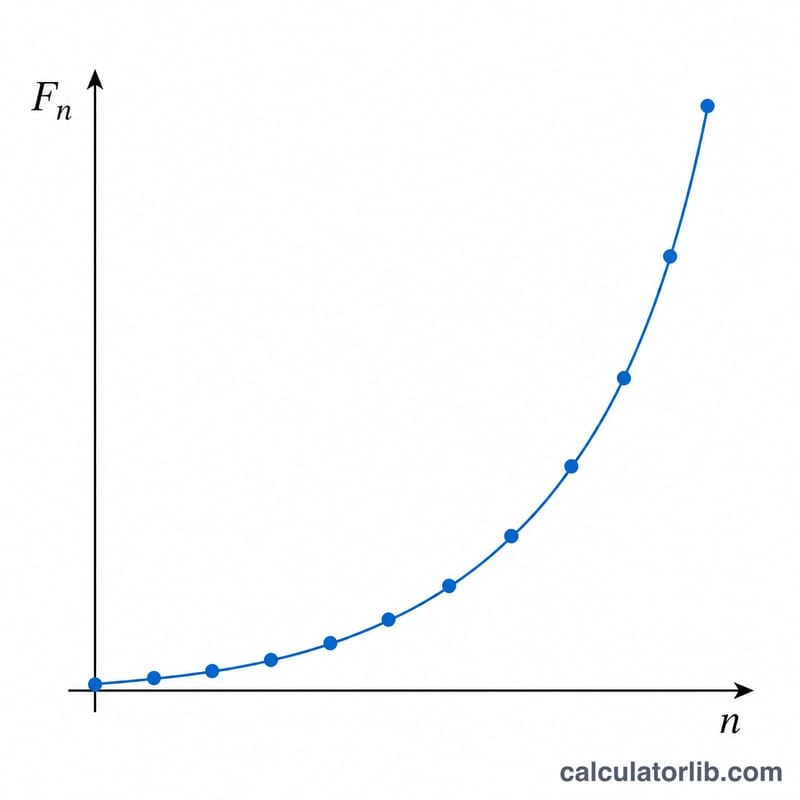
This tool builds a table of Fibonacci numbers Fn for a range of index values. You choose the first index n, how much n increases each row (the increment), and how many rows you want. The calculator then lists each n together with its Fibonacci value and plots how quickly the sequence grows. It is a pure mathematical tool, so it works identically everywhere with no regional assumptions.
How to use it
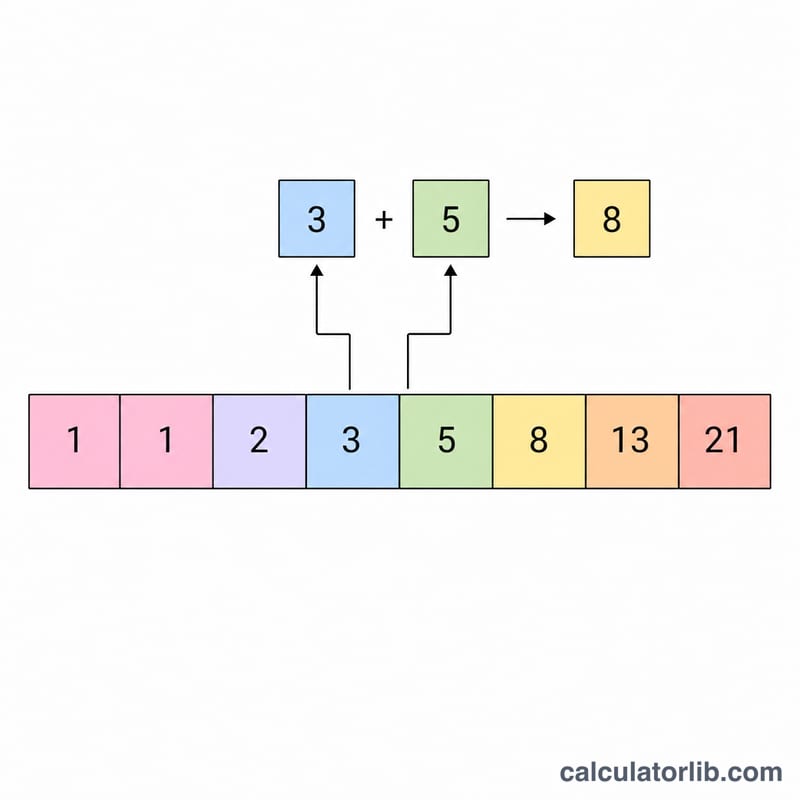
Enter the Initial value of index n (the first n shown), the Increment (how much n grows per row), and the Number of repetitions (how many rows). For example, start index 1, increment 1, and 13 rows produces the classic sequence 1, 1, 2, 3, 5, 8, ... up to \(F_{13} = 233\).
The formula explained
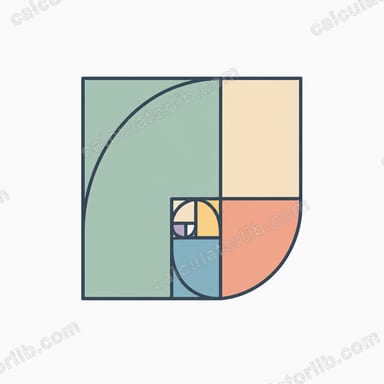
The Fibonacci sequence is defined by the recurrence \(F_1 = 1\), \(F_2 = 1\), and \(F_n = F_{n-1} + F_{n-2}\) for \(n \ge 3\). There is also Binet's closed form,
$$F_n = \frac{(1+\sqrt{5})^n - (1-\sqrt{5})^n}{2^n \cdot \sqrt{5}},$$which gives the same integers but can suffer floating-point error for large n. This calculator uses exact integer recurrence. For \(n \le 0\) it uses the generalized (negafibonacci) rule \(F_{-n} = (-1)^{n+1} F_n\), so \(F_0 = 0\), \(F_{-1} = 1\), \(F_{-2} = -1\).
Worked example
With start index 5, increment 2, and 4 rows, the n values are 5, 7, 9, 11. Their Fibonacci values are 5, 13, 34 and 89. So the last value in the table is \(F_{11} = 89\).
FAQ
Can the increment be more than 1? Yes. An increment of 2 evaluates every second index, an increment of 3 every third, and so on.
Are negative indices supported? Yes, via the negafibonacci extension. A start index of 0 gives \(F_0 = 0\).
How large can n be? Values are computed with 64-bit integers and stay exact up to roughly \(F_{90}\); beyond that very large values may overflow.