
What is a Bernoulli number?
The Bernoulli numbers \(B_n\) are a famous sequence of rational numbers that show up across mathematics: in the closed-form sums of powers of integers, in the Euler-Maclaurin formula, in values of the Riemann zeta function, and in the Taylor series of trigonometric and hyperbolic functions. This calculator builds a full table of \(B_n\) over any index range you choose, printing each value as an exact reduced fraction (a numerator and a positive denominator) and as a decimal approximation.
Convention used
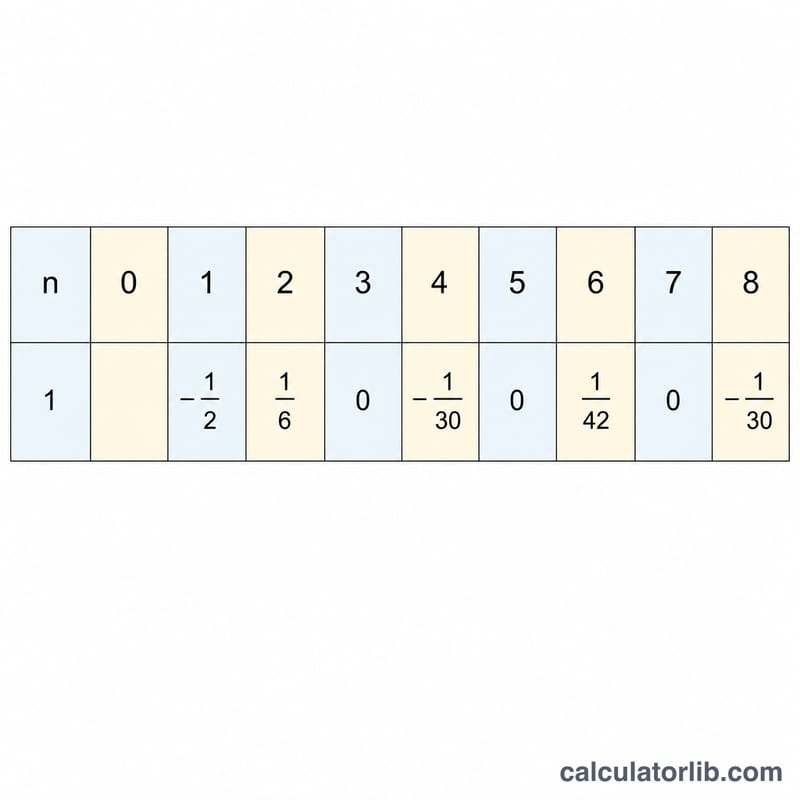
There are two common conventions that differ only at index 1. This tool uses the "first Bernoulli numbers" convention with \(B_1 = -1/2\), matching the generating function \(x/(e^x - 1)\). So \(B_0 = 1\), \(B_1 = -1/2\), \(B_2 = 1/6\), \(B_4 = -1/30\), and so on. Every odd-index value above 1 is exactly zero: \(B_3 = B_5 = B_7 = \dots = 0\).
How to use it
Enter the minimum ordinal \(n\) (at least 0) and the maximum ordinal \(n\) (up to 100). Pick the number of significant digits for the decimal column - this is purely a display setting and never changes the exact fraction. Press calculate to get one row per integer \(n\) in the range.
The formula explained
Each \(B_n\) is computed from the recurrence $$B_n = -\frac{1}{n+1}\sum_{k=0}^{n-1}\binom{n+1}{k}\,B_k,$$ starting from \(B_0 = 1\). All steps are performed in exact rational arithmetic with arbitrary-precision integers, so there is no floating-point overflow - ordinary spreadsheets typically fail near \(n = 18\), but this tool stays exact well beyond that.
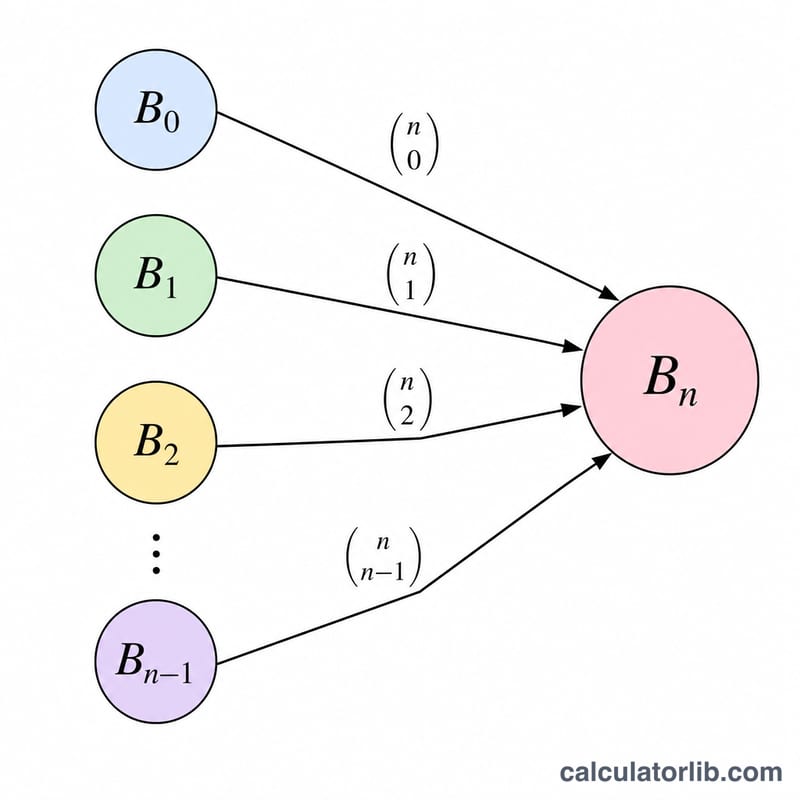
Worked example
For \(n = 2\) the recurrence gives $$\sum_{k=0}^{1} \binom{3}{k} B_k = 1\cdot 1 + 3\cdot\left(-\frac{1}{2}\right) = -\frac{1}{2},$$ so $$B_2 = -\frac{1}{3}\cdot\left(-\frac{1}{2}\right) = \frac{1}{6},$$ which equals \(0.1666\dots\) as a decimal. Likewise \(B_4 = -1/30\) and \(B_6 = 1/42\).
Key Terms & Symbols
- \(B_n\) (Bernoulli number)
- The \(n\)-th member of a sequence of rational numbers that appears throughout number theory and analysis. The first few values (using the \(B_1=-\tfrac12\) convention) are \(B_0=1,\ B_1=-\tfrac12,\ B_2=\tfrac16,\ B_3=0,\ B_4=-\tfrac1{30}\). All Bernoulli numbers with odd index \(n\ge 3\) are exactly \(0\).
- Generating function \(\dfrac{x}{e^x-1}\)
- The exponential generating function that defines the Bernoulli numbers through the power-series expansion $$\frac{x}{e^x-1}=\sum_{n=0}^{\infty} B_n\,\frac{x^n}{n!}.$$ The coefficient of \(x^n/n!\) in this series is precisely \(B_n\). This convention yields \(B_1=-\tfrac12\).
- Binomial coefficient \(\binom{n+1}{k}\)
- The number of ways to choose \(k\) items from \(n+1\), equal to \(\dfrac{(n+1)!}{k!\,(n+1-k)!}\). These coefficients are the weights applied to each earlier Bernoulli number inside the recurrence used to build the table.
- Recurrence relation
- A formula that expresses each \(B_n\) in terms of all the lower-index values \(B_0,\dots,B_{n-1}\): $$B_n=-\frac{1}{n+1}\sum_{k=0}^{n-1}\binom{n+1}{k}\,B_k.$$ Starting from \(B_0=1\), it generates the whole sequence one index at a time.
- Exact (reduced) fraction
- A representation of \(B_n\) as a ratio \(p/q\) of integers in lowest terms, where \(\gcd(p,q)=1\) — for example \(B_{12}=-\tfrac{691}{2730}\). Because every Bernoulli number is rational, an exact fraction loses no precision, unlike a rounded decimal.
- The two conventions
- Authors differ only in the sign of the single term \(B_1\). The modern convention used here sets \(B_1=-\tfrac12\) (matching the generating function \(x/(e^x-1)\)); an older convention sets \(B_1=+\tfrac12\) (matching \(x/(1-e^{-x})\)). All other \(B_n\) are identical in both conventions, so any table is unambiguous once the value of \(B_1\) is stated.
FAQ
Why is \(B_1\) negative one-half? Because we use the \(x/(e^x - 1)\) generating-function convention. The alternative "second" convention sets \(B_1 = +1/2\); everything else is identical.
Why are most odd terms zero? The function \(x/(e^x - 1) + x/2\) is even, which forces every Bernoulli number with odd index 3 or higher to vanish.
Does the precision setting affect accuracy? No. The fraction is always exact; the precision only rounds the displayed decimal.