
What is a Bernoulli number?
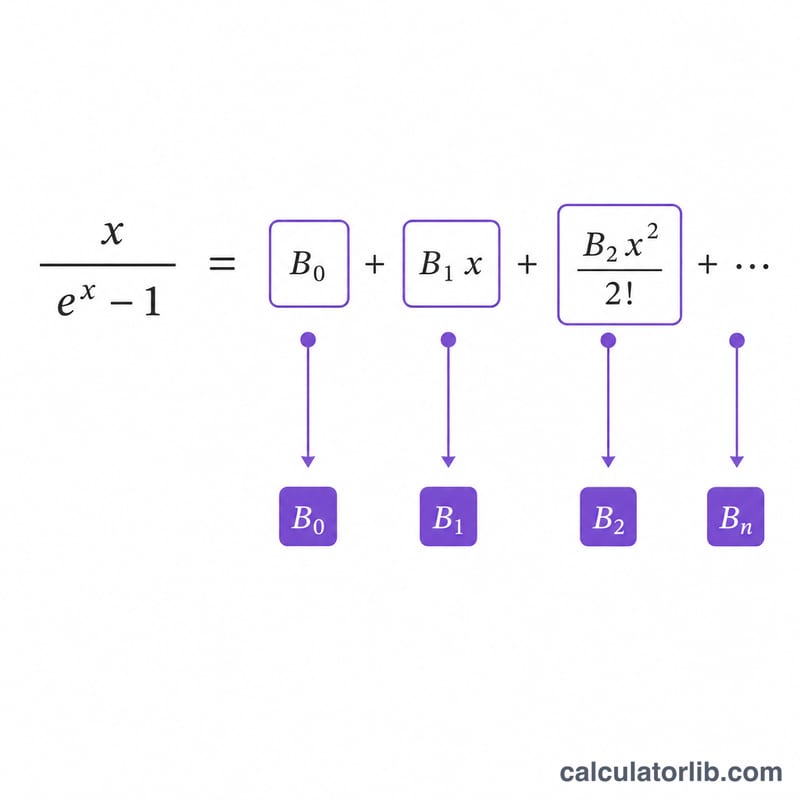
The Bernoulli numbers \(B_n\) are a sequence of rational numbers that appear throughout number theory and analysis. They are defined as the coefficients in the Maclaurin expansion of the generating function \(\frac{x}{e^x - 1}\). They show up in the closed-form sums of powers of integers, in the Euler-Maclaurin formula, in values of the Riemann zeta function at even integers, and in the Taylor series of the tangent and cotangent functions.
How to use this calculator
Enter a non-negative integer index \(n\) (0, 1, 2, 3, ...) and choose how many significant decimal digits you want displayed. The calculator returns the exact rational value as a fraction \(p/q\) (for example \(B_{12} = -\frac{691}{2730}\)) together with a rounded decimal. The significant-digit setting only affects the decimal display; the fraction is always exact.
Convention used
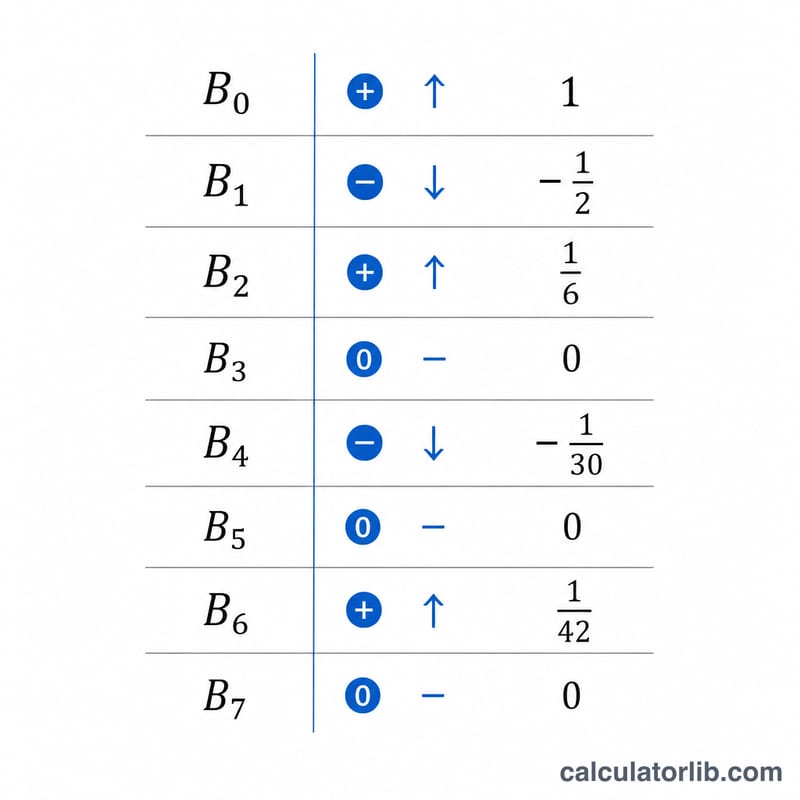
This tool uses the convention \(B_1 = -\frac{1}{2}\), which corresponds to the generating function \(\frac{x}{e^x - 1}\). The alternative "plus" convention sets \(B_1 = +\frac{1}{2}\) and uses \(\frac{x}{1 - e^{-x}}\); they differ only in the sign of \(B_1\). All other Bernoulli numbers are identical in both conventions, and every odd-index value beyond \(B_1\) is exactly zero.
The formula explained
To avoid floating-point rounding errors (for instance \(B_2\) coming out as 0.16666... so that \(6 \cdot B_2\) truncates to 0), this calculator uses exact rational arithmetic. It applies the recurrence $$B_{\text{n}} = -\frac{1}{\text{n}+1}\sum_{k=0}^{\text{n}-1}\binom{\text{n}+1}{k}\,B_{k}$$ $$\text{where}\quad B_{0}=1,\quad B_{m}=0\ \ (m\ \text{odd},\ m\ge 3)$$ where \(\binom{m+1}{k}\) is a binomial coefficient. Each \(B_k\) is kept as a reduced numerator/denominator pair, so the answer is mathematically exact before being converted to a decimal.
Worked example (n = 4)
Starting from \(B_0 = 1\), \(B_1 = -\frac{1}{2}\), \(B_2 = \frac{1}{6}\) and \(B_3 = 0\), the recurrence gives $$B_4 = -\frac{1}{30} \approx -0.0333333\ldots$$ You can verify this against the known table: \(B_6 = \frac{1}{42}\), \(B_8 = -\frac{1}{30}\), \(B_{10} = \frac{5}{66}\), \(B_{12} = -\frac{691}{2730}\).
FAQ
Why are odd Bernoulli numbers zero? Except for \(B_1\), every odd-index Bernoulli number \(B_{2n+1}\) equals 0 because of a symmetry in the generating function.
Why do large even-index values get so big? The magnitude grows rapidly; for example \(|B_{50}|\) is about \(7.5\times10^{24}\). Exact fractions handle these without overflow.
Is B₁ positive or negative here? Negative: this calculator returns \(B_1 = -\frac{1}{2}\).