
What is the double factorial?
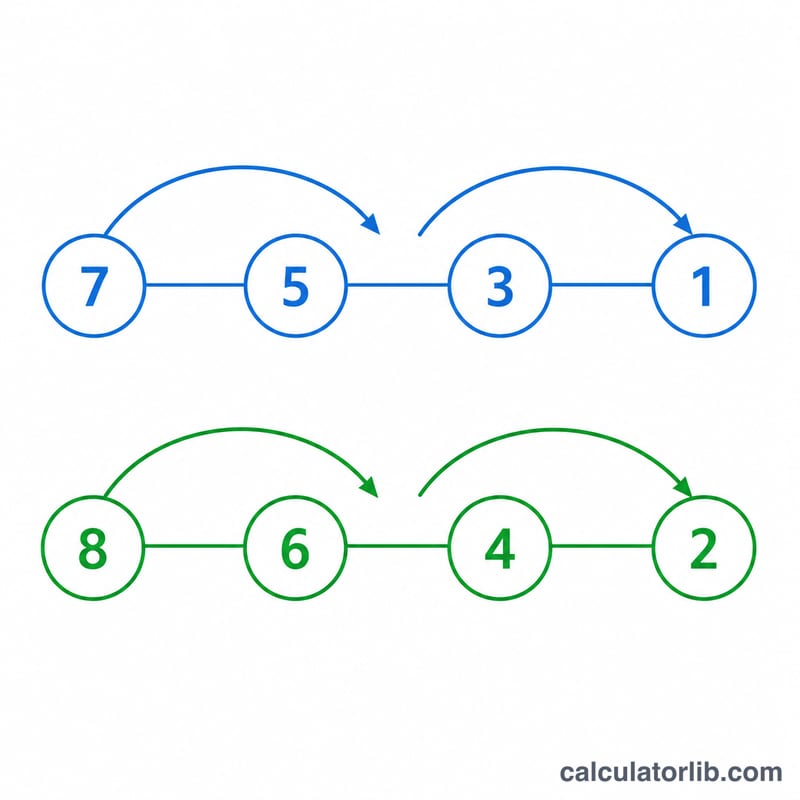
The double factorial of a number, written x!!, is the product of every other integer down to 1 or 2. For an odd number it multiplies the odd integers (for example \(5!! = 5\cdot 3\cdot 1 = 15\)), and for an even number it multiplies the even integers (\(6!! = 6\cdot 4\cdot 2 = 48\)). By convention \(0!! = 1\) and \((-1)!! = 1\). This calculator extends the definition to any real value of x using the gamma function, so you can also evaluate non-integer points such as 0.5!!.
How to use this calculator
Enter three numbers: the initial value of x (the first point in the sequence), the increment (added to x each row), and the number of repetitions (how many rows to generate). The tool builds the sequence $$x_i = \text{start} + i\cdot\text{step}, \quad i = 0, 1, \ldots, \text{count}-1$$ and lists each x alongside its double factorial. Use start = 1, step = 1 to get the classic 1!!, 2!!, 3!!… table, or a fractional step to explore the smooth analytic curve.
The formula explained
For integers we use the exact product loop to avoid rounding error. For general real x the tool applies the analytic continuation $$x!! = \left(\frac{2}{\pi}\right)^{\frac{1-\cos(\pi x)}{4}} 2^{\frac{x}{2}}\,\Gamma\!\left(\frac{x}{2}+1\right)$$ where \(\Gamma\) is the gamma function (computed with the Lanczos approximation). When x is an even integer \(\cos\pi x = 1\) so the \((2/\pi)\) factor vanishes; when x is odd \(\cos\pi x = -1\), producing the \((2/\pi)^{1/2}\) correction. Both branches agree with the integer rule.
Worked example
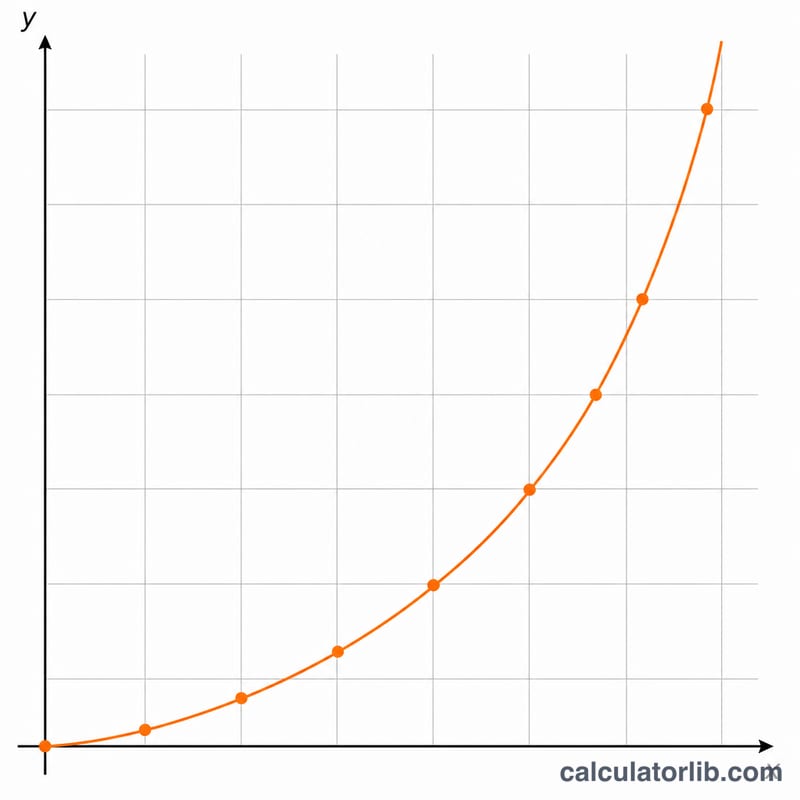
With start = 1, step = 1, count = 8 the rows are (1,1), (2,2), (3,3), (4,8), (5,15), (6,48), (7,105), (8,384). Checking x = 5 via the formula: \(\cos 5\pi = -1\), so the exponent is 0.5; $$(2/\pi)^{0.5} = 0.7979, \quad 2^{2.5} = 5.6569, \quad \Gamma(3.5) = 3.32335, \quad 0.7979\cdot 5.6569\cdot 3.32335 \approx 15$$
FAQ
Does x have to be a whole number? No — any real x works through the gamma-function continuation.
Why is a value blank or infinite? Negative even integers (-2, -4, …) hit poles of the gamma function and are undefined; the tool reports those as NaN/infinity.
How large can it get? Double factorials grow factorially fast and can overflow double precision for large x; keep the count modest for very large values.