
What is the Pochhammer symbol?
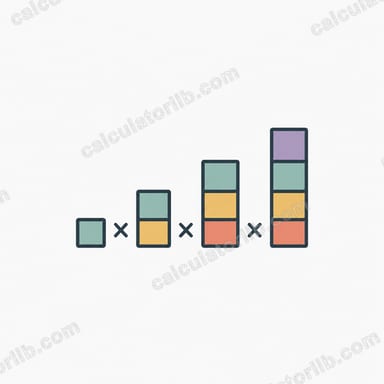
The Pochhammer symbol \((x)_n\), also called the rising factorial (and written \(x^{(n)}\) or x with an overline n), is the product of \(n\) successive integers starting at \(x\). It is fundamental in combinatorics, special functions and the theory of hypergeometric series. This calculator uses the rising convention; it is not the falling factorial.
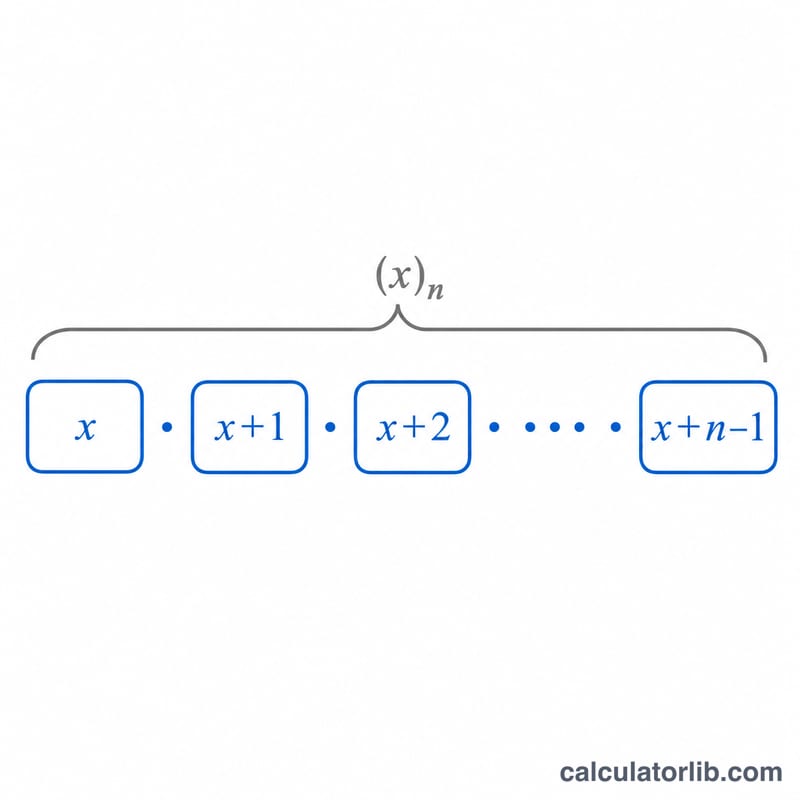
Formula
For an integer \(n \ge 1\), $$(x)_n = x(x+1)(x+2)\cdots(x+n-1),$$ a product of \(n\) terms. By the empty-product convention \((x)_0 = 1\), and \((x)_1 = x\). Equivalently $$(x)_n = \frac{\Gamma(x+n)}{\Gamma(x)}.$$ When \(x = 1\) the rising factorial reduces to the ordinary factorial: \((1)_n = n!\).
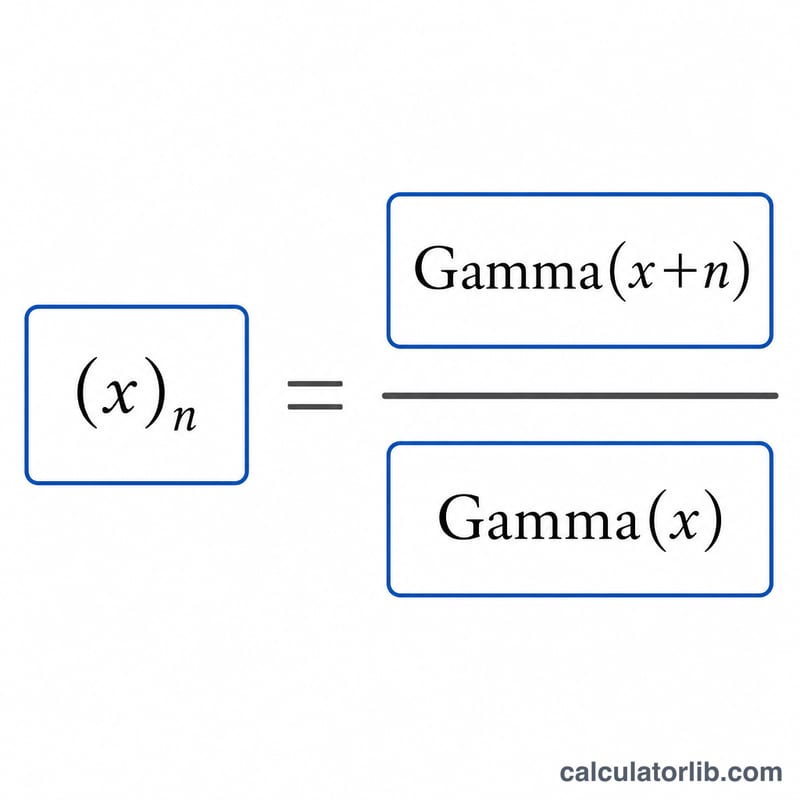
How to use the table calculator
Enter the fixed base \(x\), the first value of \(n\), the step (increment) by which \(n\) grows from row to row, and how many rows you want. The tool evaluates \(n = \text{initialN} + k\cdot\text{stepN}\) for \(k = 0, 1, \dots, \text{rowCount}-1\) and lists each \(n\) alongside its rising factorial value. A negative step produces a descending sequence of \(n\); negative \(n\) is handled through the reciprocal extension.
Worked example
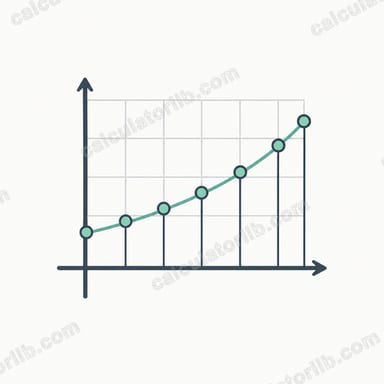
With \(x = 5\), initial \(n = 1\), step 1 and 8 rows you obtain \((5)_1 = 5\), \((5)_2 = 30\), \((5)_3 = 210\), \((5)_4 = 1680\), \((5)_5 = 15120\), \((5)_6 = 151200\), \((5)_7 = 1663200\) and \((5)_8 = 19958400\). The values grow factorially, so a plot rises very steeply.
FAQ
Why is \((x)_0\) always 1? Because it is an empty product, which equals 1 by definition, no matter what \(x\) is.
What happens for non-positive integer \(x\)? The product simply passes through zero. For example \((-3)_5 = (-3)(-2)(-1)(0)(1) = 0\) — that is the correct value, not an error.
Can the values overflow? Yes. Rising factorials grow extremely fast, so for large \(n\) the double-precision result may become very large or infinite. Keep \(n\) moderate for exact figures.