
What is the Error Function Table Calculator?
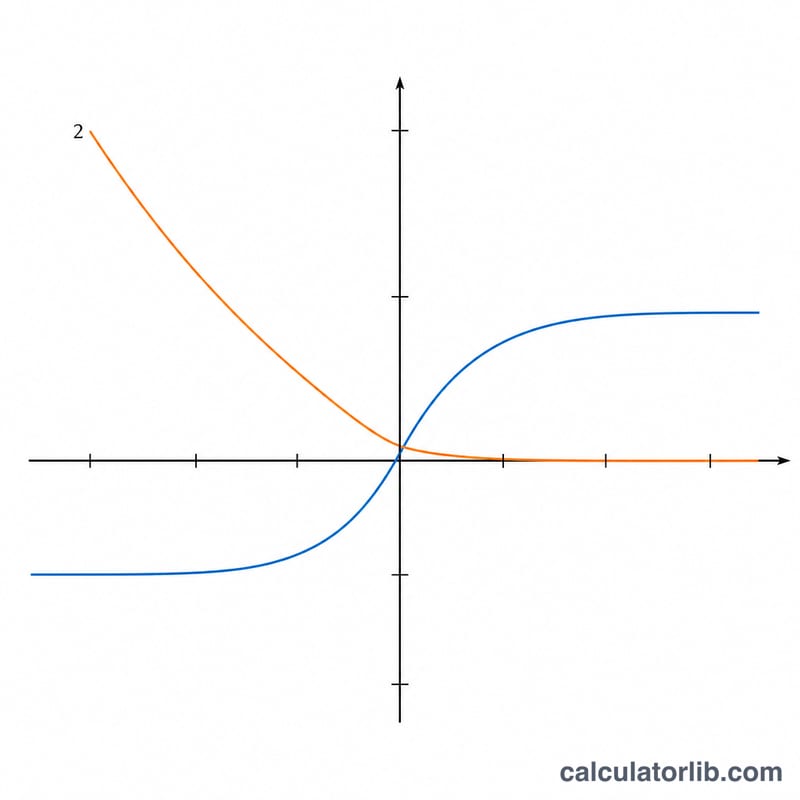
This tool builds a table of the Gauss error function erf(x) and the complementary error function erfc(x) over a sequence of x values. The error function appears throughout probability, statistics, heat conduction and diffusion problems. It is a pure mathematical (special function) tool, so it applies identically everywhere.
How to use it
Enter three numbers: the Initial value of x (the first row), the Increment added to x for each successive row, and the Number of iterations (rows). The calculator generates \(x = \text{startX} + i \times \text{stepX}\) for \(i = 0, 1, \ldots, \text{numPoints}-1\) and reports erf(x) and erfc(x) for every row. The increment may be negative (descending table) or zero (all rows identical).
The formula
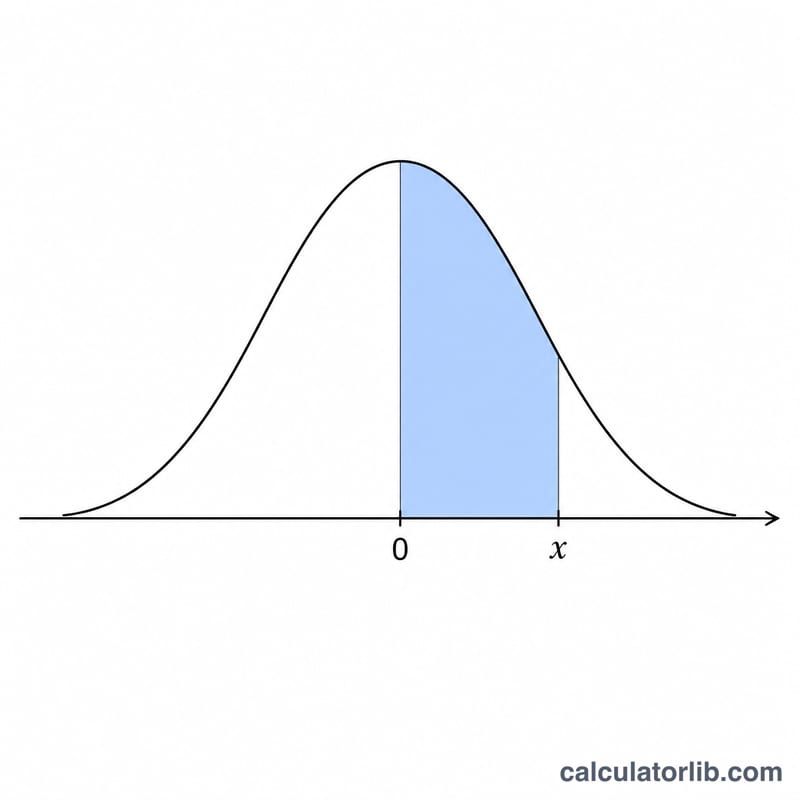
$$\operatorname{erf}(x) = \frac{2}{\sqrt{\pi}} \int_{0}^{x} e^{-t^{2}}\,dt, \qquad \operatorname{erfc}(x) = 1 - \operatorname{erf}(x)$$The values are computed with the Abramowitz & Stegun 7.1.26 rational approximation (maximum error about \(1.5 \times 10^{-7}\)), using the odd symmetry \(\operatorname{erf}(-x) = -\operatorname{erf}(x)\) for negative arguments.
Worked example
With Initial value 0, Increment 0.5 and 5 rows you get \(x = 0, 0.5, 1.0, 1.5, 2.0\). Then \(\operatorname{erf}(1.0) \approx 0.8427008\) and \(\operatorname{erfc}(1.0) \approx 0.1572992\), and indeed \(\operatorname{erf}(1.0) + \operatorname{erfc}(1.0) = 1\), confirming the identity.
FAQ
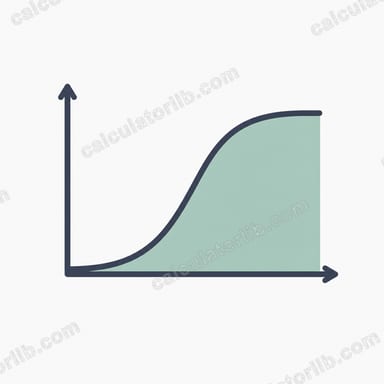
What range can erf take? \(\operatorname{erf}(x)\) lies in \((-1, 1)\); \(\operatorname{erf}(0) = 0\), \(\operatorname{erf}(+\infty) = 1\), \(\operatorname{erf}(-\infty) = -1\).
What about erfc? \(\operatorname{erfc}(x)\) lies in \((0, 2)\): \(\operatorname{erfc}(0) = 1\), \(\operatorname{erfc}(+\infty) = 0\), \(\operatorname{erfc}(-\infty) = 2\).
How many rows can I generate? The number of rows must be a positive integer; the table is capped at 2000 rows to keep output manageable.