
What Is Inverse Variation?
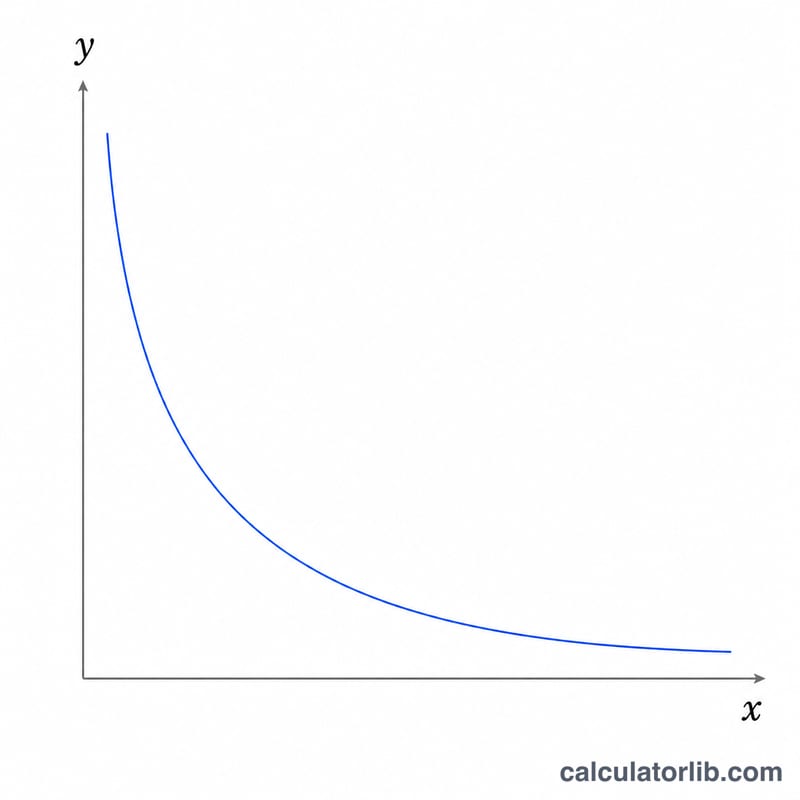
Two quantities are in inverse variation (also called inverse proportion) when their product stays constant. If y varies inversely with x, then as x increases, y decreases by the same factor, and vice versa. The relationship is written as \(y = k/x\), where k is the constant of variation. This calculator finds k from a known pair of values and then predicts y for any new x.
How to Use This Calculator
Enter a known matching pair: x₁ and y₁. The calculator computes the constant $$k = \text{x}_1 \cdot \text{y}_1$$ Then enter the new x₂ value, and it solves $$\text{y}_2 = \frac{k}{\text{x}_2}$$ This is ideal for physics and math problems such as speed and travel time, pressure and volume (Boyle's Law), or work split among workers.
The Formula Explained
Because the product is constant, \(\text{x}_1 \cdot \text{y}_1 = \text{x}_2 \cdot \text{y}_2 = k\). So you first find k from the known pair, then rearrange to isolate the unknown: \(\text{y}_2 = \frac{k}{\text{x}_2}\). The same k can be reused for as many new x values as you like, since it never changes for a given relationship.
Worked Example
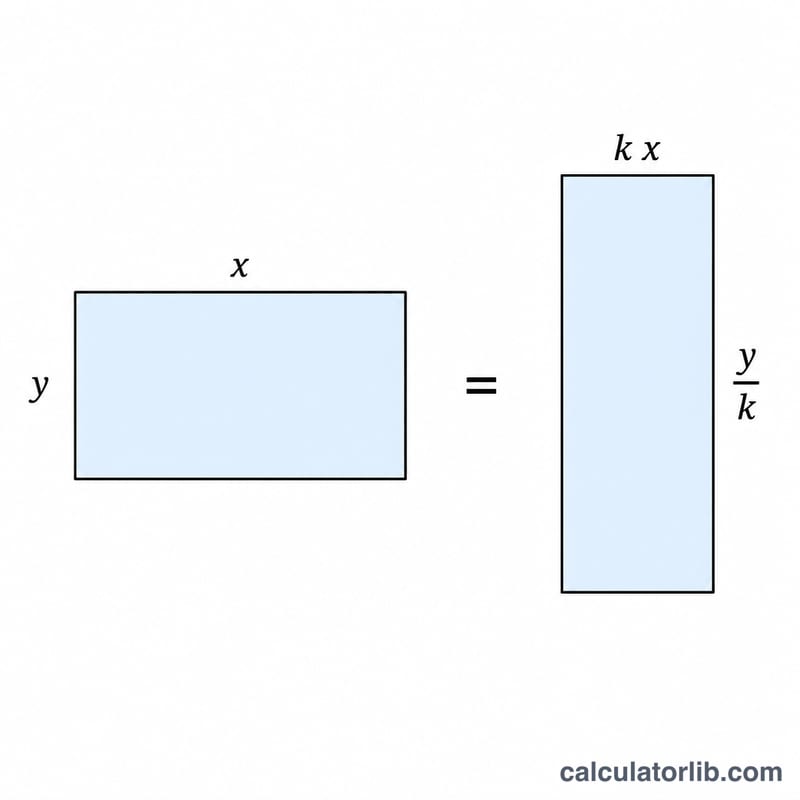
Suppose y varies inversely with x, and y = 6 when x = 4. Then $$k = 4 \times 6 = 24.$$ If x changes to 8, then $$y = 24 \div 8 = \textbf{3}.$$ Notice x doubled and y halved — exactly what inverse variation predicts.
FAQ
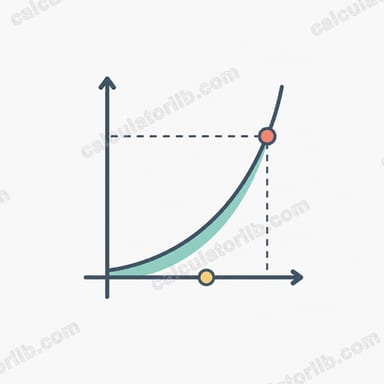
What if x₂ is zero? Division by zero is undefined, so y has no finite value at x = 0; this calculator returns 0 as a guard. Inverse variation curves approach the axes but never touch them.
How is this different from direct variation? In direct variation \(y = kx\) (the ratio is constant), while in inverse variation \(y = k/x\) (the product is constant).
Can k be negative? Yes. If your known pair has one negative value, k will be negative and the curve sits in the opposite quadrants.