
What is the exponential integral En(x)?
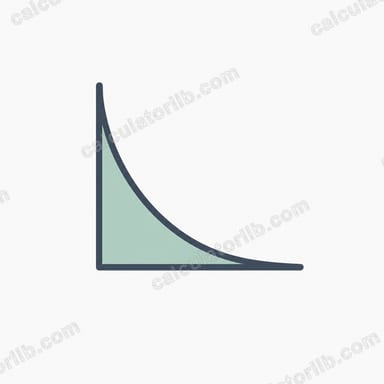
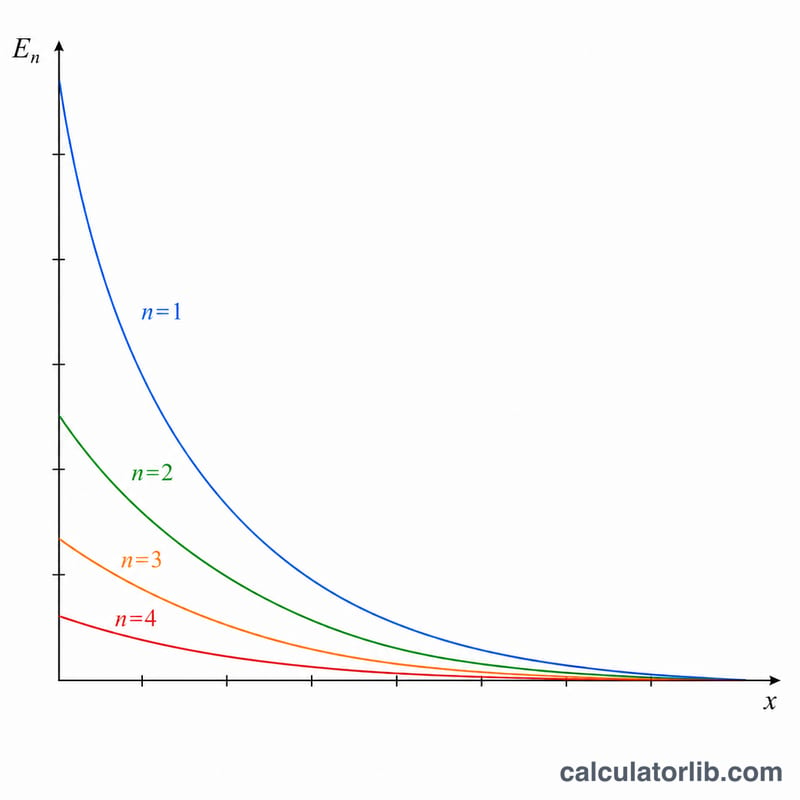
The exponential integral of order n, written En(x), is the definite integral of e-xt/tn taken from t = 1 to infinity. It appears throughout physics and engineering: radiative transfer, neutron transport, heat conduction, and antenna theory all use these functions. For a fixed integer order n it is a smooth, positive, monotonically decreasing function of x that tends to zero as x grows large. This calculator builds a full table of (x, En(x)) pairs and a line graph so you can study the curve at a glance.
How to use this calculator
Enter four numbers: the order n (a non-negative integer such as 0, 1, 2, 3), the initial value of x where the table begins, the increment (step) added to x for each successive row, and the number of repetitions (how many rows to generate). The tool computes \(x_i = \text{initialX} + i \cdot \text{step}\) for \(i = 0\) to rows-1 and evaluates En(xi) at each point. With the defaults (n = 2, start 0, step 0.02, 101 rows) you get x running from 0.00 to 2.00 in steps of 0.02.
The formula explained
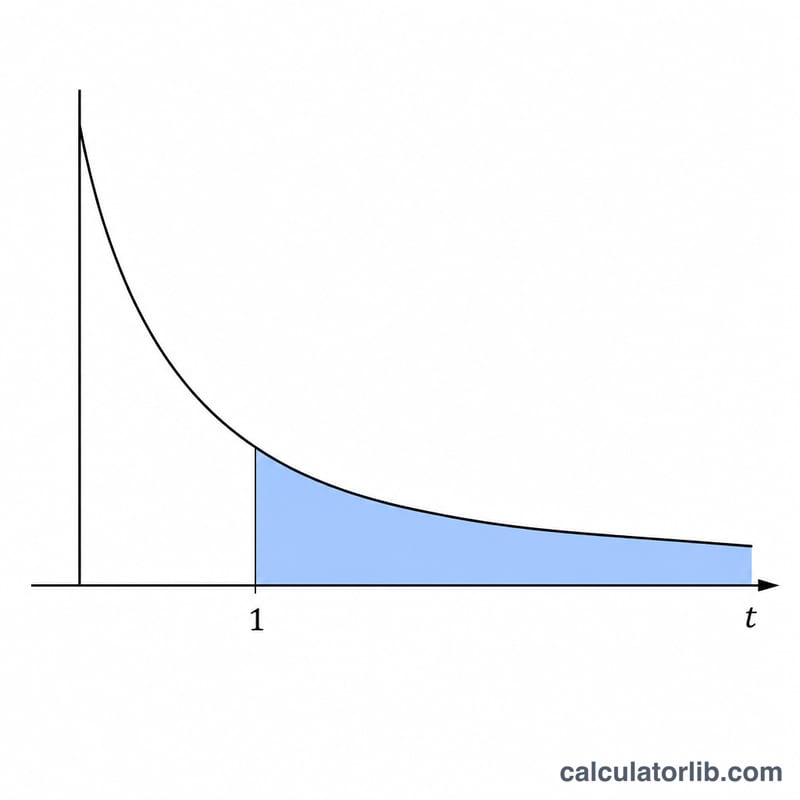
En(x) is evaluated with the classic numerical recipe: $$E_{\text{n}}(x_i) = \int_{1}^{\infty} \frac{e^{-x_i\,t}}{t^{\,\text{n}}}\, dt, \qquad x_i = \text{Initial }x + i \cdot \text{Step}, \quad i = 0,\dots,\text{Rows}-1$$ for x > 1 a Lentz continued-fraction expansion converges quickly, while for 0 < x ≤ 1 a power-series expansion is used. Special values are handled directly: \(E_0(x) = e^{-x}/x\), and \(E_n(0) = 1/(n-1)\) for \(n \ge 2\). The case \(E_1(0)\) diverges to infinity and is flagged in the table rather than printed as a number.
Worked example
Take n = 2 and x = 1. Using the identity \(E_2(x) = e^{-x} - x \cdot E_1(x)\) with \(E_1(1) \approx 0.2193839\), we get $$E_2(1) = 0.3678794 - 0.2193839 = 0.1484955$$ The calculator returns the same value. At x = 0, \(E_2(0) = 1/(2-1) = 1\), and at x = 2, \(E_2(2) \approx 0.0375343\) — the curve is clearly decreasing.
FAQ
Can n be a fraction? No. This tool is defined only for non-negative integer orders; non-integer n lies outside its domain.
Why does a row say "diverges"? \(E_1(0)\) is mathematically infinite (the integral does not converge there), so that single row is marked as divergent instead of showing a misleading number.
What about negative x? For \(n \ge 1\) the integral generally diverges for x < 0, so the calculator only returns finite values for \(x \ge 0\).