
What Is Absolute Change?
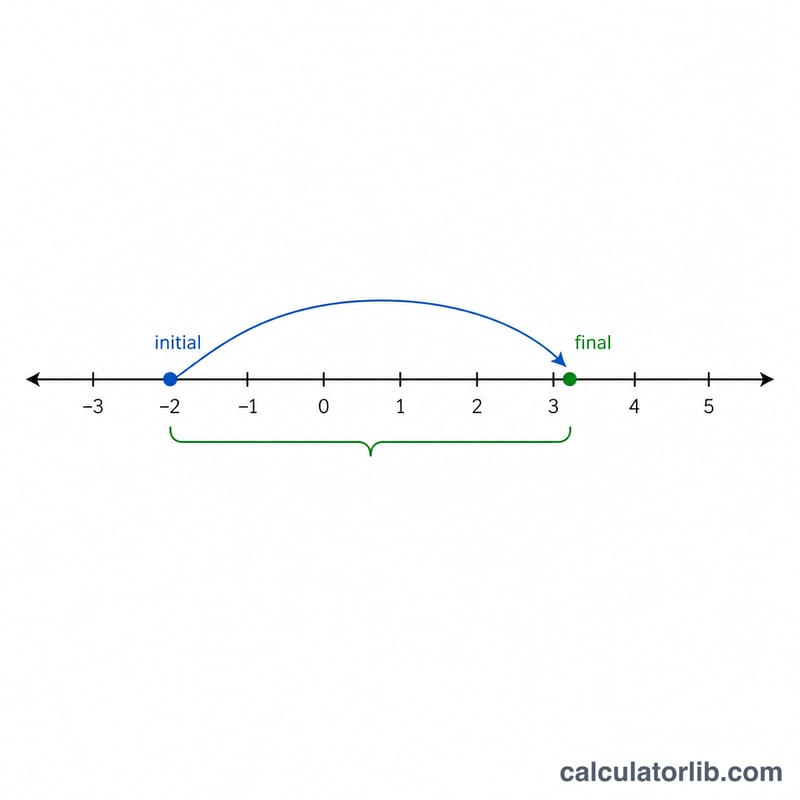
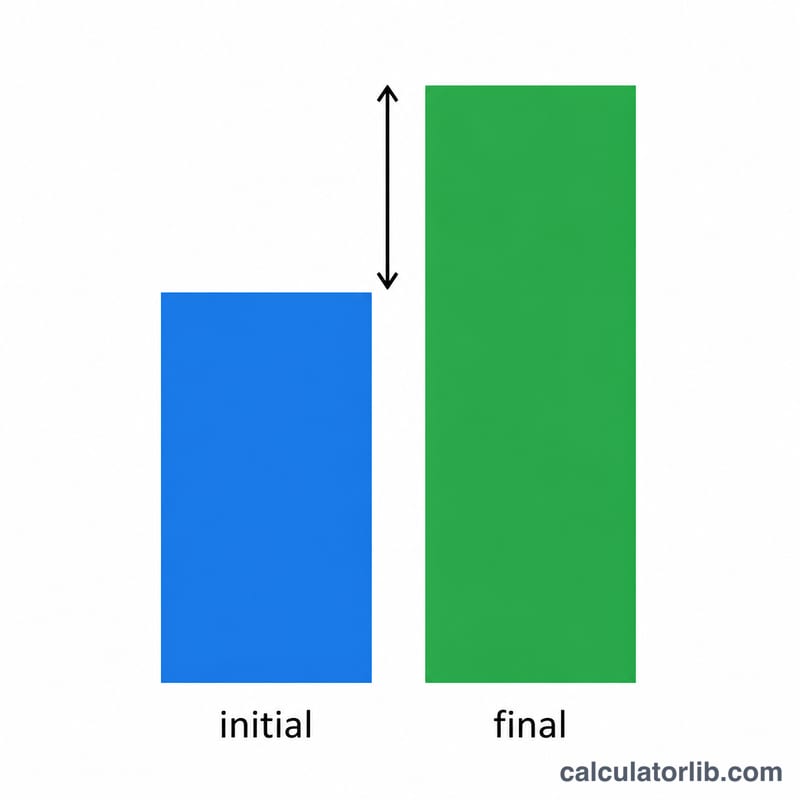
Absolute change is the simplest way to measure how much a quantity has moved from one point to another. It is the plain difference between a final value and an initial value, expressed in the same units as the original numbers. Unlike percent change, absolute change keeps its sign and unit, so a temperature rising from 18°C to 25°C has an absolute change of +7°C.
How to Use This Calculator
Enter your initial value (the starting point) and your final value (the ending point), then read the result. A positive answer means an increase, a negative answer means a decrease, and zero means no change. The calculator also reports the percent change for extra context.
The Formula Explained
The core equation is:
$$\text{Absolute change} = \text{Final value} - \text{Initial value}$$
Percent change is then calculated as the absolute change divided by the absolute value of the initial value, multiplied by 100. If the initial value is zero, percent change is undefined and is shown as 0.
Worked Example
Suppose a company's monthly sales rose from 1,200 units to 1,560 units. The absolute change is $$1{,}560 - 1{,}200 = 360 \text{ units}.$$ The percent change is $$(360 \div 1{,}200) \times 100 = 30\%.$$ So sales increased by 360 units, or 30%.
FAQ
What's the difference between absolute and relative change? Absolute change keeps the original units (e.g. dollars, degrees), while relative (percent) change scales the difference against the starting value.
Can the result be negative? Yes. A negative absolute change indicates the value decreased from initial to final.
Does the order of inputs matter? Yes. Always subtract the initial value from the final value to get the correct sign.