
What is synthetic division?
Synthetic division is a fast shortcut for dividing a polynomial \(P(x)\) by a linear factor of the form \((x - r)\). Instead of writing out long division, you work only with the numeric coefficients, producing a quotient polynomial one degree lower plus a single remainder. By the Remainder Theorem, that remainder equals \(P(r)\), so the same procedure also evaluates the polynomial at \(x = r\).
How to use this calculator
Enter the coefficients of your polynomial from the highest degree down to the constant term, separated by commas or spaces. Include zeros for any missing powers (for example, \(x^3 - 2\) becomes 1, 0, 0, -2). Then enter the root \(r\) of the divisor \((x - r)\). If you are dividing by \((x + 3)\), use \(r = -3\). The calculator returns the quotient polynomial and the remainder.
The formula explained
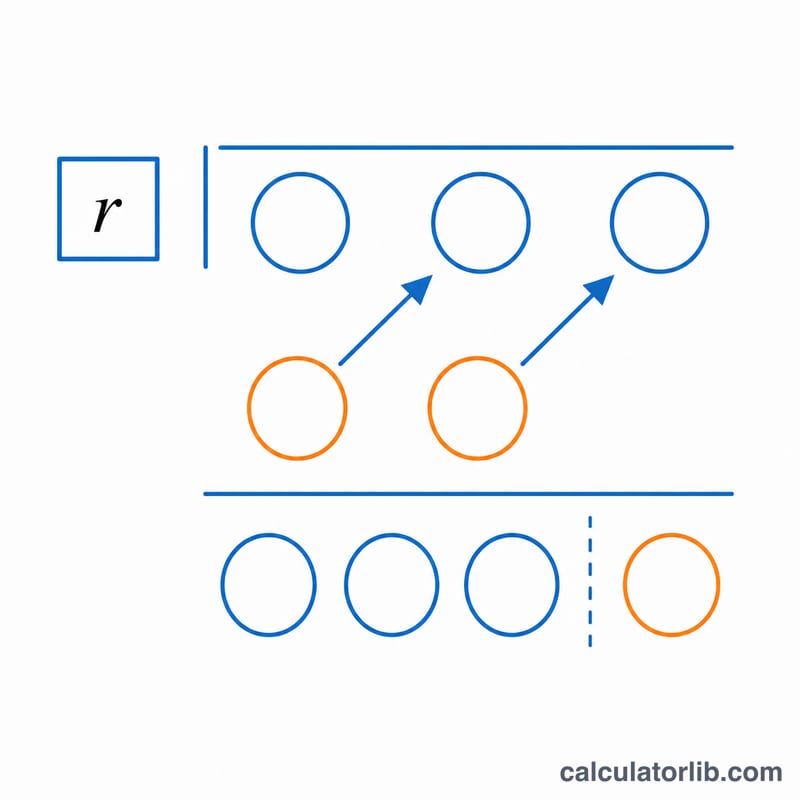
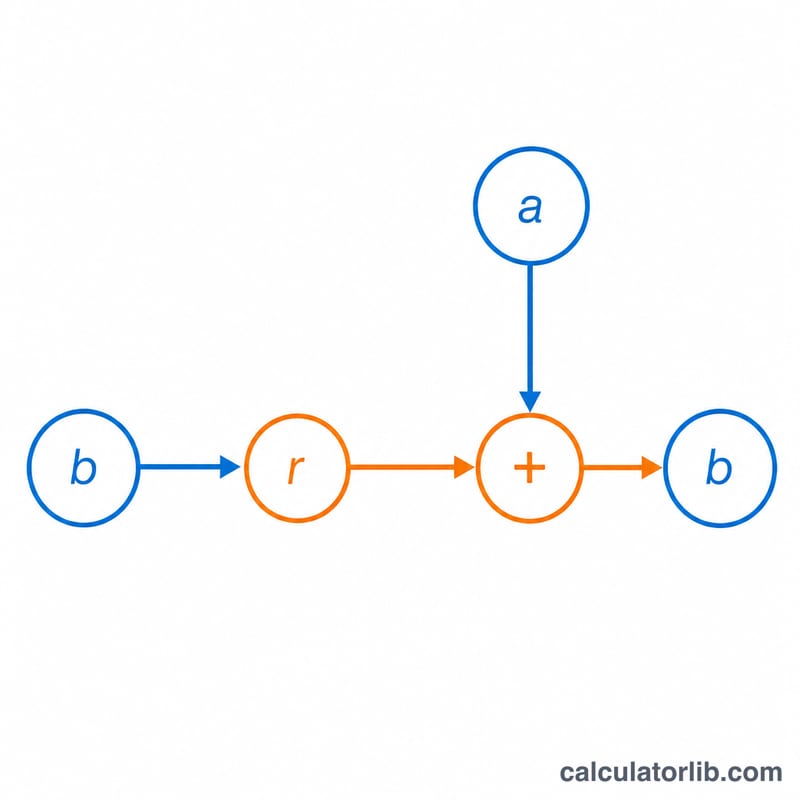
List the coefficients \(a_0, a_1, \dots, a_n\). Bring down \(a_0\) as \(b_0\). Each subsequent term uses the recurrence $$b_i = a_i + r\cdot b_{i-1}.$$ The values \(b_0\) through \(b_{n-1}\) are the quotient coefficients, and the last value \(b_n\) is the remainder \(R\). Symbolically, $$P(x) = (x - r)\cdot Q(x) + R.$$
Worked example
Divide \(x^3 - 6x^2 + 11x - 6\) by \((x - 1)\), so coefficients are \(1, -6, 11, -6\) and \(r = 1\). Bring down \(1\). Next: \(-6 + 1\cdot 1 = -5\). Then \(11 + 1\cdot(-5) = 6\). Then \(-6 + 1\cdot 6 = 0\). The quotient is \(x^2 - 5x + 6\) with remainder \(0\), confirming \((x - 1)\) is a factor.
FAQ
Can I divide by \((x + a)\)? Yes — rewrite it as \((x - (-a))\) and enter \(r = -a\).
What does a zero remainder mean? It means \((x - r)\) divides \(P(x)\) exactly, so \(r\) is a root of the polynomial.
Why must I include zeros for missing terms? Synthetic division relies on positional coefficients; skipping a power would shift everything and give wrong results.