Connect via MCP →

Enter Calculation

Formula

Advertisement

Results

Peak radial probability density D(r)
0.541341
at r ≈ 1 Bohr radii
Nuclear charge Z 1
Quantum numbers (n, l) 1, 0
Prefactor P 2
Approx ∫ D(r) dr (norm check) 0.9999
r (a) Rnl(r) D(r) D(r) plot
0 -2 0
0.2 -1.637462 0.107251
0.4 -1.34064 0.287571
0.6 -1.097623 0.43372
0.8 -0.898658 0.516855
1 -0.735759 0.541341
1.2 -0.602388 0.522535
1.4 -0.493194 0.476751
1.6 -0.403793 0.417405
1.8 -0.330598 0.354115
2 -0.270671 0.29305
2.2 -0.221606 0.237689
2.4 -0.181436 0.189613
2.6 -0.148547 0.149168
2.8 -0.12162 0.115965
3 -0.099574 0.089235
3.2 -0.081524 0.068057
3.4 -0.066747 0.051501
3.6 -0.054647 0.038703
3.8 -0.044742 0.028906
4 -0.036631 0.02147
4.2 -0.029991 0.015867
4.4 -0.024555 0.011673
4.6 -0.020104 0.008552
4.8 -0.016459 0.006242
5 -0.013476 0.00454
5.2 -0.011033 0.003292
5.4 -0.009033 0.002379
5.6 -0.007396 0.001715
5.8 -0.006055 0.001233
6 -0.004958 0.000885
6.2 -0.004059 0.000633
6.4 -0.003323 0.000452
6.6 -0.002721 0.000322
6.8 -0.002228 0.000229
7 -0.001824 0.000163
7.2 -0.001493 0.000116
7.4 -0.001223 0.000082
7.6 -0.001001 0.000058
7.8 -0.000819 0.000041
8 -0.000671 0.000029
8.2 -0.000549 0.00002
8.4 -0.00045 0.000014
8.6 -0.000368 0.00001
8.8 -0.000301 0.000007
9 -0.000247 0.000005
9.2 -0.000202 0.000003
9.4 -0.000165 0.000002
9.6 -0.000135 0.000002
9.8 -0.000111 0.000001
10 -0.000091 0.000001
10.2 -0.000074 0.000001
10.4 -0.000061 0
10.6 -0.00005 0
10.8 -0.000041 0
11 -0.000033 0
11.2 -0.000027 0
11.4 -0.000022 0
11.6 -0.000018 0
11.8 -0.000015 0
12 -0.000012 0
12.2 -0.00001 0
12.4 -0.000008 0
12.6 -0.000007 0
12.8 -0.000006 0
13 -0.000005 0
13.2 -0.000004 0
13.4 -0.000003 0
13.6 -0.000002 0
13.8 -0.000002 0
14 -0.000002 0
14.2 -0.000001 0
14.4 -0.000001 0
14.6 -0.000001 0
14.8 -0.000001 0
15 -0.000001 0
15.2 -0.000001 0
15.4 -0 0
15.6 -0 0
15.8 -0 0
16 -0 0
16.2 -0 0
16.4 -0 0
16.6 -0 0
16.8 -0 0
17 -0 0
17.2 -0 0
17.4 -0 0
17.6 -0 0
17.8 -0 0
18 -0 0
18.2 -0 0
18.4 -0 0
18.6 -0 0
18.8 -0 0
19 -0 0
19.2 -0 0
19.4 -0 0
19.6 -0 0
19.8 -0 0
20 -0 0

What this calculator does

This tool evaluates the radial part of the quantum-mechanical wavefunction for a hydrogen-like atom (one electron bound to a nucleus of charge Z, such as hydrogen H or the helium ion He+). It returns the radial wavefunction \(R_{n\ell}(r)\) and the radial probability density \(D(r) = r^{2}\,|R_{n\ell}(r)|^{2}\), sampled over a range of radii and plotted as a simple bar chart. It is a universal physics tool with no country-specific assumptions; all distances are expressed in Bohr radii (\(a = 1\)).

How to use it

Pick the nucleus (H for \(Z = 1\) or He+ for \(Z = 2\)), then enter the principal quantum number \(n\) (1, 2, 3, ...) and the azimuthal quantum number \(\ell\) (0 to \(n-1\)). Set the starting radius, the step size, and how many points to sample. The calculator builds a table of \(r\), \(R_{n\ell}(r)\) and \(D(r)\), highlights the radius where \(D(r)\) peaks, and shows an approximate value of the normalization integral as a sanity check.

The formula explained

With the substitution \(x = 2Zr/n\), the radial function is $$R_{n\ell}(r) = -P\, e^{-Zr/n}\, x^{\ell}\, L_{n-\ell-1}^{2\ell+1}(x),$$ where the prefactor $$P = \sqrt{\left(\tfrac{2Z}{n}\right)^{3}\dfrac{(n-\ell-1)!}{2n\,(n+\ell)!}}$$ and \(L\) is the associated Laguerre polynomial. The leading minus sign is just a phase convention and does not affect \(|R_{n\ell}|^{2}\). Multiplying by \(r^{2}\) gives \(D(r)\), the probability of finding the electron in a thin shell between \(r\) and \(r+dr\).
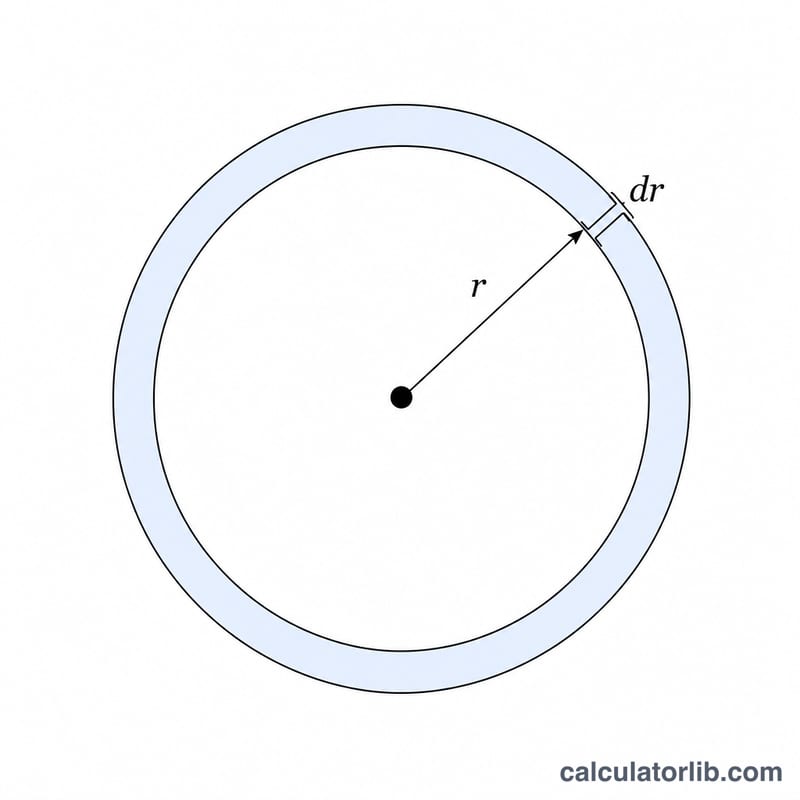
Spherical shell of radius r and thickness dr around a central nucleus illustrating the r-squared volume factor
The factor \(r^{2}\) comes from the volume of a thin spherical shell of radius \(r\) around the nucleus.
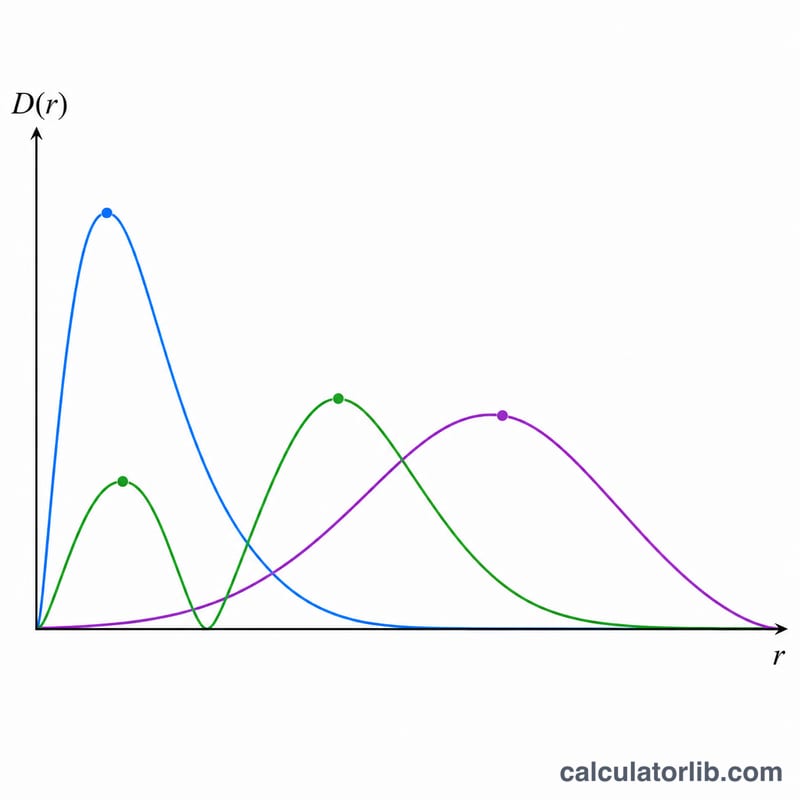
Radial probability density curves D(r) versus r for several hydrogen orbitals showing peaks and nodes
Radial probability density \(D(r) = r^{2}[R_{n\ell}(r)]^{2}\) for different hydrogen orbitals, showing peaks and radial nodes.

Worked example

For hydrogen 1s (\(Z = 1\), \(n = 1\), \(\ell = 0\)) at \(r = 1\) Bohr radius: \(x = 2\), \(P = \sqrt{8 \times 0.5} = 2\), \(L_{0}^{1}(2) = 1\), so $$R = -2e^{-1} = -0.73576$$ and $$D = 1^{2} \times 0.73576^{2} = 0.54134.$$ This is in fact the maximum of \(D(r)\) for the 1s orbital, confirming the most probable radius of the electron is one Bohr radius.

FAQ

Why is the peak of \(D(r)\) not at \(r = 0\)? Even though \(|R_{n\ell}|^{2}\) is largest near the nucleus for 1s, the shell volume factor \(r^{2}\) vanishes at the origin, so \(D(0) = 0\) and the probability peaks at a finite radius.

What units are used? Everything is in Bohr radii (\(a = 1\)), so \(r\), the step and the peak radius are all dimensionless multiples of the Bohr radius (~0.529 angstrom).

Why does the norm check not equal exactly 1? The integral is approximated by a simple rectangle sum over your chosen points; widen the range and use a small step to get closer to 1.

Last updated: