
What is the Electron Speed Calculator?
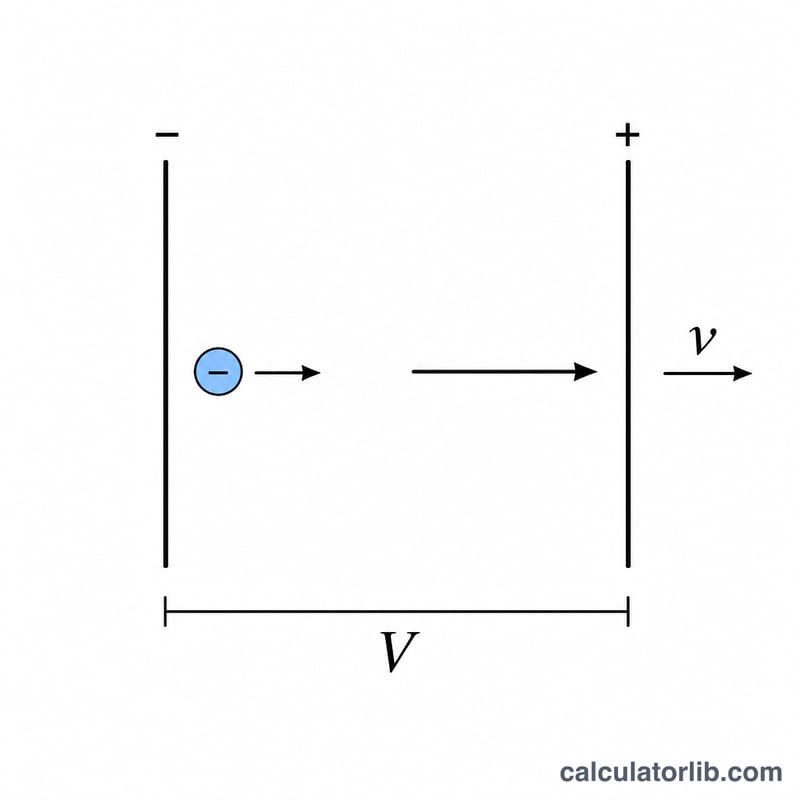
This calculator finds how fast an electron travels after being accelerated from rest through an electric potential difference (voltage). It is a staple of physics courses and applications such as cathode-ray tubes, electron microscopes, and particle accelerators. The result is given in metres per second and as a fraction of the speed of light.
How to use it
Enter the accelerating voltage in volts and read off the electron's final speed. For example, a voltage of 100 V produces a speed of roughly 5.93 million m/s — just under 2% of light speed.
The formula explained
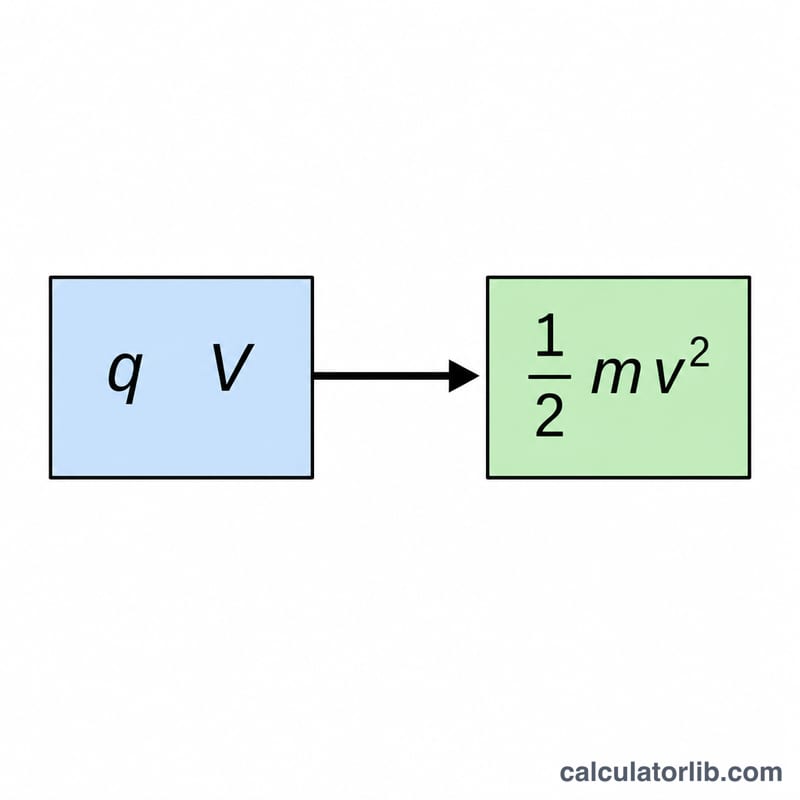
An electron carrying charge \(q\) gains kinetic energy equal to the work done on it by the field: \(qV = \tfrac{1}{2}mv^2\). Solving for \(v\) gives $$v = \sqrt{\dfrac{2qV}{m}}$$ Here \(q = 1.602 \times 10^{-19}\ \text{C}\) is the elementary charge and \(m = 9.109 \times 10^{-31}\ \text{kg}\) is the electron rest mass. This is the non-relativistic form; it stays accurate while \(v\) is well below the speed of light (roughly under a few keV of accelerating energy).
Worked example
For \(V = 100\ \text{V}\):
$$v = \sqrt{\frac{2 \times 1.602\times10^{-19} \times 100}{9.109\times10^{-31}}} = \sqrt{3.518\times10^{13}} \approx 5{,}930{,}000\ \text{m/s}$$or about \(0.0198c\).
FAQ
Does this account for relativity? No — it uses the classical kinetic energy. At very high voltages (tens of kV+), relativistic corrections matter and this will slightly overestimate the speed.
What if I enter 0 volts? The electron starts and stays at rest, so the speed is \(0\ \text{m/s}\).
Does this work for protons or ions? The formula is identical, but you would substitute the proton/ion charge and mass instead of the electron's values.