
What Is Synchronous Speed?
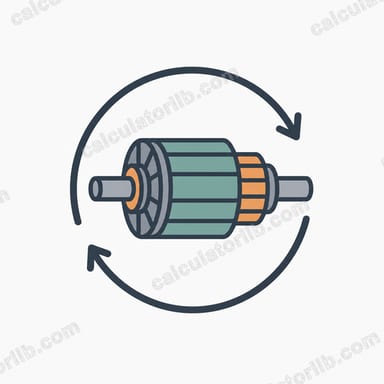
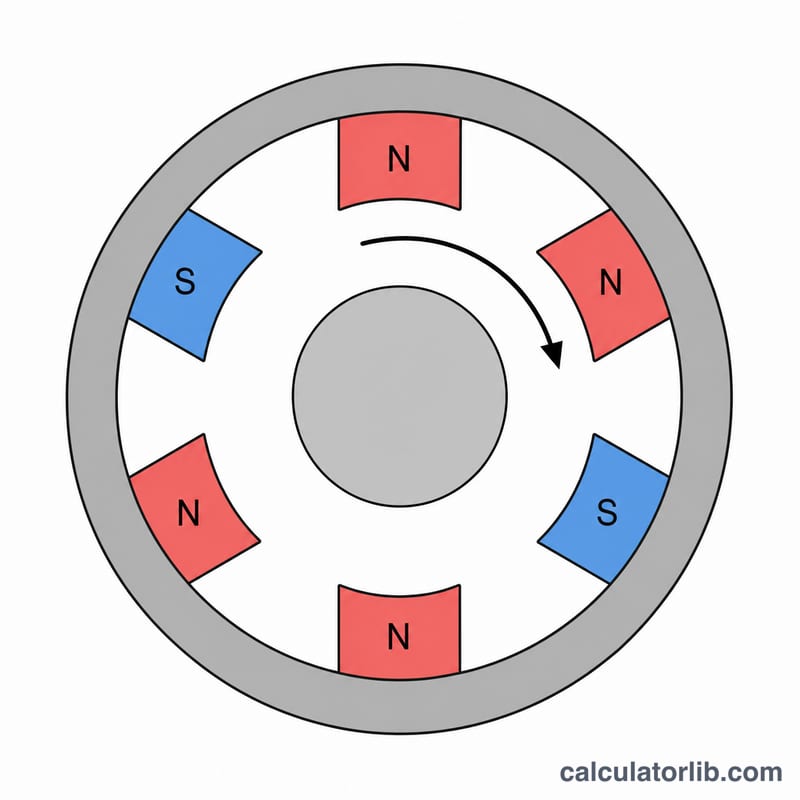
Synchronous speed is the rotational speed of the rotating magnetic field produced by the stator windings of an AC machine, such as an induction motor, synchronous motor, or alternator. It is the theoretical speed at which the field rotates and serves as the reference for the actual rotor speed. For an induction motor, the rotor always runs slightly slower than synchronous speed — the difference is called slip.
How to Use This Calculator
Enter the supply frequency in hertz (Hz) — typically 60 Hz in North America or 50 Hz in most of Europe, Asia, and Africa — and the number of magnetic poles in the machine (always an even number: 2, 4, 6, 8, ...). The calculator returns the synchronous speed in revolutions per minute (RPM) and also in revolutions per second.
The Formula Explained
The governing equation is \(N_s = \dfrac{120 \times f}{P}\), where \(N_s\) is synchronous speed in RPM, \(f\) is the supply frequency in Hz, and \(P\) is the total number of poles. The factor 120 converts the per-second electrical frequency into per-minute mechanical revolutions while accounting for pole pairs (120 = 60 seconds/minute × 2 poles/pole-pair).
$$N_s = \frac{120 \times \text{Frequency (Hz)}}{\text{Poles}}$$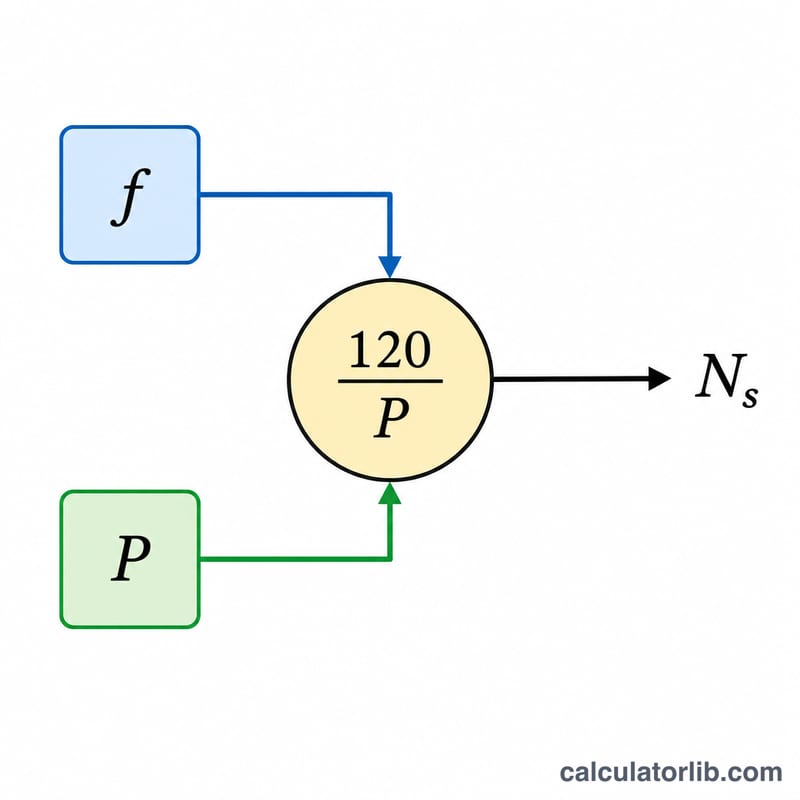
Worked Example
Consider a 4-pole induction motor connected to a 60 Hz supply.
$$N_s = \frac{120 \times 60}{4} = \frac{7200}{4} = 1800 \text{ RPM}$$In rev/s that is \(1800 / 60 = 30\) rev/s. The actual loaded rotor might spin around 1750 RPM, giving roughly 2.8% slip.
FAQ
Why must poles be even? Magnetic poles always come in north-south pairs, so the total pole count is always an even number.
Does the rotor run at synchronous speed? A synchronous motor does, by design. An induction motor runs slightly below it because torque is produced only when there is relative motion (slip) between the field and rotor.
What changes with a 50 Hz supply? The same 4-pole motor at 50 Hz gives \(N_s = \dfrac{120 \times 50}{4} = 1500\) RPM, which is why 50 Hz machines run slower than 60 Hz ones of the same pole count.