
What is peak-to-peak voltage?
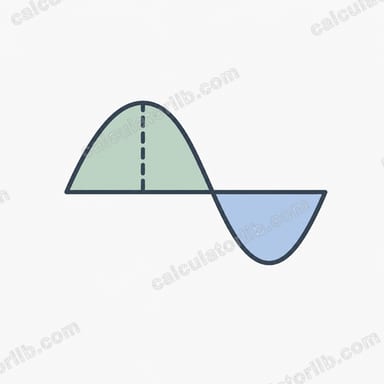
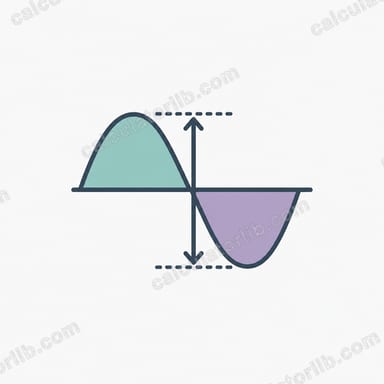
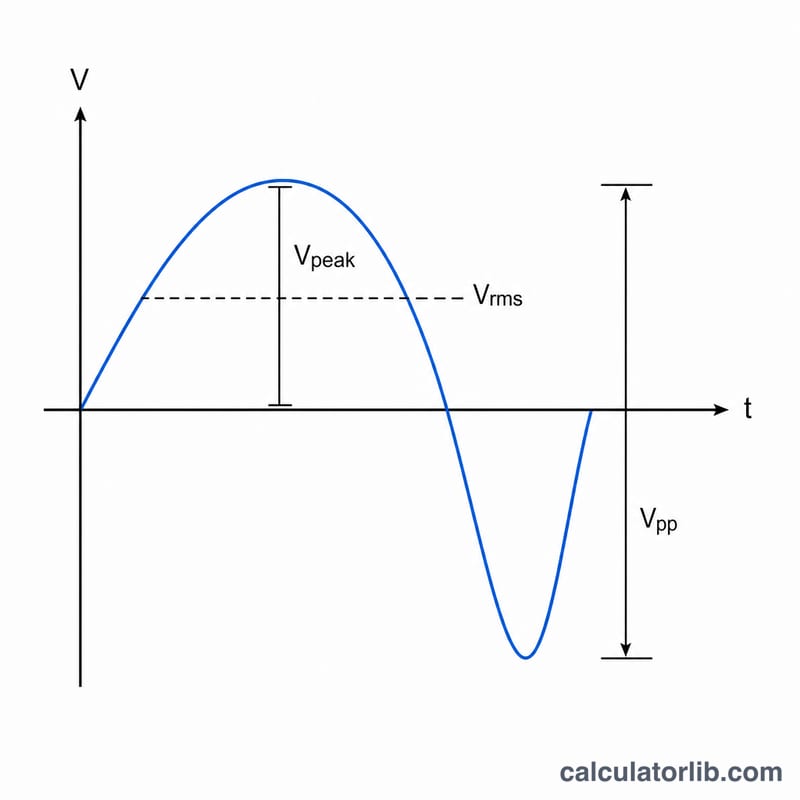
Peak-to-peak voltage (Vpp) is the total vertical distance between the highest positive point and the lowest negative point of a waveform. For a symmetric sine wave it is exactly twice the peak voltage (Vpeak). These conversions are essential when reading an oscilloscope, designing audio or RF circuits, or interpreting datasheets that may quote any one of Vpp, Vpeak or RMS.
How to use this calculator
Choose which voltage you know — peak, peak-to-peak, or RMS — then type its value in volts. The calculator instantly returns all three quantities. The relationships assume a clean sinusoidal waveform centred on zero volts.
The formulas explained
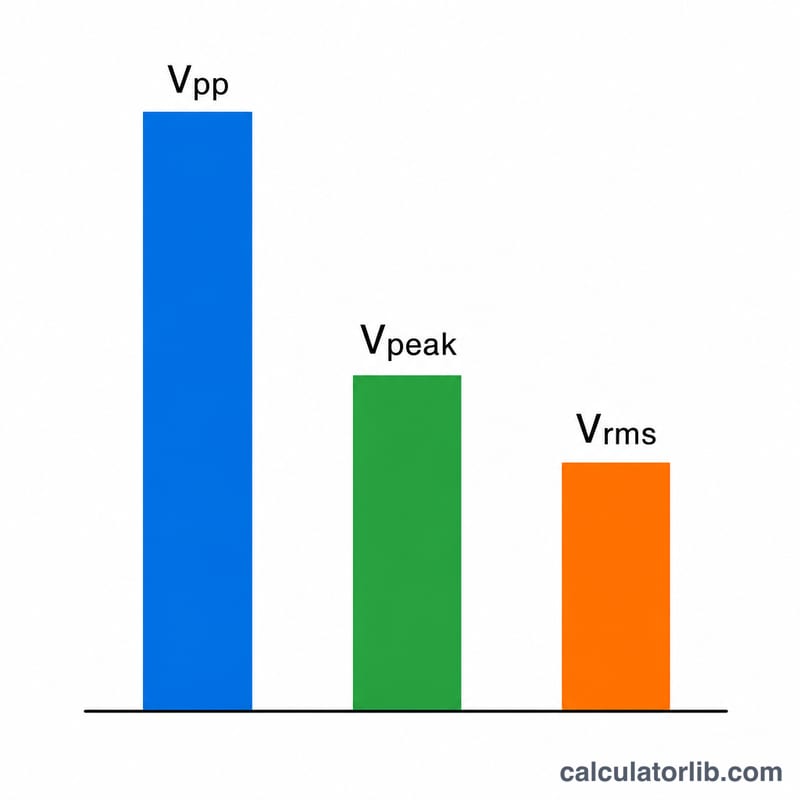
The core identities are \(V_{pp} = 2 \times V_{peak}\) and \(V_{rms} = V_{peak} / \sqrt{2}\). Rearranging: \(V_{peak} = V_{pp} / 2\), and \(V_{peak} = V_{rms} \times \sqrt{2}\). Combining these gives \(V_{rms} = V_{pp} / (2\sqrt{2}) \approx V_{pp} \times 0.3536\) for a sine wave. The \(\sqrt{2}\) factor comes from averaging the square of a sine over a full cycle.
Worked example
Suppose an oscilloscope shows a peak voltage of 5 V. Then $$V_{pp} = 2 \times 5 = 10 \text{ V}$$ and $$V_{rms} = \frac{5}{\sqrt{2}} \approx 3.5355 \text{ V}.$$ A standard 230 V RMS mains supply, by contrast, has a peak of about 325 V and a peak-to-peak of about 650 V.
FAQ
Does this work for non-sine waves? The Vpp ↔ Vpeak relation holds for any symmetric waveform, but the \(V_{rms} = V_{peak}/\sqrt{2}\) conversion is valid only for pure sine waves. Square, triangle and other shapes have different crest factors.
What is Vrms used for? RMS voltage represents the equivalent DC voltage that delivers the same power to a resistive load, which is why power ratings use RMS values.
How do I get Vpp from Vrms? Multiply Vrms by \(2\sqrt{2}\) (about 2.8284) for a sine wave.