What is the Fraction to MM Conversion Chart Calculator?
This calculator converts a fractional inch measurement into its equivalent in millimeters, centimeters, and decimal inches. Fractional inches are common on US and imperial rulers, drill bit sets, wrenches, and woodworking plans, while millimeters dominate engineering drawings and metric tooling. This tool bridges the two systems instantly so you never have to guess.
How to use it
Enter the numerator (the top number of the fraction) and the denominator (the bottom number). For example, for 3/8 inch, type 3 in the numerator and 8 in the denominator. The calculator returns the decimal inch, the millimeter value, and the centimeter value. It works for any fraction, including ones like 5/16, 7/64, or even whole numbers if you set the denominator to 1.
The formula explained
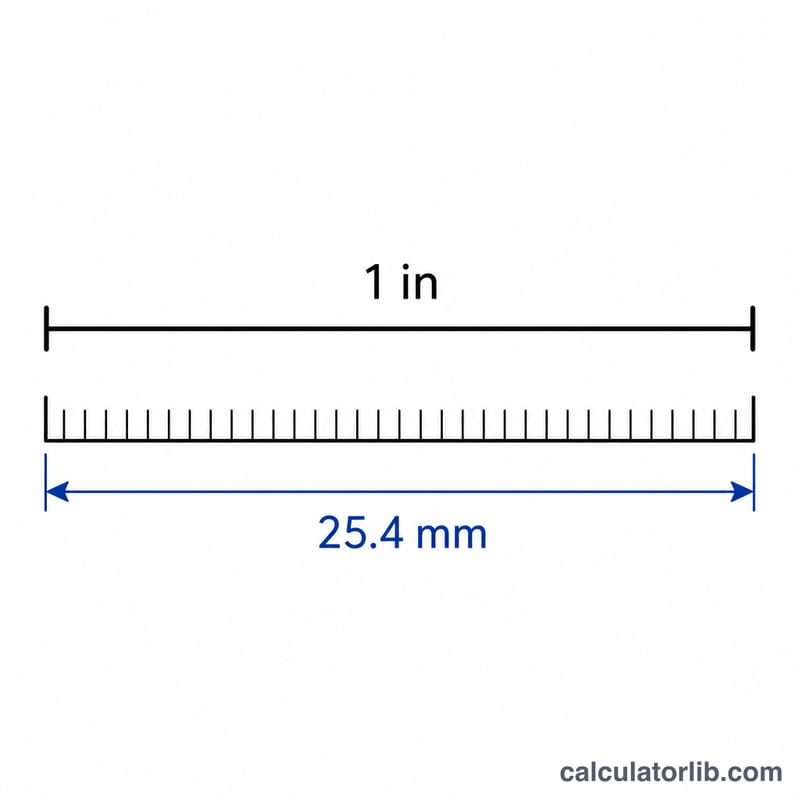
One inch is defined as exactly 25.4 millimeters. To convert, first turn the fraction into a decimal by dividing the numerator by the denominator, then multiply that decimal by 25.4: $$\text{mm} = \frac{\text{numerator}}{\text{denominator}} \times 25.4$$. Centimeters are simply the millimeter value divided by 10.
Worked example
Convert 3/8 inch to millimeters. First, \(3 \div 8 = 0.375\) inches (the decimal value). Then $$0.375 \times 25.4 = 9.525 \text{ mm}.$$ In centimeters that is 0.9525 cm. So 3/8 inch equals 9.525 mm.
Practical Tips for Using Converted Measurements
The conversion is exact: 1 inch = 25.4 mm, so \(\text{mm} = \frac{n}{d} \times 25.4\). What you do with the result matters as much as the number itself. These tips are general guidance, so always follow the specification for your own job.
1. Round to a sensible precision
- Woodworking, carpentry, general DIY: 0.1 mm is usually more than enough. Wood moves with humidity, and most hand tools cannot hold tighter than about 0.5 mm.
- Sheet metal, 3D printing, laser cutting: 0.1 mm to 0.05 mm, depending on the machine's stated accuracy.
- Machining and precision fits: 0.01 mm, or finer if the drawing calls for it.
- Keep full precision through multi-step calculations and round only the final value. Rounding each piece before adding them up lets small errors accumulate.
2. Match fractional sizes to the nearest standard metric size
Worked example: for a 5/16 in drill bit, \(\frac{5}{16} \times 25.4 = 0.3125 \times 25.4 = \) 7.9375 mm, which rounds to 7.94 mm. An 8 mm bit is only about 0.06 mm larger, so it is a practical substitute for most clearance holes.
- 1/4 in = 6.35 mm, which falls between 6.3 mm and 6.4 mm. Check which sizes your drill set actually includes.
- 3/8 in = 9.525 mm, which is close to 9.5 mm.
- 1/2 in = 12.7 mm, which is between 12.5 mm and 13 mm.
Choose the direction of the substitution deliberately. A slightly larger bit suits a clearance hole. A slightly smaller bit is safer for a tapped or press-fit hole, where a hole that is too big cannot be fixed. For tapping, use the tap manufacturer's recommended drill size rather than a simple conversion.
For wrenches and sockets, a small mismatch can round off fasteners. For example, 7/16 in = 11.1125 mm, so an 11 mm wrench is too small and a 12 mm one is loose. Test the fit before applying force, and use the correct size when possible.
3. Allow for tolerance and kerf
- Converted values are nominal sizes. Real parts have tolerances, so decide whether a dimension needs to be a minimum, a maximum, or a fit.
- Cutting removes material. A saw blade's kerf is often around 2 to 3 mm, depending on the blade, so add it to your cut plan or the pieces will come out short.
- Leave a small clearance gap (for example 0.2 to 0.5 mm) for sliding or fitted parts. Choose the amount based on the material and the process.
4. Double-check critical dimensions
- Confirm the numerator and denominator before converting. Mistaking 5/16 for 5/8 doubles the error.
- Reduce mixed numbers properly: 1 3/8 in is \(1.375 \times 25.4 = 34.925\) mm.
- Do a quick sanity check: 1/2 in should be about 12.7 mm, and 1/4 in about 6.35 mm.
- Measure the first part or a test piece before cutting or drilling the rest, especially with expensive material.
- When a dimension is safety-critical or has a tight tolerance, use the drawing's stated value or consult a qualified professional rather than a rounded conversion.
FAQ
Is one inch exactly 25.4 mm? Yes. Since 1959 the international inch has been defined as exactly 25.4 millimeters, so the conversion is exact, not an approximation.
What about common fractions like 1/2 and 1/4? 1/2 inch = 12.7 mm, 1/4 inch = 6.35 mm, 1/8 inch = 3.175 mm, and 1/16 inch = 1.5875 mm.
Can I enter improper fractions? Yes. For example, 9/8 gives 1.125 inches = 28.575 mm. You can also use a denominator of 1 to convert a whole inch value.