
What This Calculator Does
This tool converts a running or walking pace expressed in minutes per mile into a speed in miles per hour (mph). Pace tells you how long it takes to cover one mile, while speed tells you how far you travel in one hour — two ways of describing the same effort. It also shows the equivalent speed in kilometres per hour for convenience.
How to Use It
Enter the minutes portion of your pace, plus any extra seconds. For example, a pace of 8 minutes 30 seconds per mile is entered as 8 minutes and 30 seconds. Press calculate to see your speed in mph instantly.
The Formula Explained
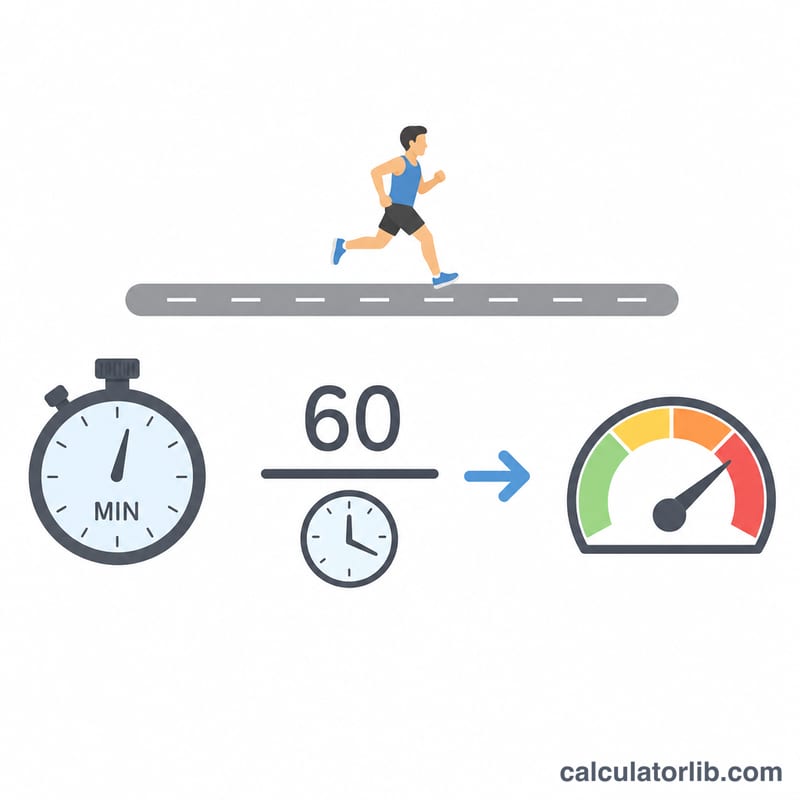
There are 60 minutes in an hour, so the number of miles you can cover in an hour is simply 60 divided by the minutes it takes to run one mile:
$$\text{mph} = \frac{60}{\text{minutes per mile}}$$
If your pace includes seconds, convert them to a fraction of a minute first: \(\text{total pace} = \text{minutes} + \dfrac{\text{seconds}}{60}\).
Worked Example
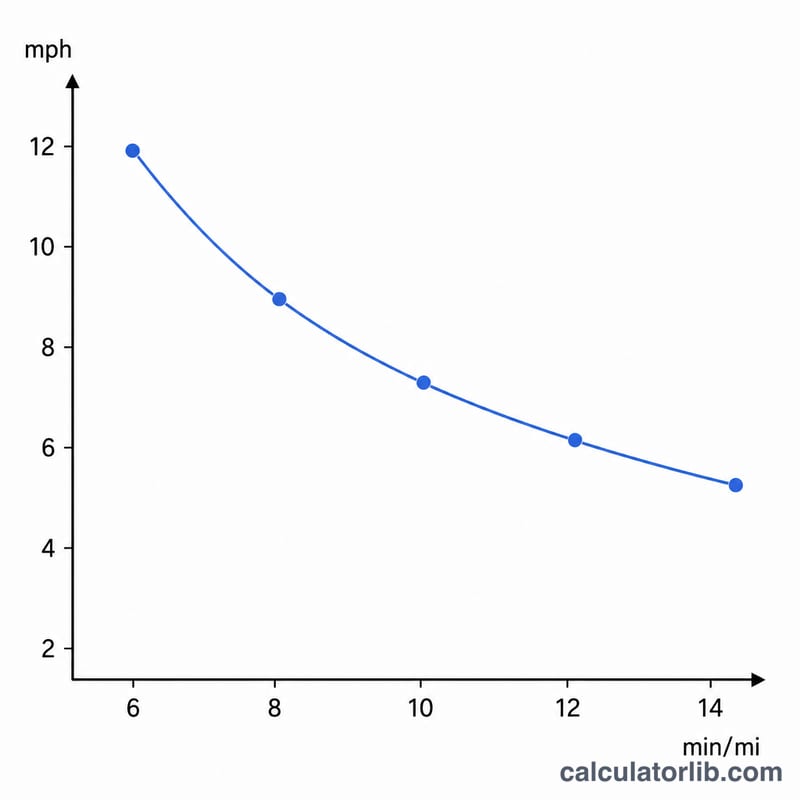
Suppose you run a steady 10 minutes per mile. Then \(\text{mph} = \frac{60}{10} = \textbf{6 mph}\). If you speed up to 8 minutes per mile, \(\text{mph} = \frac{60}{8} = \textbf{7.5 mph}\). A 7:30 pace (7.5 minutes) gives \(\frac{60}{7.5} = \textbf{8 mph}\).
FAQ
Is a lower minutes-per-mile better? Yes — a smaller pace number means you cover each mile faster, which equals a higher mph.
How do I convert mph back to pace? Use the inverse: \(\text{minutes per mile} = \frac{60}{\text{mph}}\).
What is a typical jogging speed? Most recreational joggers run around 5–6 mph, roughly a 10–12 minute mile.