
What is function evaluation?
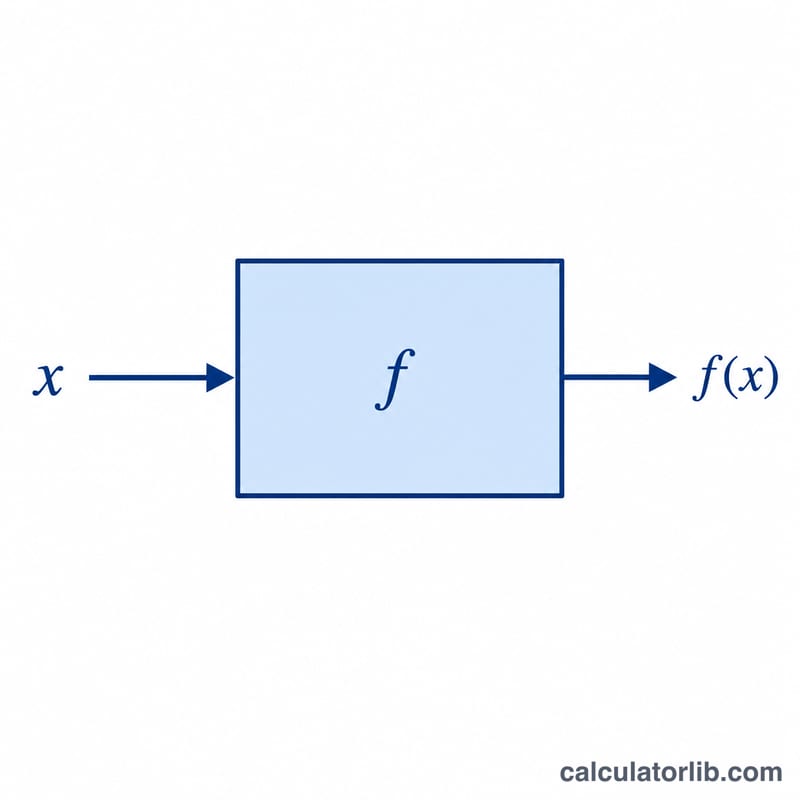
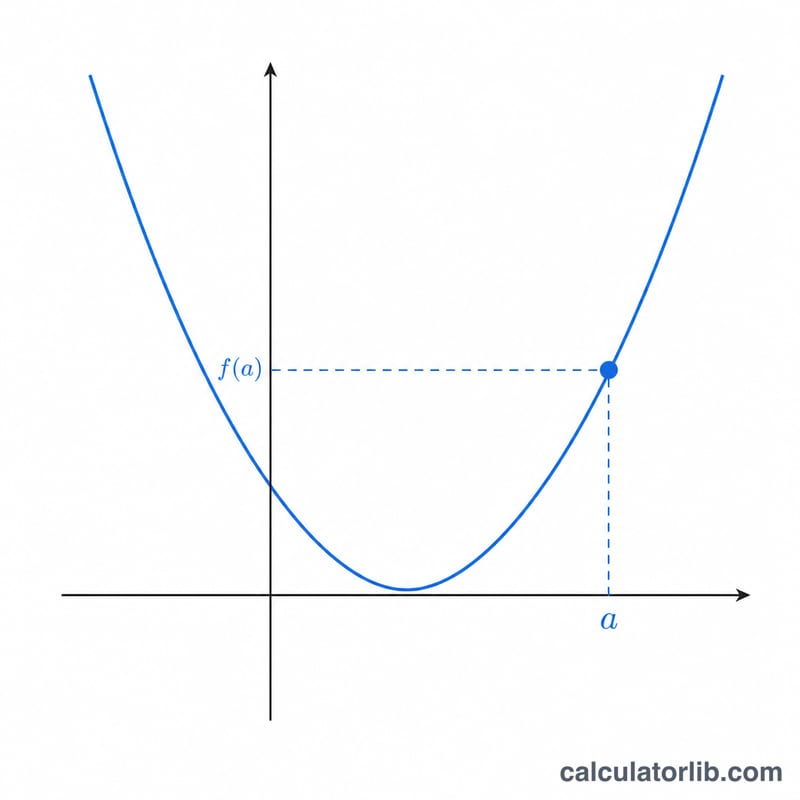
Evaluating a function means finding its output for a specific input. If you have a function f(x) and you want to know its value at x = a, you substitute a in place of every x and then compute. The notation f(a) reads "f of a" and represents that output value. This calculator works with the common quadratic form \(f(x) = ax^2 + bx + c\), which covers linear functions (set \(a = 0\)) and constants (set \(a = 0\), \(b = 0\)) as special cases.
How to use this calculator
Enter the three coefficients of your function: a (the coefficient of x²), b (the coefficient of x), and c (the constant term). Then enter the value of x at which you want to evaluate. The calculator returns f(x) along with a breakdown of each term so you can see exactly how the answer was built.
The formula explained
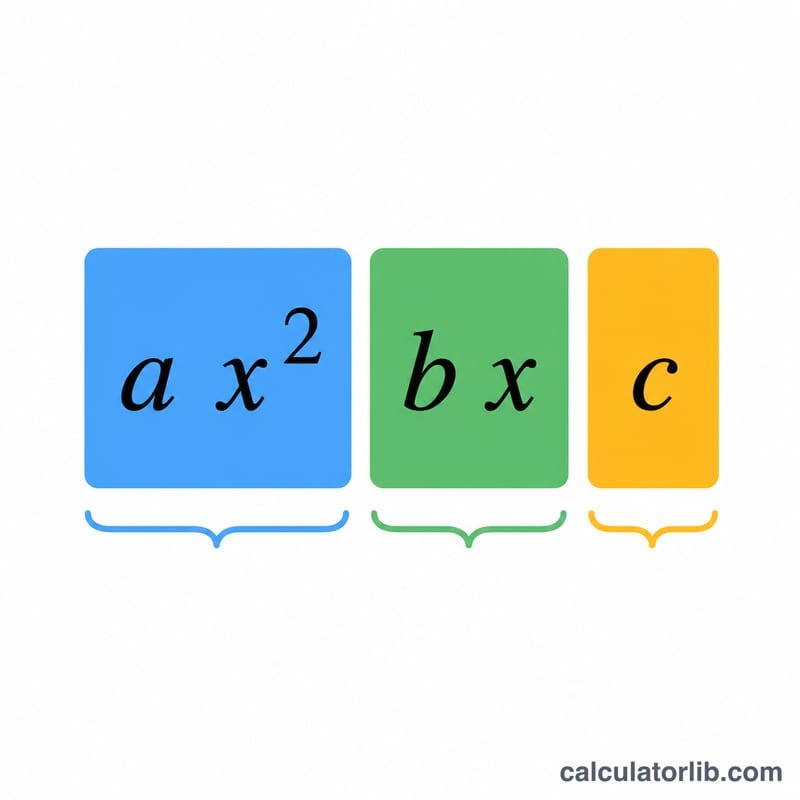
The function is $$f(x) = ax^2 + bx + c.$$ To evaluate at \(x = a\), the calculator computes three pieces: the squared term \(a \cdot x^2\), the linear term \(b \cdot x\), and the constant \(c\), then adds them together. Because multiplication is applied before addition, each term is computed independently and summed.
Worked example
Suppose \(f(x) = x^2 - 3x + 2\) and you want \(f(4)\). Substitute \(x = 4\): the squared term is \(1 \cdot (4^2) = 16\), the linear term is \(-3 \cdot 4 = -12\), and the constant is \(2\). Adding gives $$16 - 12 + 2 = 6.$$ So \(f(4) = 6\).
FAQ
Can I evaluate a linear function? Yes — set \(a = 0\) and the function becomes \(f(x) = bx + c\).
What about a constant function? Set \(a = 0\) and \(b = 0\), leaving \(f(x) = c\) for every input.
Does this handle negative or decimal inputs? Yes, all coefficients and the value of x may be negative or contain decimals.