
What this calculator does
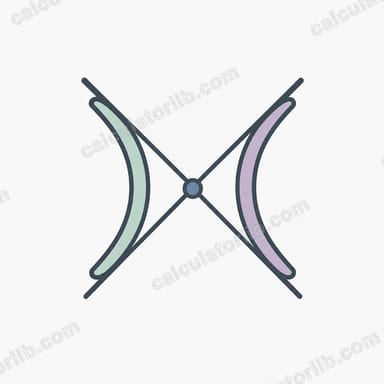
This tool analyzes a horizontal hyperbola written in standard form, \(\frac{(x-h)^2}{a^2}-\frac{(y-k)^2}{b^2}=1\). From the center \((h, k)\) and the semi-axes \(a\) and \(b\) it returns every key feature: the center, the two vertices, the two foci, the focal distance \(c\), the slope of the asymptotes, and the eccentricity. It is useful for algebra, precalculus and analytic-geometry coursework.
How to use it
Enter the center coordinates \(h\) and \(k\), then the positive values \(a\) (the semi-transverse axis, under the x term) and \(b\) (the semi-conjugate axis, under the y term). Press calculate to see all derived properties. If your equation is centered at the origin, simply enter 0 for both \(h\) and \(k\).
The formula explained
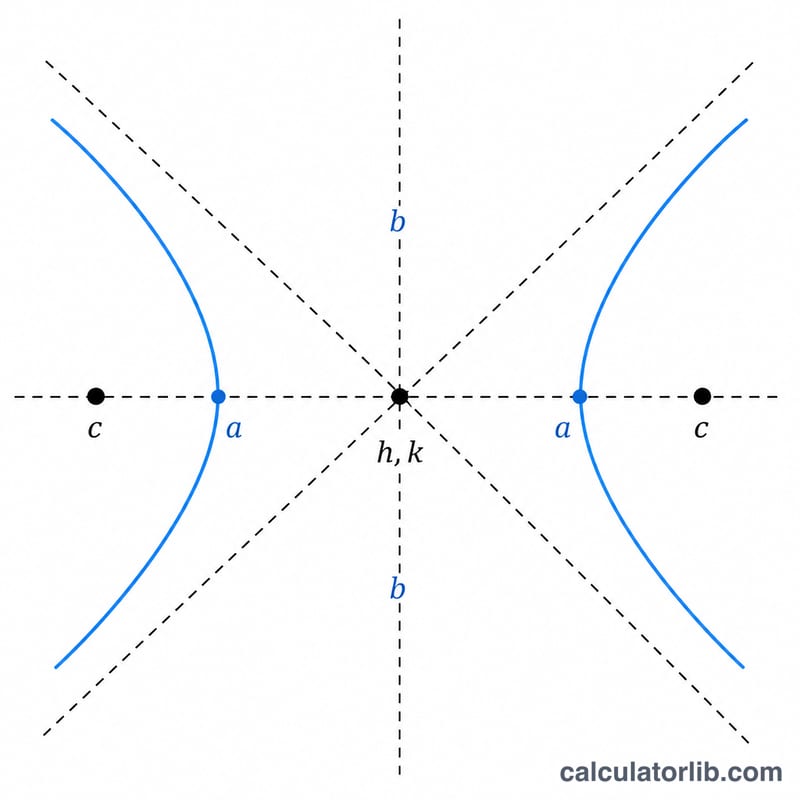
For a horizontal hyperbola the transverse axis is horizontal. The vertices sit \(a\) units left and right of the center: \((h \pm a, k)\). The foci lie \(c\) units from the center where \(c = \sqrt{a^2 + b^2}\), giving \((h \pm c, k)\). The asymptotes pass through the center with slopes \(\pm\frac{b}{a}\), so their equations are $$y = k \pm \frac{b}{a}(x - h).$$ Eccentricity \(e = \frac{c}{a}\) is always greater than 1 for a hyperbola.
Worked example
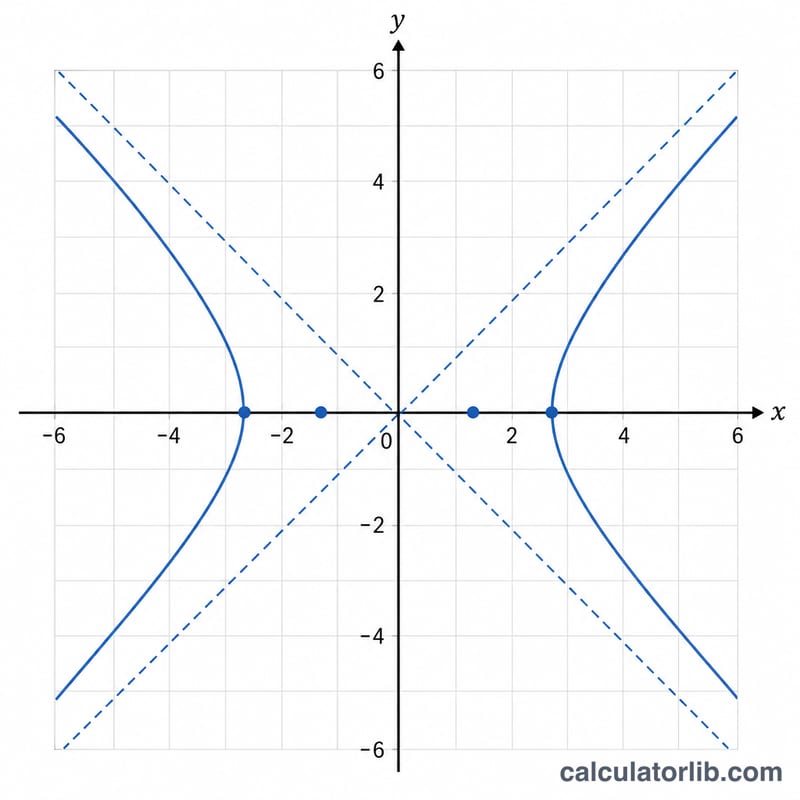
Take \(a = 3\), \(b = 4\), center \((0, 0)\). Then $$c = \sqrt{9 + 16} = \sqrt{25} = 5.$$ Vertices are \((3, 0)\) and \((-3, 0)\); foci are \((5, 0)\) and \((-5, 0)\). Asymptote slope is \(\frac{4}{3} \approx 1.333\), and eccentricity \(e = \frac{5}{3} \approx 1.667\).
FAQ
Does this handle vertical hyperbolas? This calculator assumes the standard horizontal form (x term positive). For a vertical hyperbola swap the roles of x and y.
Why is eccentricity over 1? Because \(c\) is always larger than \(a\) for a hyperbola, \(e = \frac{c}{a}\) exceeds 1 — that is what makes the curve open outward.
What are a and b? \(a\) is the distance from the center to each vertex; \(b\) controls the conjugate axis and, with \(a\), sets the asymptote slope \(\frac{b}{a}\).