
What this calculator does
This tool rewrites a single logarithm of a combined expression into a sum, difference, or multiple of simpler logarithms using the three core logarithm properties. It works with any positive base — common log (10), natural log (e), binary log (2), or any custom base — and also evaluates both the original and expanded forms so you can confirm they match.
The three rules
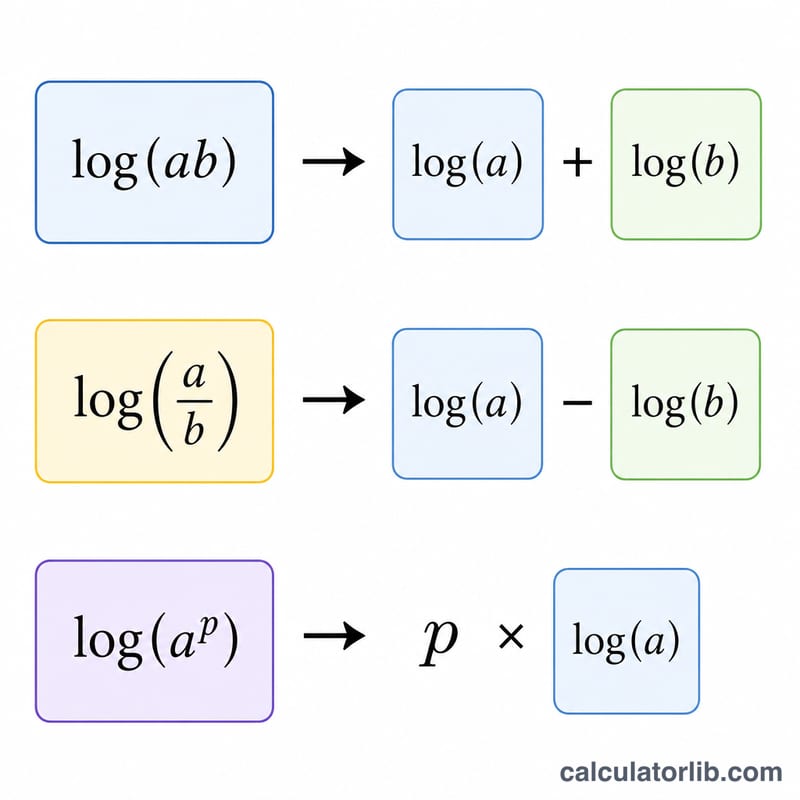
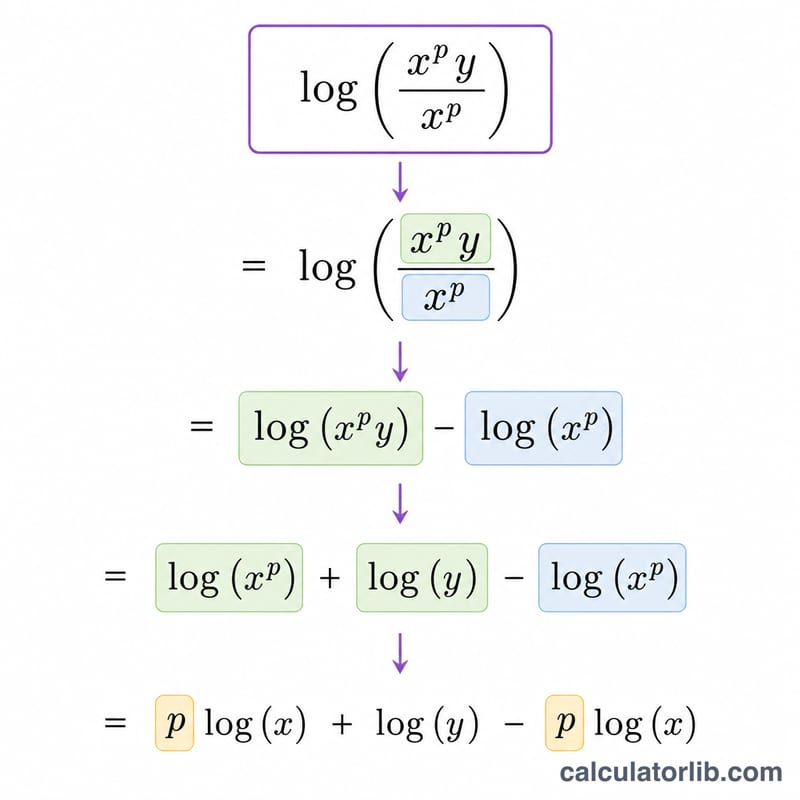
Product rule: \(\log_{\text{b}}\!\left(\text{x}\cdot\text{y}\right) = \log_{\text{b}}\!\text{x} + \log_{\text{b}}\!\text{y}\). Quotient rule: \(\log_{\text{b}}\!\left(\frac{\text{x}}{\text{y}}\right) = \log_{\text{b}}\!\text{x} - \log_{\text{b}}\!\text{y}\). Power rule: \(\log_{\text{b}}\!\left(\text{x}^{\text{p}}\right) = \text{p}\cdot\log_{\text{b}}\!\text{x}\). These follow directly from the laws of exponents, since logarithms are exponents.
How to use it
Pick the expression type, enter the log base b, then enter x and the second value (y for product/quotient, or the exponent p for power). The calculator returns the expanded value and breaks down each individual term.
Worked example
Expand log base 2 of (8 × 4). Using the product rule:
$$\log_{2}(8\cdot 4) = \log_{2} 8 + \log_{2} 4 = 3 + 2 = 5.$$Checking the original: \(\log_{2}(32) = 5\). Both forms agree, confirming the expansion is correct.
FAQ
Why must x and y be positive? Logarithms of zero or negative numbers are undefined over the real numbers, so inputs must be greater than 0.
Can the exponent p be negative or fractional? Yes. The power rule holds for any real exponent, so p can be negative (e.g. for roots and reciprocals) or a decimal.
What base should I use? Use 10 for common logs, \(e \approx 2.71828\) for natural logs, or any positive base other than 1. The rules are identical regardless of base.