
What this calculator does
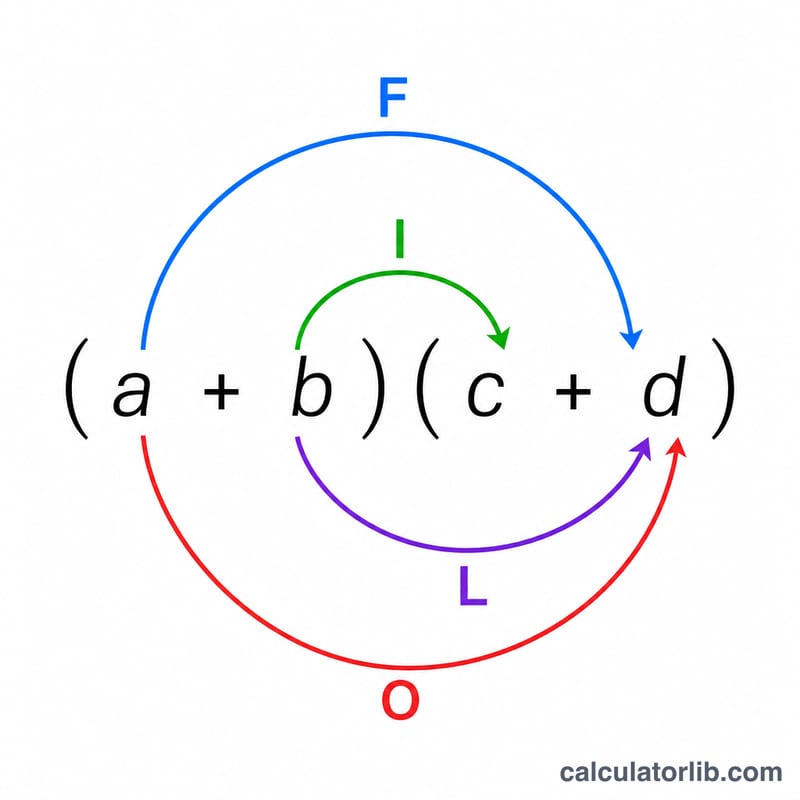
This Expand and Simplify Expression Calculator multiplies two linear binomials of the form \((a\cdot x + b)(c\cdot x + d)\) and returns the simplified quadratic \(A\cdot x^2 + B\cdot x + C\). It applies the distributive property — often remembered as FOIL (First, Outer, Inner, Last) — and then combines like terms for you, so you get a clean, fully simplified answer.
How to use it
Enter four numbers: the coefficient and constant of the first factor (a and b), and the coefficient and constant of the second factor (c and d). The calculator multiplies the factors and outputs the three coefficients of the expanded polynomial: the x² term, the x term, and the constant.
The formula explained
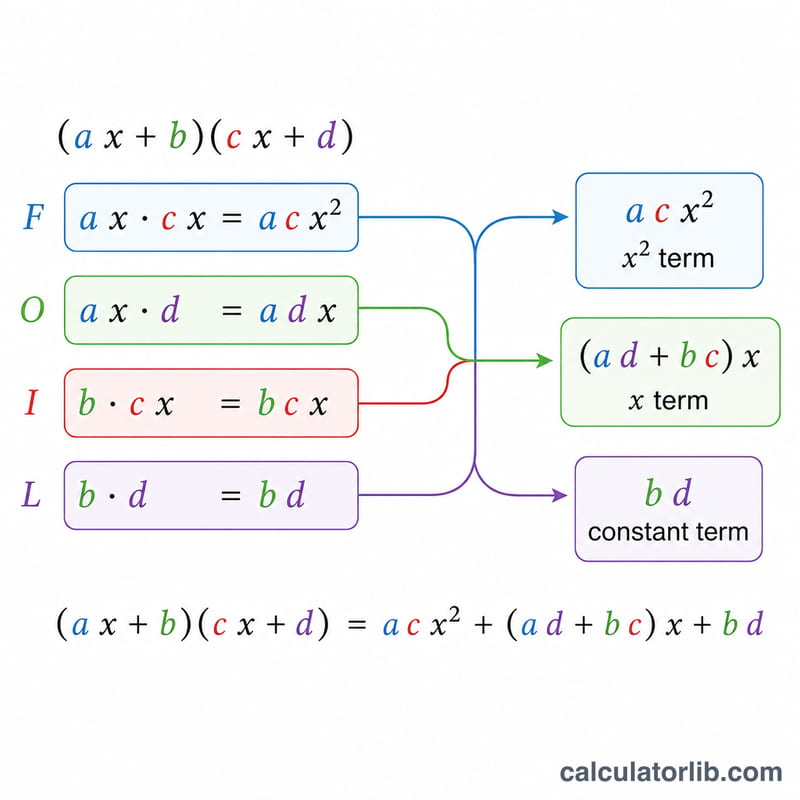
The distributive property says \(a(b + c) = ab + ac\). Extending it to two binomials gives FOIL: multiply the First terms (\(a\cdot x \cdot c\cdot x = ac\cdot x^2\)), the Outer terms (\(a\cdot x \cdot d = ad\cdot x\)), the Inner terms (\(b \cdot c\cdot x = bc\cdot x\)), and the Last terms (\(b \cdot d = bd\)). Adding the two middle x-terms gives the combined coefficient \((ad + bc)\). The final simplified form is:
$$\left(\text{a}\,x + \text{b}\right)\left(\text{c}\,x + \text{d}\right) = \text{a}\text{c}\,x^{2} + \left(\text{a}\text{d} + \text{b}\text{c}\right)x + \text{b}\text{d}$$where \(A = ac\), \(B = ad + bc\), and \(C = bd\).
Worked example
Expand \((2x + 3)(4x + 5)\). Here \(a = 2\), \(b = 3\), \(c = 4\), \(d = 5\).
$$A = 2\cdot 4 = 8$$$$B = 2\cdot 5 + 3\cdot 4 = 10 + 12 = 22$$$$C = 3\cdot 5 = 15$$The result is \(8x^2 + 22x + 15\).
FAQ
Can I expand a perfect square like \((x + 3)^2\)? Yes — enter it as \((1x + 3)(1x + 3)\): \(a = 1\), \(b = 3\), \(c = 1\), \(d = 3\), giving \(x^2 + 6x + 9\).
What if a factor has no x term? Set that coefficient to 0. For example \((0x + 2)(3x + 4)\) becomes \(2(3x + 4) = 6x + 8\), shown as \(0x^2 + 6x + 8\).
Does it work with negative or decimal numbers? Yes. Enter negatives or decimals for any field and the simplified coefficients are computed exactly the same way.