
What is the Complex Number Power Calculator?
This tool raises a complex number written in rectangular form, \(z = a + bi\), to an arbitrary power \(n\). Instead of multiplying the number by itself repeatedly, it converts \(z\) to polar form and applies De Moivre theorem, which makes integer and even non-integer powers fast and accurate. The answer is returned in the familiar \(a + bi\) form, plus its modulus and argument.
How to use it
Enter the real part \(a\), the imaginary part \(b\), and the exponent \(n\). Press calculate to see the rectangular result, the new modulus, the new argument in degrees, and the polar parameters of the original number. Powers can be positive, negative, or fractional.
The formula explained
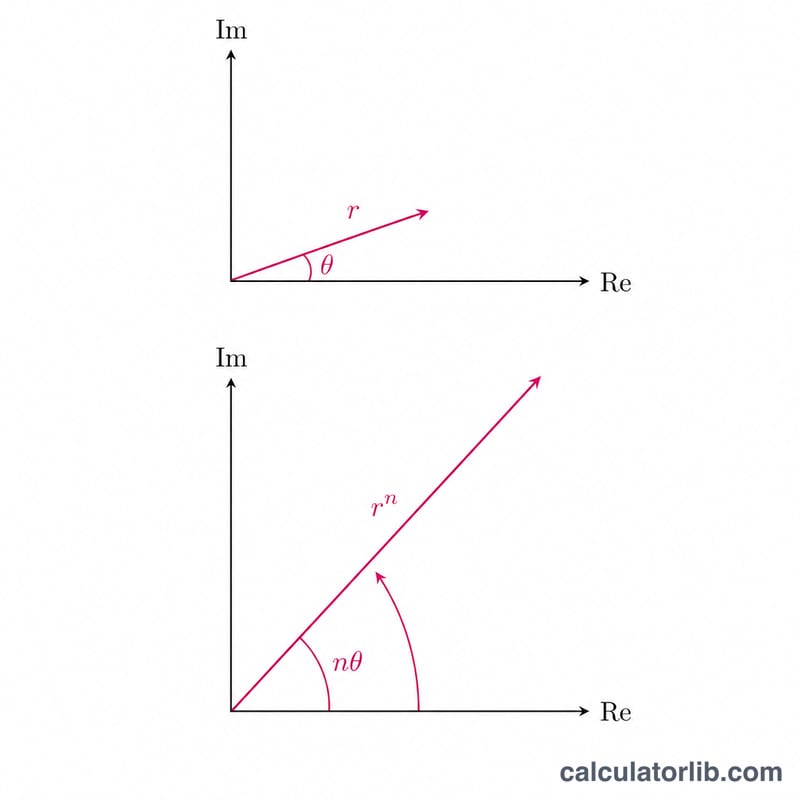
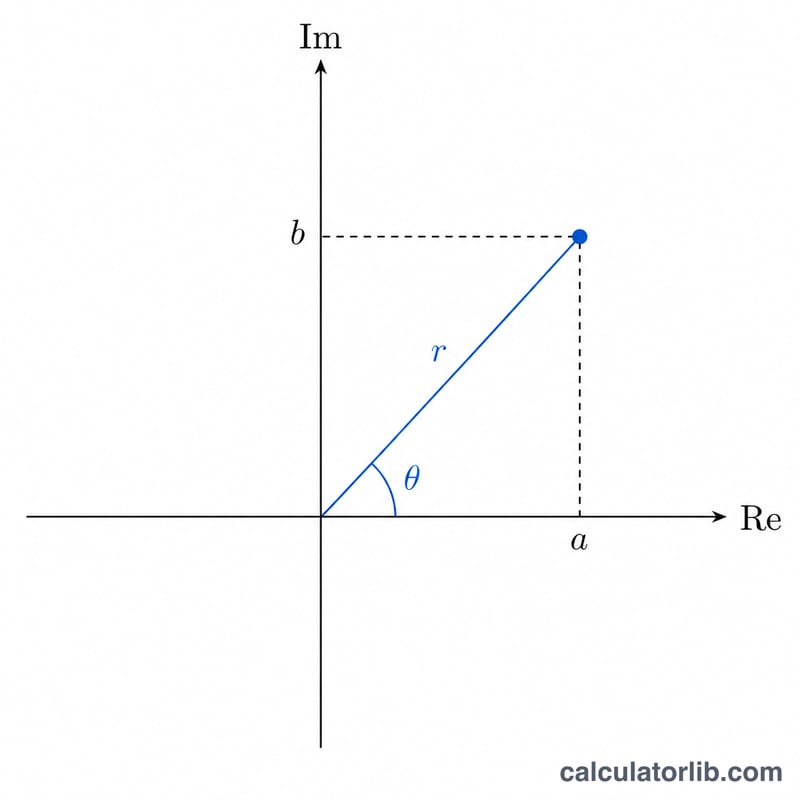
First the number is converted to polar form: the modulus is \(r = \sqrt{a^2 + b^2}\) and the argument is \(\theta = \operatorname{atan2}(b, a)\). De Moivre theorem then states that $$z^{n} = r^{n}\left(\cos n\theta + i\sin n\theta\right)$$ Multiplying out gives the real part \(r^{n}\cdot\cos(n\theta)\) and the imaginary part \(r^{n}\cdot\sin(n\theta)\). Using atan2 keeps the angle in the correct quadrant.
Worked example
Take \(z = 1 + i\) and \(n = 2\). The modulus is \(r = \sqrt{1 + 1} = \sqrt{2}\) and the argument is \(\theta = 45^\circ\). Then \(r^{n} = (\sqrt{2})^{2} = 2\) and \(n\theta = 90^\circ\). So $$z^{2} = 2(\cos 90^\circ + i\sin 90^\circ) = 2(0 + i\cdot 1) = 0 + 2i$$ You can verify directly: $$(1 + i)^{2} = 1 + 2i + i^{2} = 1 + 2i - 1 = 2i$$
FAQ
Can n be negative? Yes. A negative power gives the reciprocal raised to the positive power, which is fully supported as long as \(z\) is not zero.
Can n be a fraction? Yes — fractional exponents return the principal root (one branch). Other roots differ by adding multiples of \(2\pi/n\) to the angle.
Why use atan2 instead of arctan? atan2 accounts for the signs of both \(a\) and \(b\), so the argument lands in the correct quadrant rather than being off by 180°.