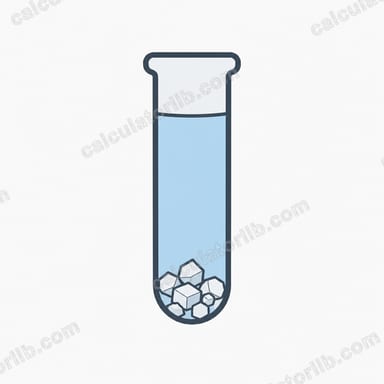

What Is the Ksp from Solubility Calculator?
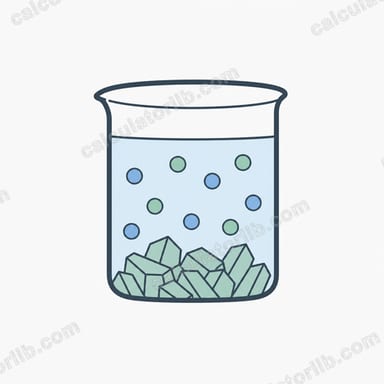
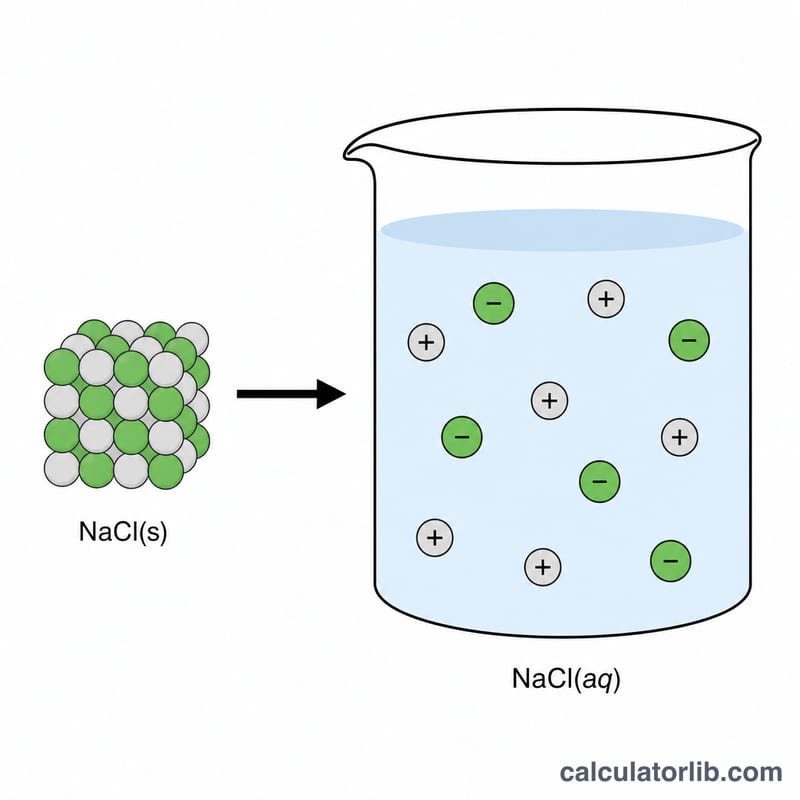
This calculator finds the solubility product constant (Ksp) of a sparingly soluble ionic salt from its molar solubility, s. It works for any general salt of the form AnBm that dissolves to give n cations and m anions per formula unit. It is a universal chemistry tool and applies anywhere.
How to Use It
Enter the molar solubility s in mol/L (for example 1.3×10⁻⁴ written as 1.3e-4), then enter the cation subscript n and the anion subscript m from the formula AnBm. The calculator returns Ksp along with the individual cation and anion terms.
The Formula Explained
When AnBm dissolves: AnBm → n Am+ + m Bn−. If the molar solubility is s, then [A] = n·s and [B] = m·s. The solubility product is the product of ion concentrations each raised to its stoichiometric coefficient:
$$K_{sp} = \left(\text{n} \cdot \text{s}\right)^{\text{n}} \cdot \left(\text{m} \cdot \text{s}\right)^{\text{m}}$$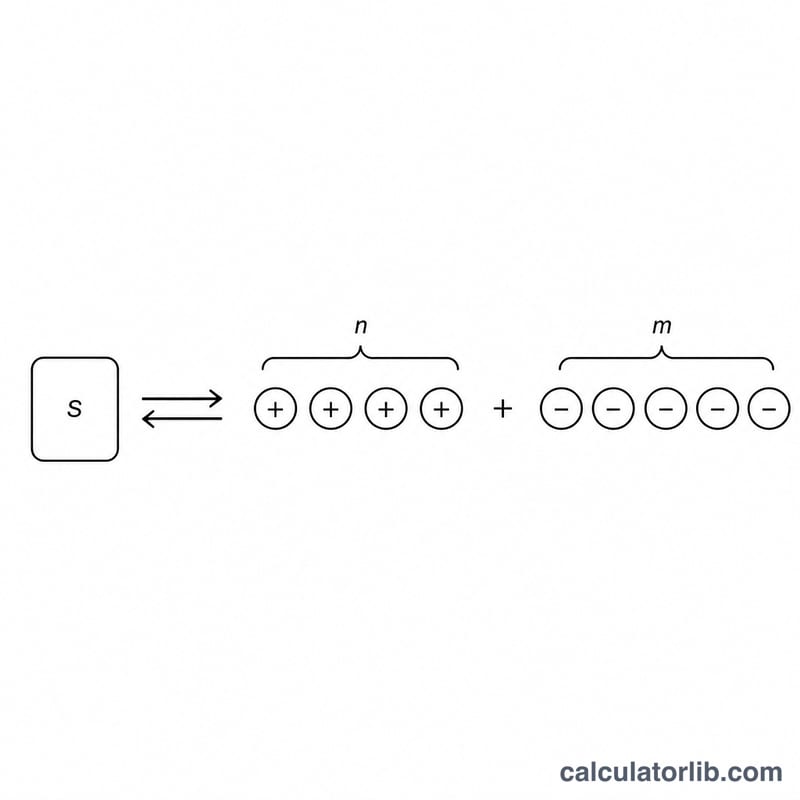
Worked Example
For CaF₂ (a 1:2 salt, n=1, m=2) with s = 1.3×10⁻⁴ mol/L: cation term = (1·s)¹ = 1.3×10⁻⁴, anion term = (2·s)² = (2.6×10⁻⁴)² = 6.76×10⁻⁸. So
$$K_{sp} = 1.3\times10^{-4} \times 6.76\times10^{-8} \approx 8.79\times10^{-12}$$matching the textbook value.
FAQ
What units does Ksp have? Ksp is conventionally treated as dimensionless, though concentrations are in mol/L.
What are n and m for AgCl? AgCl is a 1:1 salt, so n = 1 and m = 1, giving \(K_{sp} = s^2\).
What about Ag₂CO₃? It is a 2:1 salt (n = 2, m = 1): \(K_{sp} = (2s)^2(s) = 4s^3\).