
What this calculator does
The Function Transformation Calculator applies the standard transformation form \(g(x) = a \cdot f(b(x - h)) + k\) to a base function f. Instead of memorizing every rule, you supply the parameters a, b, h, and k, the point x, and the value of the base function at the transformed argument, and the tool returns the transformed output along with a breakdown of each transformation.
How to use it
Enter the four transformation parameters: a (vertical stretch/compression), b (horizontal stretch/compression), h (horizontal shift), and k (vertical shift). Then enter the x-value you want to evaluate and the value of the base function f evaluated at the inner argument \(b(x - h)\). The calculator reports \(g(x)\) and shows the inner argument so you can verify which input the base function should use.
The formula explained
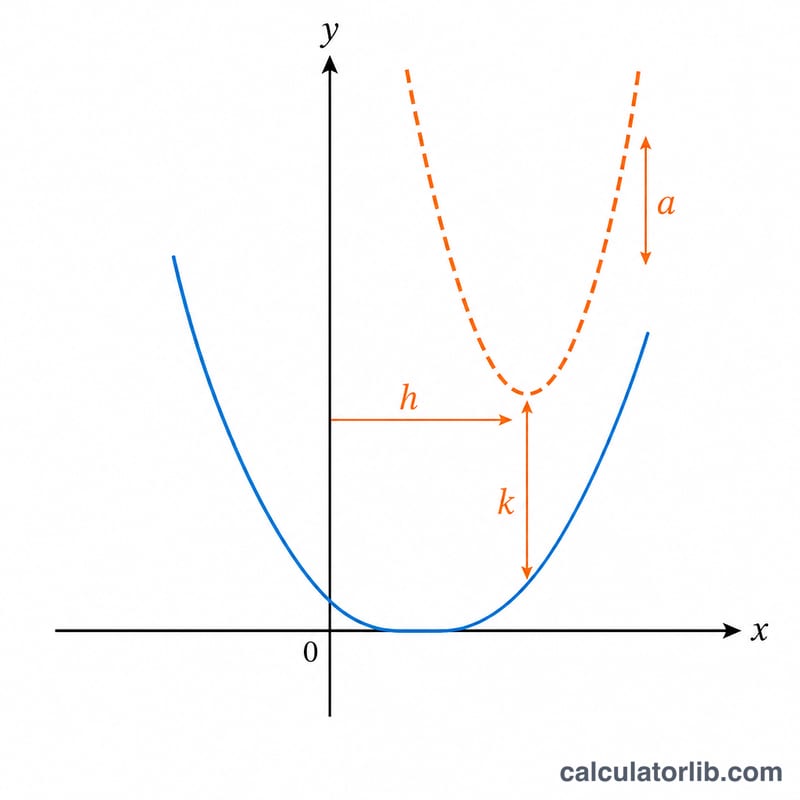
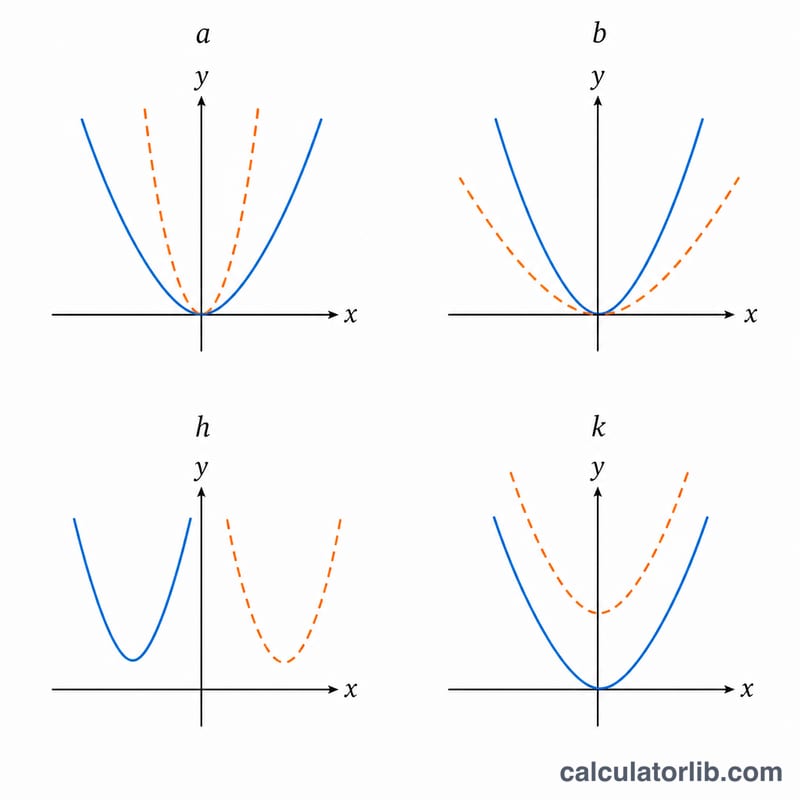
Each parameter controls one geometric effect: a stretches the graph vertically by a factor of \(|a|\), and if a is negative it reflects over the x-axis. b compresses horizontally by a factor of \(|b|\); a negative b reflects over the y-axis. h shifts the graph right by h units (left if h is negative), and k shifts it up by k units (down if negative). The order matters: horizontal scaling and shifting happen inside the function, so the argument becomes \(u = b(x - h)\).
Worked example
Suppose a = 2, b = 1, h = 3, k = 1, with x = 5. The inner argument is $$u = 1 \cdot (5 - 3) = 2.$$ If \(f(2) = 4\), then $$g(5) = 2 \cdot 4 + 1 = 9.$$ The graph of f has been stretched vertically by 2, shifted right 3, and up 1.
FAQ
Why do I enter the base function value manually? The calculator is function-agnostic — it works for any f. You compute or look up f at the inner argument and the tool applies the transformation algebra.
What makes a reflection? A negative a reflects over the x-axis; a negative b reflects over the y-axis.
Does h shift left or right? A positive h shifts the graph to the right because the argument is \((x - h)\).