
What is the percent proportion?
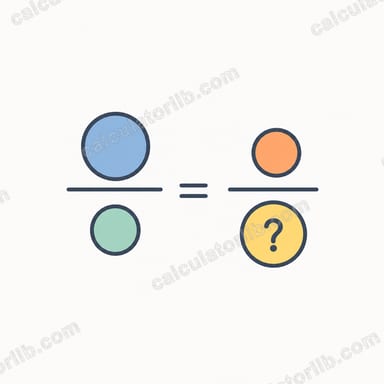
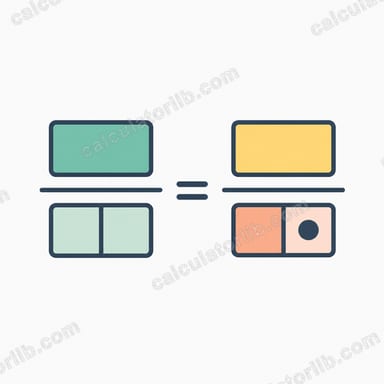
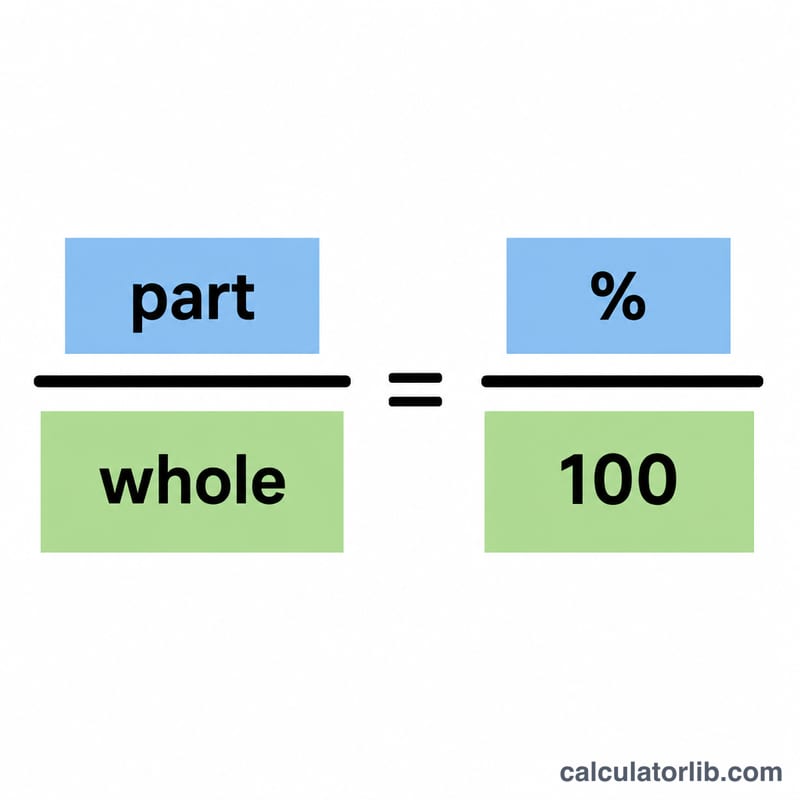
The percent proportion is the equation part / whole = percent / 100. It expresses the idea that a part of a whole corresponds to a percent out of one hundred. Because it is a single equation with three quantities, knowing any two of them lets you solve for the third. This solver does exactly that: tell it which value is unknown, supply the other two, and it returns the missing number along with all three quantities for a quick sanity check.
How to use it
Choose what you are solving for — the part, the whole, or the percent. Then enter the two values you already know. The field you are solving for can be left blank; it will be recomputed. Press calculate to see the answer and the completed proportion.
The formula explained
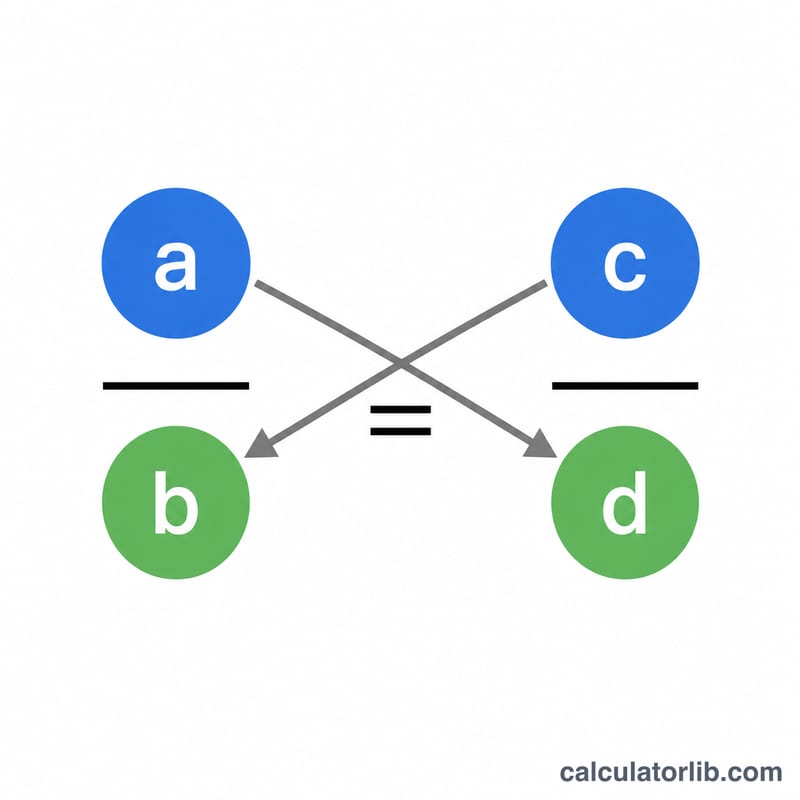
Starting from \( \frac{\text{part}}{\text{whole}} = \frac{\text{percent}}{100} \), cross-multiplying gives \( 100 \cdot \text{part} = \text{whole} \cdot \text{percent} \). From there you isolate whichever variable is unknown:
$$\text{part} = \frac{\text{whole} \cdot \text{percent}}{100}, \quad \text{whole} = \frac{100 \cdot \text{part}}{\text{percent}}, \quad \text{percent} = \frac{100 \cdot \text{part}}{\text{whole}}$$To avoid division errors, the solver guards against a zero whole (when finding percent) and a zero percent (when finding the whole).
Worked example
Suppose 30 students out of a class passed an exam and that represents 25% of the class. To find the whole class size, set part = 30 and percent = 25. Then
$$\text{whole} = \frac{100 \times 30}{25} = 120 \text{ students}$$Check: \( \frac{30}{120} = 0.25 = \frac{25}{100} \). Correct.
FAQ
What if I know the part and whole? Solve for percent: \( \text{percent} = \frac{\text{part}}{\text{whole}} \times 100 \).
Can the part be larger than the whole? Yes — that simply yields a percent greater than 100, which is valid.
Why does it return 0 when percent is blank while solving for the whole? Dividing by a zero percent is undefined, so the solver returns 0 as a safe placeholder; enter a nonzero percent for a real answer.