
What is the Ksp Calculator?
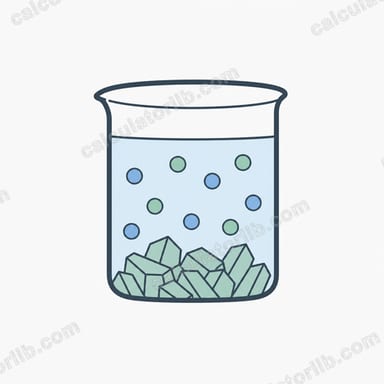
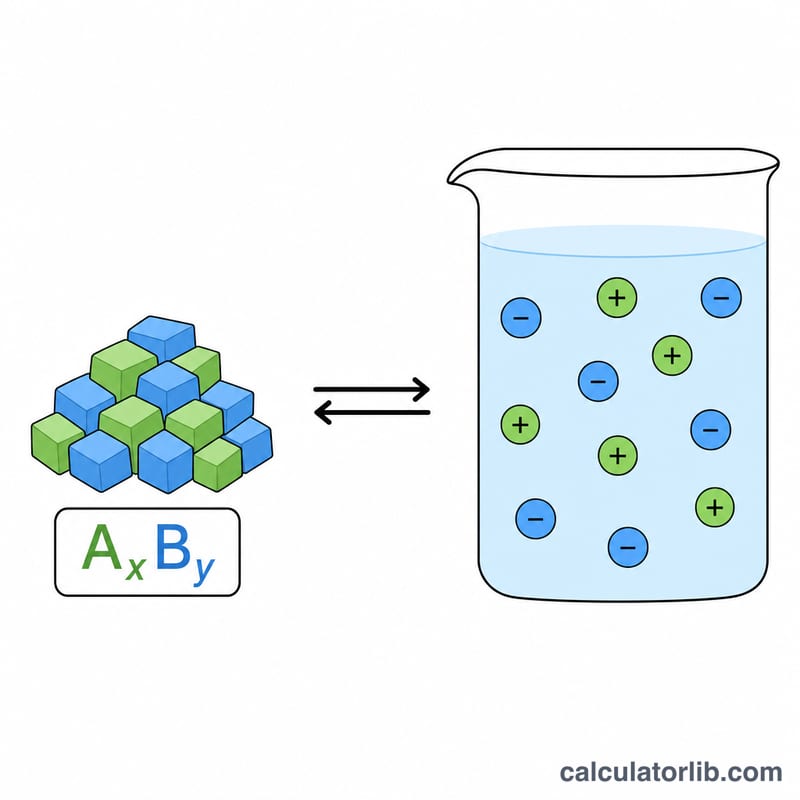
The solubility product constant, Ksp, describes the equilibrium between a slightly soluble ionic solid and its dissolved ions in a saturated solution. This calculator converts the molar solubility (s, in mol/L) of a salt with the general formula AxBy into its Ksp value. It works for any stoichiometry — 1:1 salts like AgCl, 1:2 salts like CaF₂, 2:3 salts like Ca₃(PO₄)₂ analogues, and more.
How to use it
Enter the subscript of the cation (x), the subscript of the anion (y), and the molar solubility s in mol/L. The tool returns Ksp along with the individual ion concentration terms. For AgCl, x = 1, y = 1; for CaF₂, x = 1, y = 2.
The formula explained
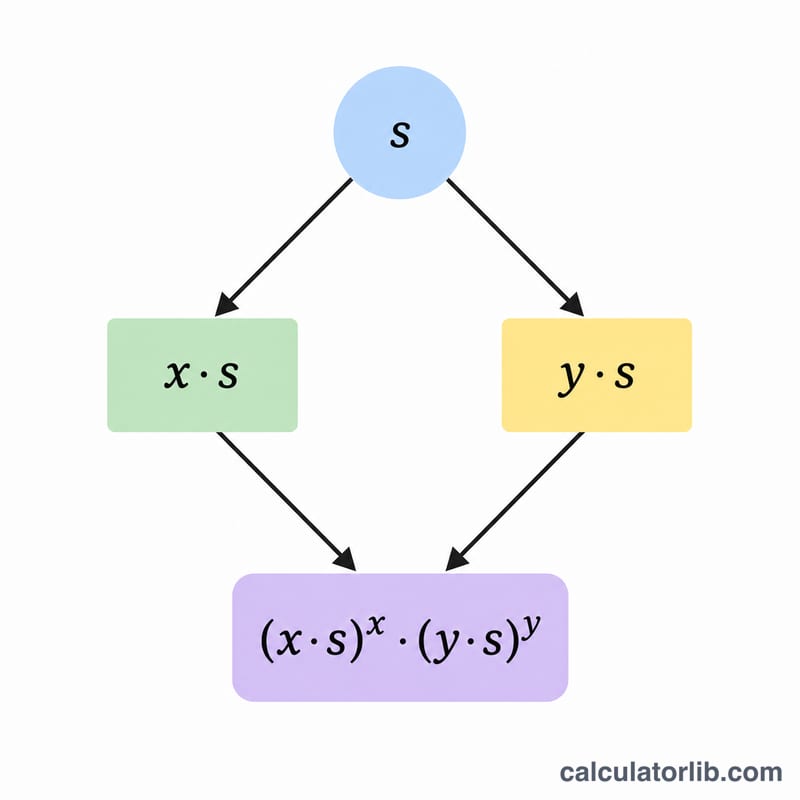
When AxBy dissolves, each formula unit releases x cations and y anions. If solubility is \(s\), the cation concentration is \(x \cdot s\) and the anion concentration is \(y \cdot s\). Substituting into the equilibrium expression gives:
$$K_{sp} = \left(x \cdot s\right)^{x} \cdot \left(y \cdot s\right)^{y}$$
Worked example
For calcium fluoride CaF₂ (x = 1, y = 2) with molar solubility \(s = 2.14 \times 10^{-4}\) mol/L: cation term = \((1 \times 2.14\mathrm{e}\text{-}4)^{1} = 2.14\mathrm{e}\text{-}4\), anion term = \((2 \times 2.14\mathrm{e}\text{-}4)^{2} = (4.28\mathrm{e}\text{-}4)^{2} = 1.832\mathrm{e}\text{-}7\). $$K_{sp} = 2.14\mathrm{e}\text{-}4 \times 1.832\mathrm{e}\text{-}7 \approx 3.92 \times 10^{-11}$$ matching the literature value.
FAQ
Does Ksp have units? By convention Ksp is treated as dimensionless because it uses activities, though concentration-based values are often quoted in mol-based units.
What if my salt is 1:1? Set x = 1 and y = 1, and Ksp simply equals \(s^{2}\).
Can I go backwards from Ksp to s? This tool computes Ksp from s; to find s you would take the appropriate root of the Ksp expression.