
What Is Enantiomeric Excess?
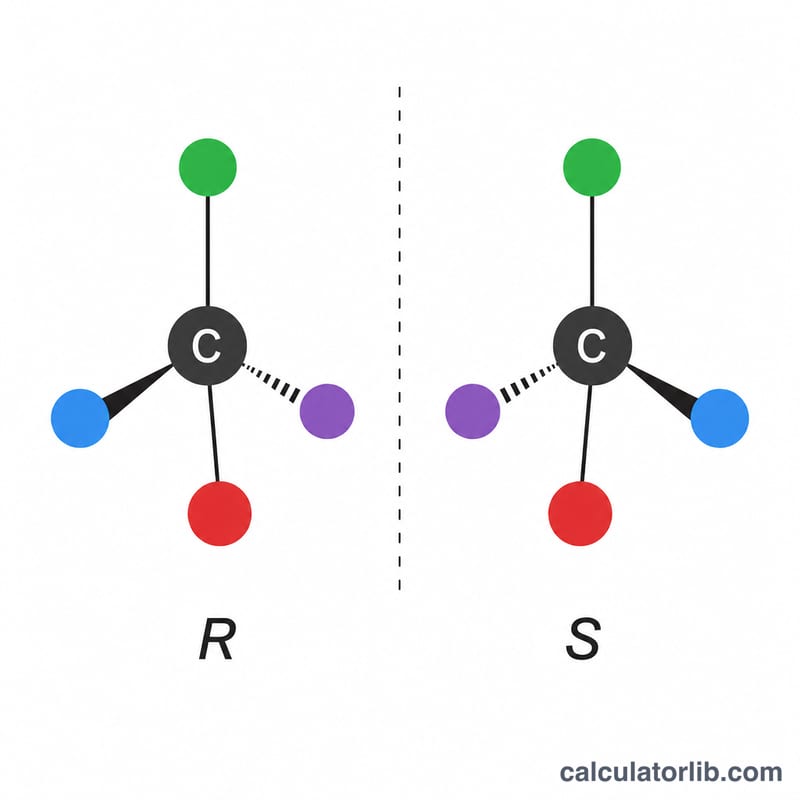
Enantiomeric excess (ee) measures the purity of a chiral mixture — how much one enantiomer (R or S) dominates over its mirror-image twin. A value of 100% ee means a single, optically pure enantiomer, while 0% ee describes a racemic mixture with equal amounts of both. This calculator works with any consistent units: moles, grams, peak areas from HPLC/GC, or relative percentages.
How to Use This Calculator
Enter the measured amount of the R enantiomer and the amount of the S enantiomer. Both values must use the same unit. The tool returns the enantiomeric excess as a percentage, identifies the dominant enantiomer, and shows the fraction of each enantiomer in the mixture.
The Formula Explained
The enantiomeric excess is defined as:
$$\%\,ee = \frac{\left|\,\text{R} - \text{S}\,\right|}{\text{R} + \text{S}} \times 100\%$$
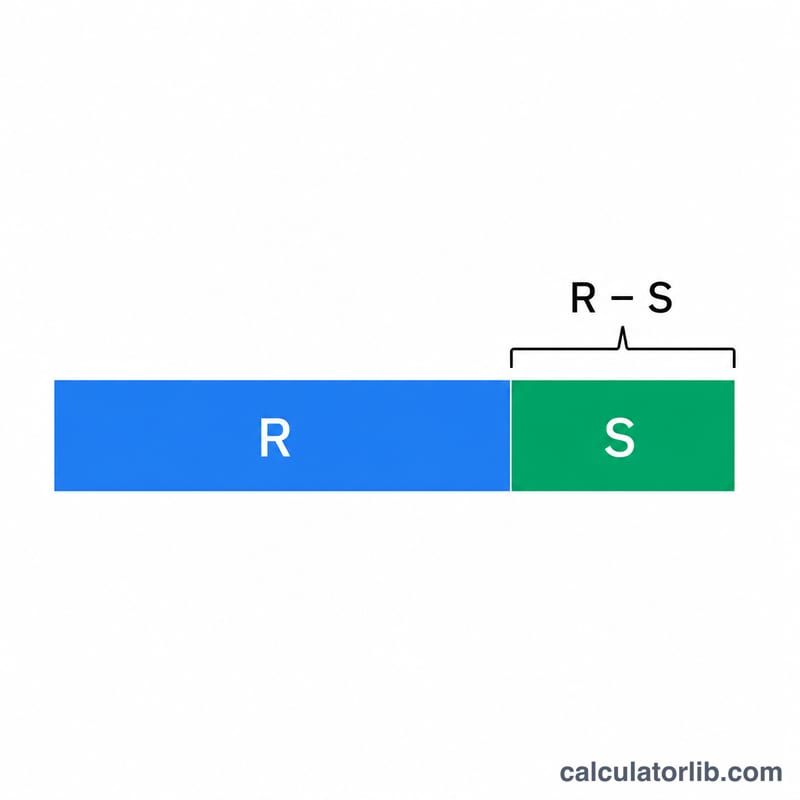
The numerator \(\left|\,\text{R} - \text{S}\,\right|\) is the absolute difference between the two enantiomers — the "excess" of the major over the minor. Dividing by the total \(\text{R} + \text{S}\) normalizes it to the whole mixture, and multiplying by 100 expresses it as a percentage. Because of the absolute value, the result is always positive regardless of which enantiomer is in excess.
Worked Example
Suppose an HPLC analysis gives R = 75 and S = 25 (relative peak areas). Then:
$$\%\,ee = \frac{\left|\,75 - 25\,\right|}{75 + 25} \times 100 = \frac{50}{100} \times 100 = 50\%\ ee$$ 50% ee, with R as the dominant enantiomer (75% R, 25% S).
FAQ
What units should I use? Any consistent unit works — moles, grams, concentrations, or chromatography peak areas — since the formula uses a ratio.
How does ee relate to enantiomeric ratio (er)? An er of 75:25 corresponds to 50% ee. You can convert: %ee equals the major fraction minus the minor fraction.
What is 0% ee? It means a racemic mixture — equal amounts of both enantiomers and no net optical activity.