
What Is Vapor Pressure Lowering?
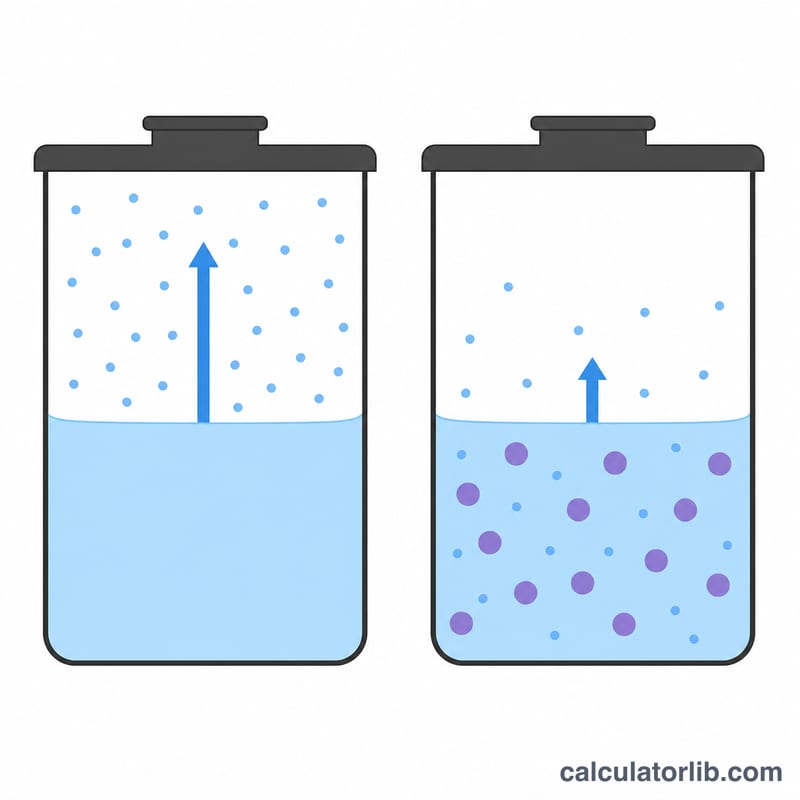
When a non-volatile solute is dissolved in a solvent, the vapor pressure of the solution is lower than that of the pure solvent. This colligative property is described by Raoult's law. The amount of lowering, \(\Delta p\), depends only on the mole fraction of the dissolved solute — not on its chemical identity. This calculator works with any consistent pressure unit (mmHg, atm, kPa, torr) since the unit simply carries through.
How to Use This Calculator
Enter the number of moles of solute (the dissolved substance), the moles of solvent, and the vapor pressure of the pure solvent (\(p^{\circ}\)). The tool computes the solute mole fraction, the resulting vapor pressure lowering \(\Delta p\), and the final vapor pressure of the solution.
The Formula Explained
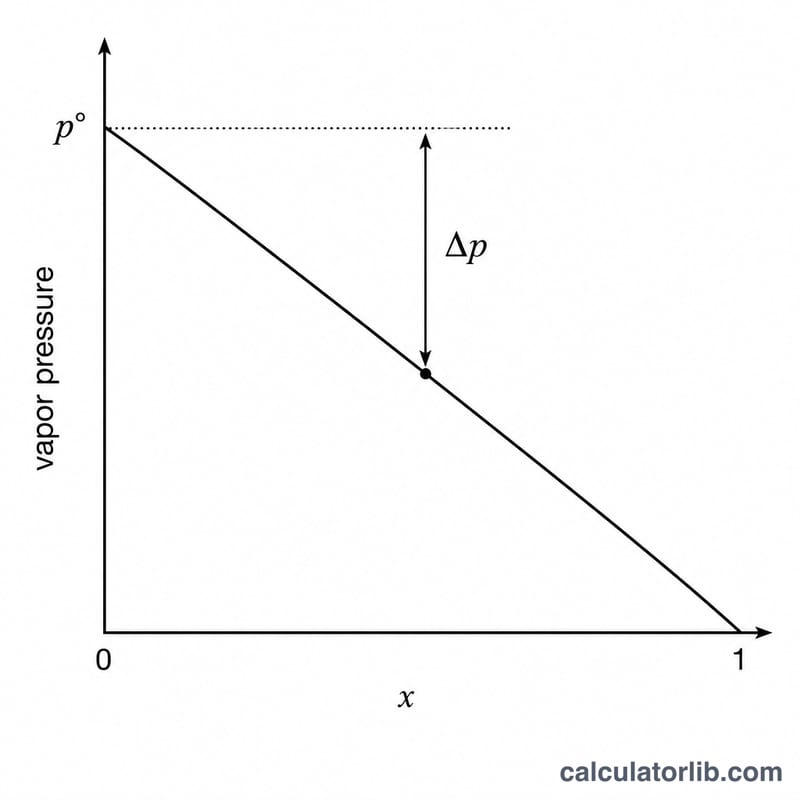
The vapor pressure of an ideal solution is \(p = x_{\text{solvent}} \times p^{\circ}\). Because the mole fractions add to one, the lowering is $$\Delta p = p^{\circ} - p = x_{\text{solute}} \times p^{\circ}$$ The solute mole fraction is \(x_{\text{solute}} = n_{\text{solute}} / (n_{\text{solute}} + n_{\text{solvent}})\). The vapor pressure of the solution is then \(p = p^{\circ} - \Delta p\).
Worked Example
Suppose 0.5 mol of a non-volatile solute is dissolved in 9.5 mol of water, and pure water has a vapor pressure of 760 mmHg. The total moles = 10, so $$x_{\text{solute}} = \frac{0.5}{10} = 0.05$$ Therefore $$\Delta p = 0.05 \times 760 = 38 \text{ mmHg}$$ and the solution's vapor pressure is \(760 - 38 = 722\) mmHg.
FAQ
Does the solute identity matter? For an ideal solution with a non-volatile solute, only the mole fraction matters, not the type of solute.
What if the solute dissociates? For ionic solutes, multiply the effective moles by the van't Hoff factor (\(i\)) to account for dissociation into ions.
What units should \(p^{\circ}\) be in? Any pressure unit works; \(\Delta p\) and the solution vapor pressure come out in the same unit you entered.