
What Are Growing Degree Days?
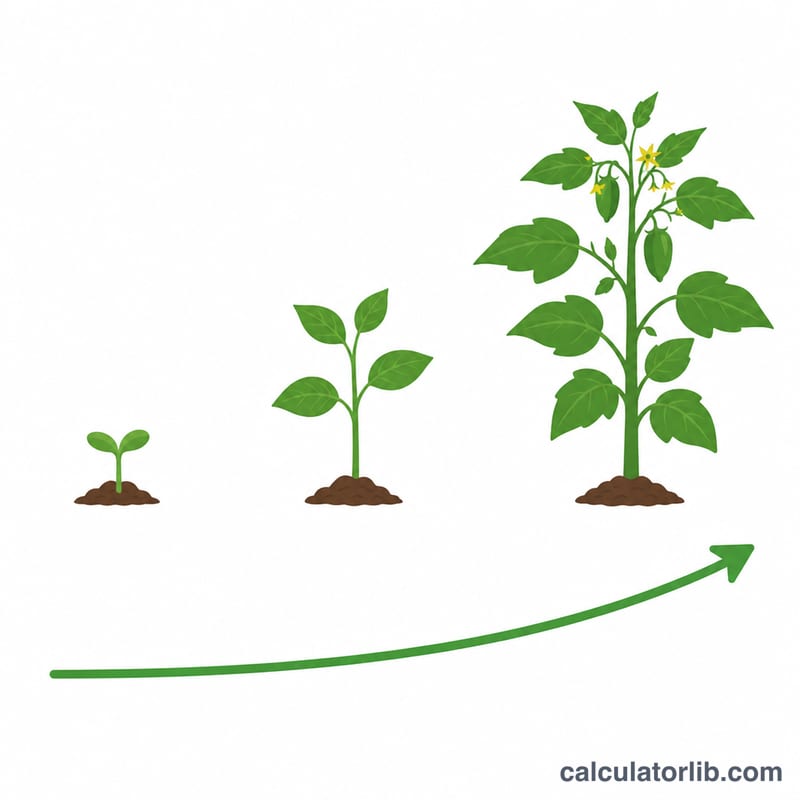
Growing Degree Days (GDD), also called heat units or growing degree units, measure the accumulation of heat over time that drives the development of plants and insects. Because biological growth depends largely on temperature, GDD provides a far better predictor of crop stages, flowering, harvest timing, and pest emergence than calendar days alone. This calculator is unit-agnostic: enter all three temperatures in the same scale (°C or °F) and the result is expressed in those same degree-days.
How to Use the Calculator
Enter the day's maximum temperature (Tmax), the day's minimum temperature (Tmin), and the base temperature (Tbase) for your crop or organism. The base temperature is the threshold below which growth effectively stops — for example, around 10 °C (50 °F) for corn. The tool averages the high and low, subtracts the base, and reports the result, never going below zero.
The Formula Explained
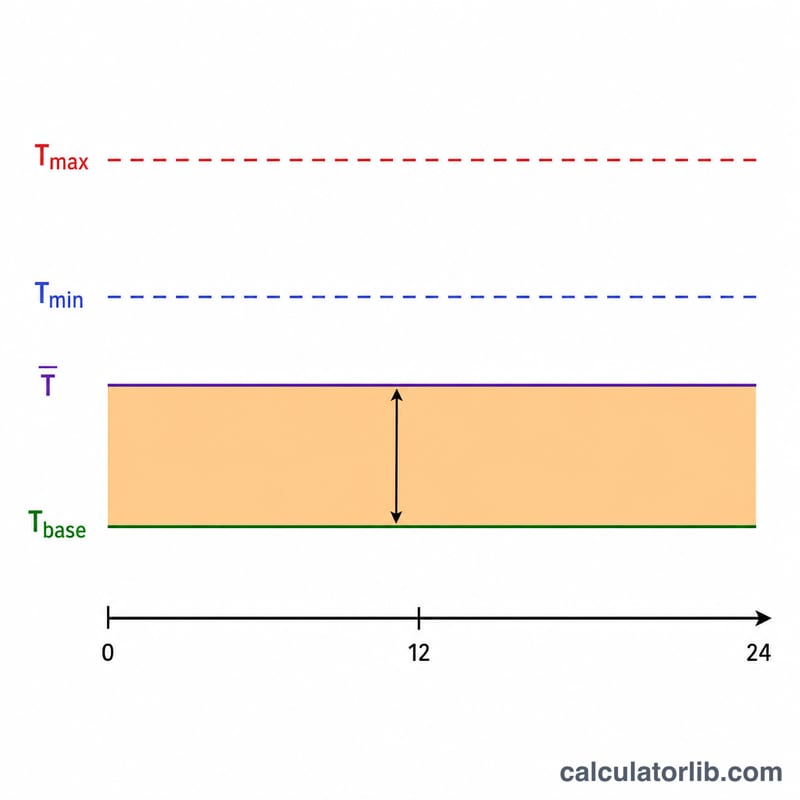
The standard single-sine simple-average method is: $$\text{GDD} = \max\!\left(0,\; \frac{\text{T}_{\max} + \text{T}_{\min}}{2} - \text{T}_{\text{base}}\right)$$. First the daily mean temperature is found by averaging the high and low. The base temperature is then subtracted to find how much warmth exceeded the growth threshold. The \(\max(0, \ldots)\) step ensures cold days contribute zero rather than negative heat units. Daily GDD values are summed across the season to get accumulated GDD.
Worked Example
Suppose Tmax = 30°, Tmin = 15°, and Tbase = 10°. The average temperature is $$\frac{30 + 15}{2} = 22.5°.$$ Subtracting the base gives \(22.5 - 10 = 12.5\). Since this is positive, the GDD for the day is 12.5.
FAQ
What if the average is below the base temperature? The GDD is set to 0 for that day — growth is assumed not to advance below the threshold.
Should I use Celsius or Fahrenheit? Either works, but keep all inputs in the same unit and use the matching base temperature; GDD totals differ between scales.
How do I get seasonal GDD? Calculate GDD for each day and add them together over the growth period to track cumulative heat accumulation.