
What This Calculator Does
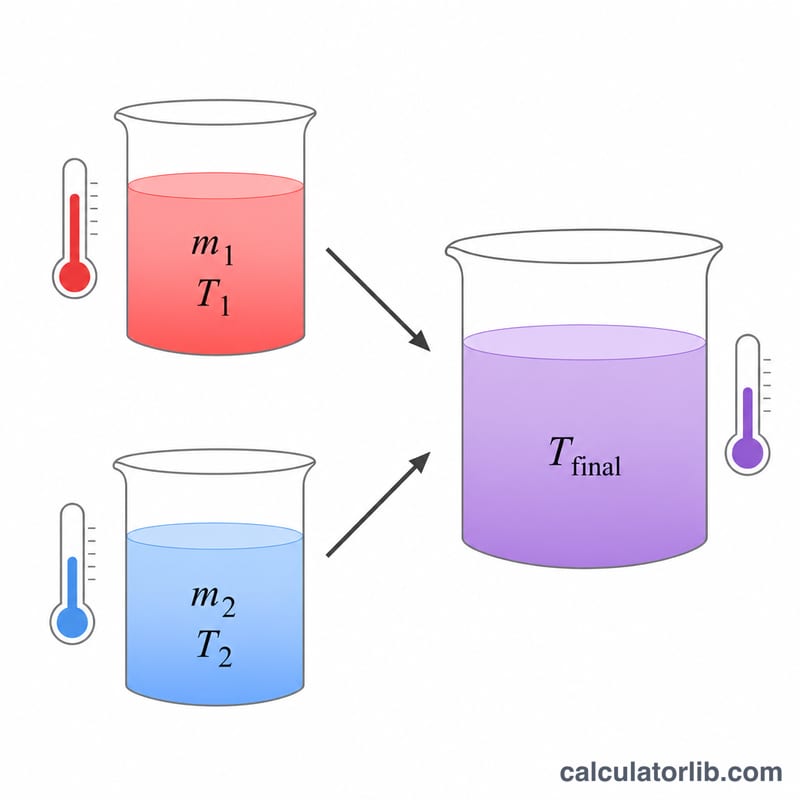
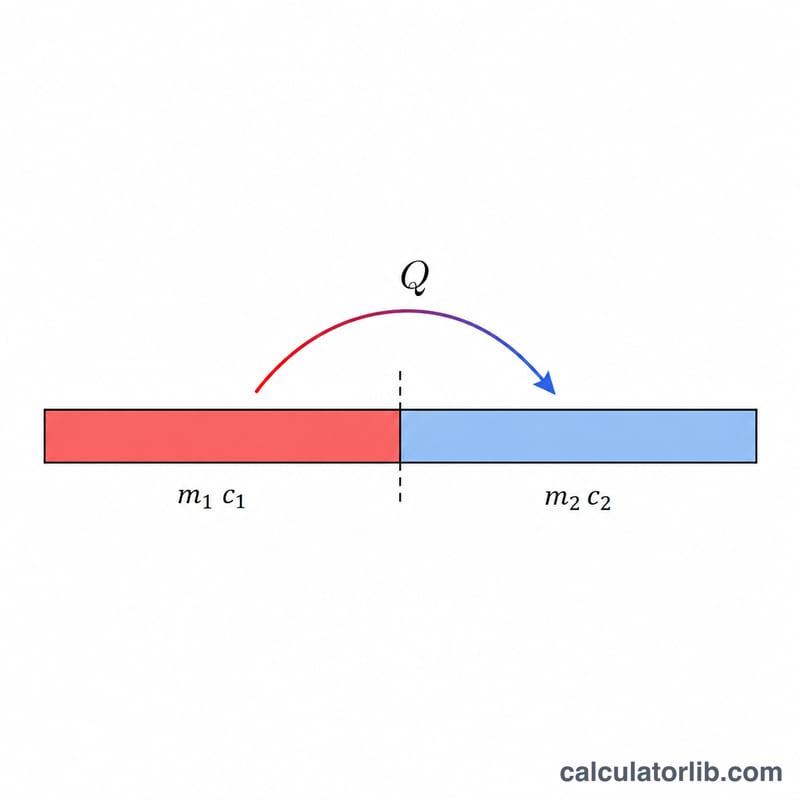
This tool predicts the final equilibrium temperature reached when two fluids are mixed together in an insulated container. It is based on the principle of conservation of energy: the heat lost by the hotter fluid equals the heat gained by the cooler fluid until both reach a common temperature. It works for any substances and any consistent units, including water, oils, and metals expressed as fluids.
How to Use It
Enter the mass of each fluid, its specific heat capacity (in J/kg·°C, or any consistent energy/temperature unit), and its starting temperature in °C. For water, the specific heat is about 4186 J/kg·°C. Click calculate to get the predicted mixed temperature. As long as both specific heats use the same units, the masses can be in kilograms, grams, or pounds.
The Formula Explained
The mixing temperature is a weighted average of the two starting temperatures, weighted by each fluid heat capacity (mass × specific heat):
$$T_f = \frac{m_1 c_1 T_1 + m_2 c_2 T_2}{m_1 c_1 + m_2 c_2}$$
The product \(m \cdot c\) is the total heat capacity of a fluid — how much energy it takes to change its temperature. A fluid with a larger heat capacity pulls the final temperature closer to its own starting value.
Worked Example
Mix 1 kg of water at 80 °C with 1 kg of water at 20 °C (c = 4186 each). The result is $$\frac{1 \cdot 4186 \cdot 80 + 1 \cdot 4186 \cdot 20}{4186 + 4186} = \frac{418600}{8372} = 50 \text{ °C}$$ — exactly halfway, because both fluids have equal heat capacity.
FAQ
Does this account for heat lost to the container or air? No. It assumes a perfectly insulated system with no phase changes and no chemical reaction.
Can I use Fahrenheit? Yes, if both temperatures use the same scale, though the specific heat must match. For best results use °C with SI specific heats.
What if the fluids are the same substance? Then \(c_1 = c_2\) cancels and the result is simply the mass-weighted average of the two temperatures.